A cooling tower is more than just a box with a fan. It is a system of carefully designed components that work together to reject heat efficiently and reliably. If any component underperforms, the entire system suffers.
As a Cooling Tower Fill Manufacturer, we see the full picture. But the fill is only one part of the story. Let me walk you through each major component of a cooling tower, how they work together, and what to look for when selecting or maintaining them.
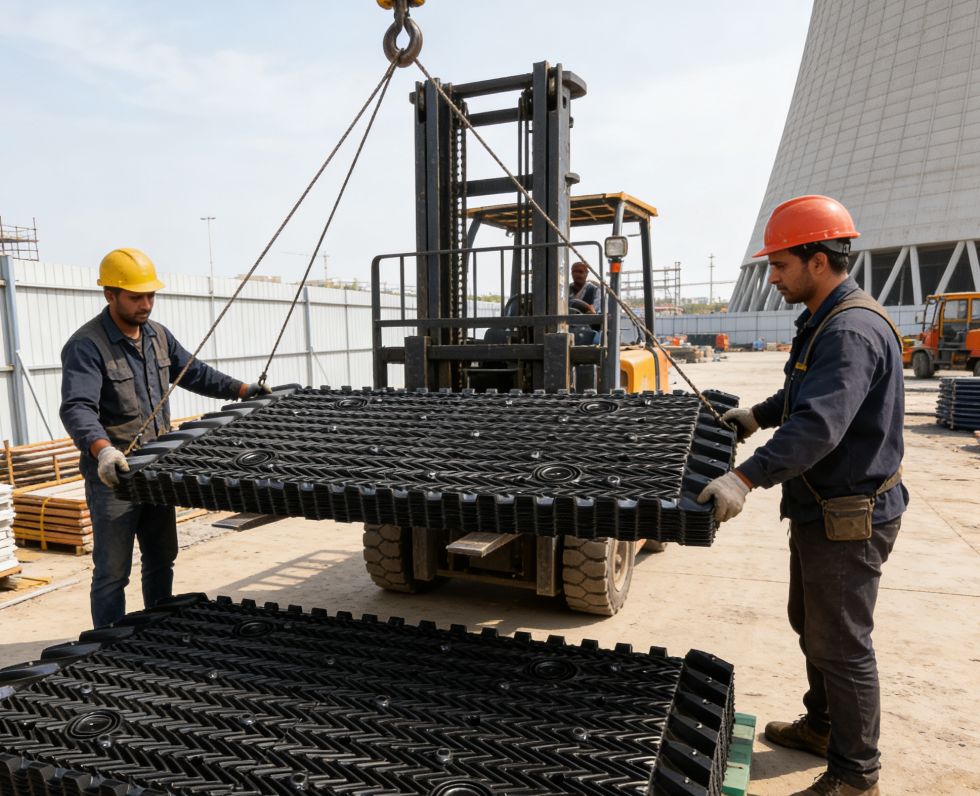
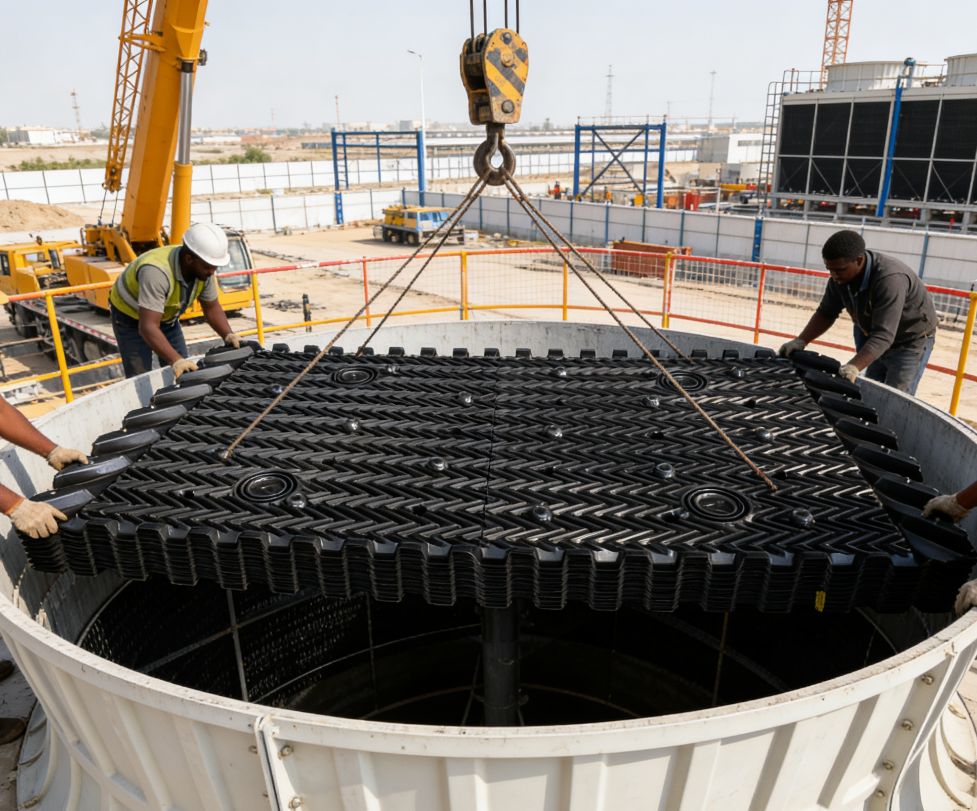
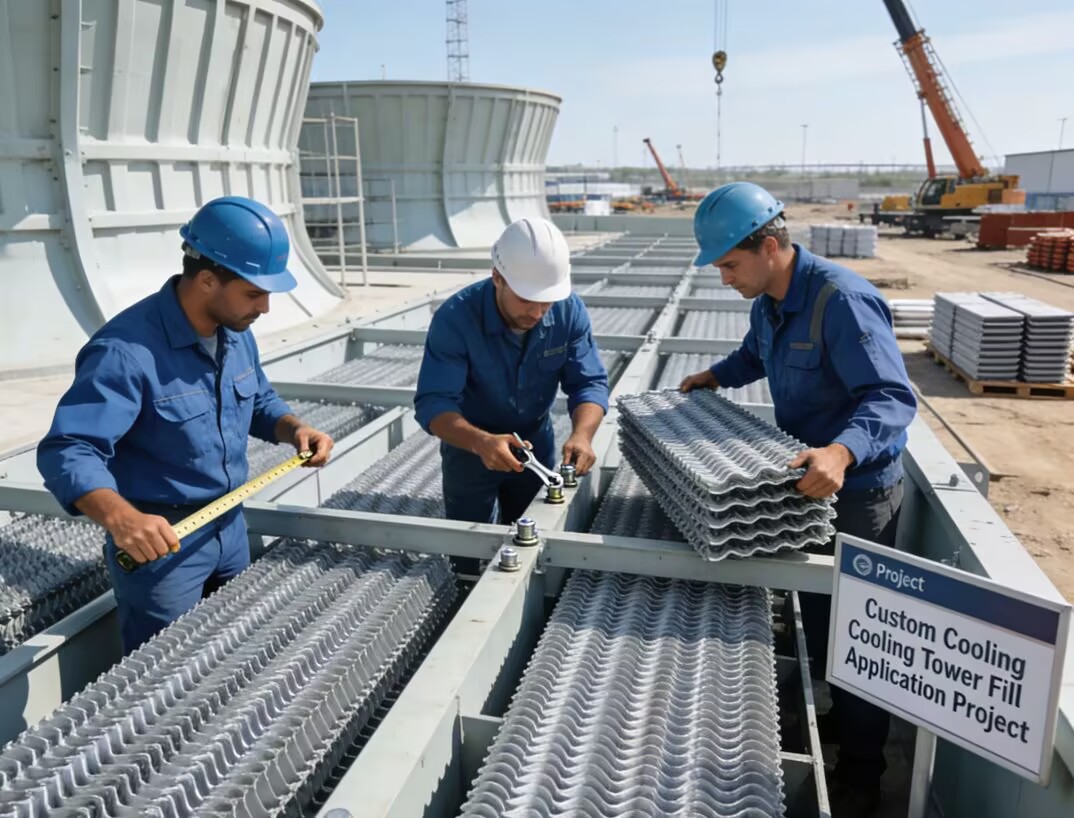
Cooling tower fill is where the heat transfer happens. Water flows down through the fill while air moves up or across, and heat is transferred from the water to the air through evaporation and direct contact.
There are two main types of cooling tower fill:
Film fill spreads water into thin films over closely spaced sheets. This creates a large surface area for heat transfer within a compact volume. Film fill offers the highest cooling efficiency of any fill type and is the standard choice for most clean water applications.
Film fill is best suited for:
Learn more about Film Fill Cooling Tower solutions.
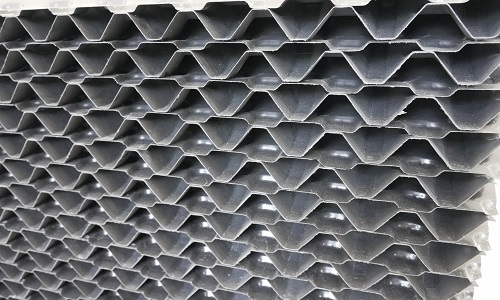
Splash fill breaks water into droplets through successive layers of splash bars. It is less efficient than film fill but much more tolerant of fouling and poor water quality.
Splash fill is best suited for:
For general-purpose applications, standard Cooling Tower Fill provides a good balance of efficiency and durability.
When selecting cooling tower media, consider water quality, operating temperature, space constraints, and maintenance capability. Cooling Tower Media comes in various materials including PVC, polypropylene, and specialty formulations for high-temperature or corrosive applications.
Drift eliminators capture water droplets entrained in the exhaust air stream before they leave the cooling tower. Without effective drift eliminators, significant water can be lost to the atmosphere, and any bacteria in the water can be aerosolized.
Drift eliminators use a series of zigzag passages or chevron-shaped blades to change the direction of the air flow. Water droplets, being heavier than air, cannot make the sharp turns and instead impact the eliminator surfaces, where they coalesce and drain back into the tower.
Current standards require drift eliminators to reduce drift to 0.002 percent or less of recirculated water flow for counterflow towers and 0.005 percent or less for crossflow towers. High-efficiency drift eliminators achieve even lower drift rates, some below 0.0005 percent.
For water conservation and Legionella safety, high-efficiency Drift Eliminator technology is strongly recommended.
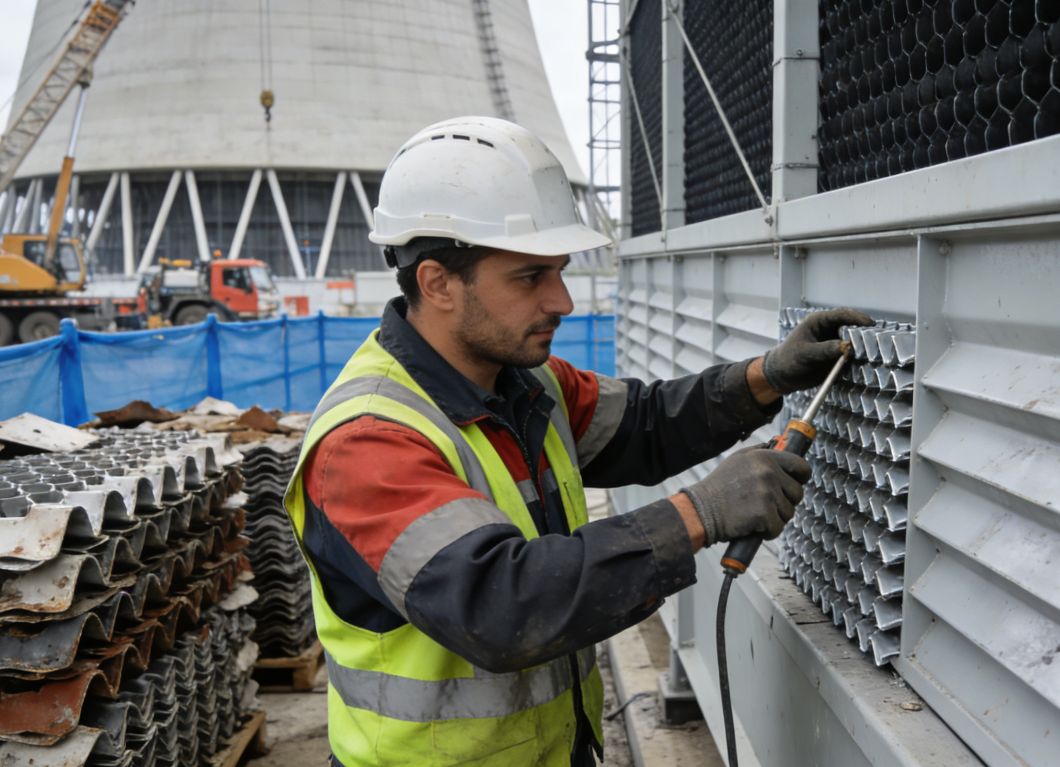
Drift eliminators require periodic inspection and cleaning. Fouled drift eliminators restrict airflow, increasing fan energy consumption. Damaged eliminators allow excessive drift. Inspect drift eliminators quarterly and clean or replace as needed.
Water collectors work alongside drift eliminators to capture water that would otherwise be lost. While drift eliminators target fine droplets in the exhaust air, water collectors capture larger droplets that fall within the tower.
High-efficiency Water Collector systems can reduce water loss by an additional five to ten percent compared to standard designs. In water-scarce regions like the Middle East, this can represent significant annual savings.
Water collectors also help maintain water quality by reducing the amount of water that falls to the basin without contacting the fill, improving overall system efficiency.
When selecting water collectors, consider:
Mist eliminators and demisters are similar to drift eliminators but are designed for applications where very fine mist must be captured. They are used in specialized cooling applications such as:
High-efficiency Mist Eliminator systems can achieve near-zero mist emissions. Demister technology is similar but may use different internal geometries optimized for specific droplet size ranges.
If your facility is located near residential areas or has environmental permit limits for aerosol emissions, consider upgrading to high-efficiency mist eliminators.
Air intake louvers are installed at the air inlet of the cooling tower. Their primary function is to prevent debris from entering the tower while allowing air to flow freely. They also help distribute airflow evenly across the fill.
Properly designed Air Inlet Louvers use a series of vanes to separate dust and debris from the incoming air stream. The heavy particles fall out before they reach the fill.
I have seen cooling towers in dusty industrial areas where the fill was completely clogged within two years because the plant had inadequate air intake louvers. Installing high-efficiency louvers solved the problem and extended fill life by several years.
Air Inlet Grilles provide additional protection by blocking larger debris such as leaves, birds, and insects. While grilles alone cannot stop fine dust, they are an important complement to louvers.
For facilities in particularly dusty environments, Air Intake Screens with finer mesh can be added. However, finer screens increase pressure drop, so the trade-off between protection and airflow must be evaluated.
Cooling Tower Intake Louvers are available in various materials including PVC, polypropylene, and metal. Material selection depends on climate, UV exposure, and chemical environment.
A cooling tower is a system, not a collection of independent parts. Here is how the components interact:
Air enters through the intake louvers, which remove large debris and help distribute airflow evenly. The air then passes upward through the fill, where it contacts water flowing downward. Heat is transferred from the water to the air. As the air exits the fill, it passes through drift eliminators or mist eliminators, which capture water droplets before the air leaves the tower. Water collectors capture additional water that falls within the tower.
If any component is undersized, fouled, or damaged, the entire system suffers. Fouled intake louvers restrict airflow to the fill. Damaged drift eliminators allow water loss. Improperly selected fill reduces cooling efficiency.
This is why I always recommend a holistic approach to cooling tower specification and maintenance. Do not focus on one component at the expense of others.
If you are specifying a new cooling tower, here is my component selection advice:
Select high-density PVC film fill for maximum cooling efficiency. Pair with high-efficiency drift eliminators rated at 0.0005 percent drift or less. Add water collectors for additional water conservation. Use standard air intake louvers for debris protection.
Select splash fill for fouling resistance. Use drift eliminators with easy-clean designs. Consider polypropylene fill if temperatures are high. Install high-efficiency air intake louvers to keep debris out of the tower.
Select high-efficiency film fill paired with ultra-low-drift eliminators (0.0002 percent or less). Add water collectors. Use air intake louvers with high dust separation efficiency. Consider polypropylene for high-temperature resistance.
In addition to standard components, add high-efficiency mist eliminators or demisters for near-zero aerosol emissions. Consider antimicrobial additives in fill materials. Implement a comprehensive water treatment and Legionella prevention program.
If you have an existing cooling tower, consider component upgrades rather than full replacement. Here are the most cost-effective upgrades:
Replacing old, fouled fill with modern high-efficiency media typically pays for itself within two years through energy savings alone. This is the single most effective cooling tower upgrade.
Upgrading to high-efficiency drift eliminators reduces water loss and improves Legionella safety. The payback period is typically one to three years depending on water costs.
Installing or upgrading air intake louvers keeps debris out of the fill, extending fill life and maintaining performance. The cost is modest and the benefits are long-term.
I recommend evaluating all cooling tower components during any retrofit project. The incremental cost of upgrading multiple components at once is much lower than doing separate projects over time.
Here is a summary of maintenance requirements for each cooling tower component:
Inspect quarterly, clean annually (or more often in fouling service), replace every 7-10 years (PVC) or 10-15 years (polypropylene).
Inspect quarterly, clean as needed, replace when damaged or when drift efficiency drops.
Inspect annually, clean as needed, replace if damaged.
Inspect quarterly, clean as needed, repair or replace damaged louvers promptly.
Inspect quarterly, clean as needed, replace when efficiency drops below requirements.
Drift eliminators capture larger water droplets. Mist eliminators capture finer mist. The distinction is based on droplet size range. In practice, high-efficiency drift eliminators capture most mist as well.
Yes, they serve different functions. Drift eliminators capture droplets in the exhaust air. Water collectors capture falling water within the tower. Both are needed for maximum water conservation.
Drift eliminators typically last ten to fifteen years with proper maintenance. However, if you are upgrading to meet tighter drift standards, replacement may be justified sooner.
In most cases, yes, as long as the components are physically compatible. However, working with a single supplier for all components ensures compatibility and simplifies support.
A cooling tower is a system of interdependent components. For optimal performance and reliability:
We manufacture and supply all cooling tower components including fill, drift eliminators, water collectors, mist eliminators, and air intake louvers. Contact our team for assistance with component selection, retrofit planning, or maintenance support.
We manufacture and supply all cooling tower components including fill, drift eliminators, water collectors, mist eliminators, and air intake louvers. Whether you need a single component or a complete system, our engineering team can help you select the right products for your application.
Contact Us Here →We are professional cooling tower fills manufacturer, which can supply wide ranges of cooling tower fills with PVC, PP or CPVC materials.
The brake oil pipes we provide have multiple monitoring certifications and complete compliance documents to help your business smoothly enter the global market.
Fully automated production line, supporting individual customization. Combined with just-in-time logistics solutions, ensuring stable inventory.
A professional foreign trade technical team provides rapid response and is a trustworthy partner, offering everything from technical Q&A to market insights.

The cooling tower fill from this company has performed reliably in our systems. We appreciate the consistent quality and noticeable efficiency improvement.
CEO & Founder

As a CEO, I value partners who deliver on their promises. Their cooling tower fill is a solid product that contributes to stable operations.
CEO & Founder

We are satisfied with the performance of this cooling tower fill. It has integrated well into our existing setup with good results.
Manager

This company provides quality cooling tower fill that meets our operational needs. It's a dependable component in our infrastructure.
CEO & Founder

We are professional cooling tower fills manufacturer, which can supply wide ranges of cooling tower fills with PVC, PP or CPVC materials.

Instant Chat Support
+8615303180686
packingesale@gmail.com
Get the latest information
Scan the code to follow
Return to the top of the page