If you manage a cooling tower in a petrochemical plant in Saudi Arabia, a power station in Japan, or a manufacturing facility in Thailand, you already know this: cooling tower fill is the heart of your thermal system. When it performs well, your process stays stable, energy consumption is predictable, and maintenance intervals are manageable. When it doesn't—approach temperatures rise, compressors work harder, and your operating budget takes a hit.
I have spent the last decade working on cooling towers across Southeast Asia, the Middle East, and Northeast Asia. In that time, I have seen film fill clogged within six months because someone specified the wrong type for dirty water. I have seen cooling tower fill last twelve years in a Japanese chemical plant because the maintenance team understood their water chemistry and chose the right material. The difference is not luck—it is engineering judgment.
This article is written for engineers and procurement professionals who need practical, actionable information about cooling tower fill. No marketing fluff. No exaggerated claims. Just real experience, clear explanations, and a framework for making better decisions.
In simple terms, cooling tower fill media is the internal structure inside a cooling tower where the actual heat exchange happens. Hot water from your process or condenser is distributed over the fill surface. Air moves through the fill—either counterflow or crossflow—and as the water spreads out over the fill media, it gives up heat to the air through both sensible and evaporative cooling.
From an engineering perspective, the fill serves three critical functions:
The choice of cooling tower fill directly impacts your tower's thermal performance, pressure drop, maintenance frequency, and service life. Get it wrong, and you will be dealing with cooling tower fill clogged passages, scaling, or premature aging within a few seasons.
There are two primary categories of cooling tower fill: film fill and splash fill. Within these categories, corrugated fill has become the dominant geometry for modern high-efficiency towers. Each type has a specific application window, and the selection is rarely a matter of "which is better"—it is a matter of "which is appropriate for your conditions."
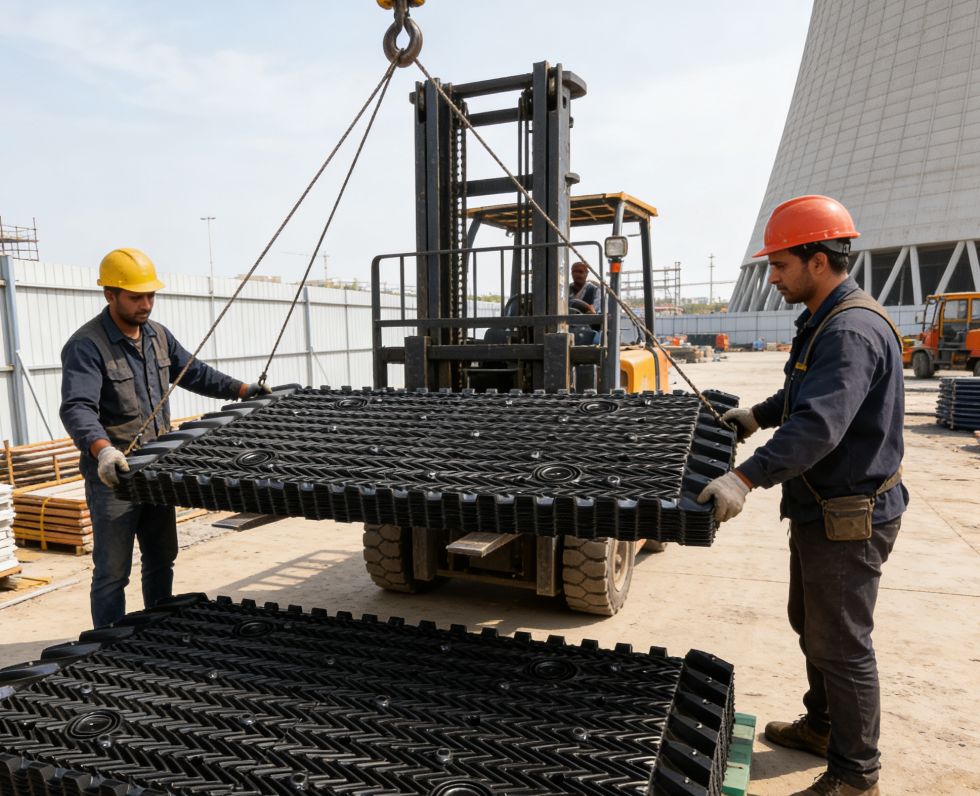
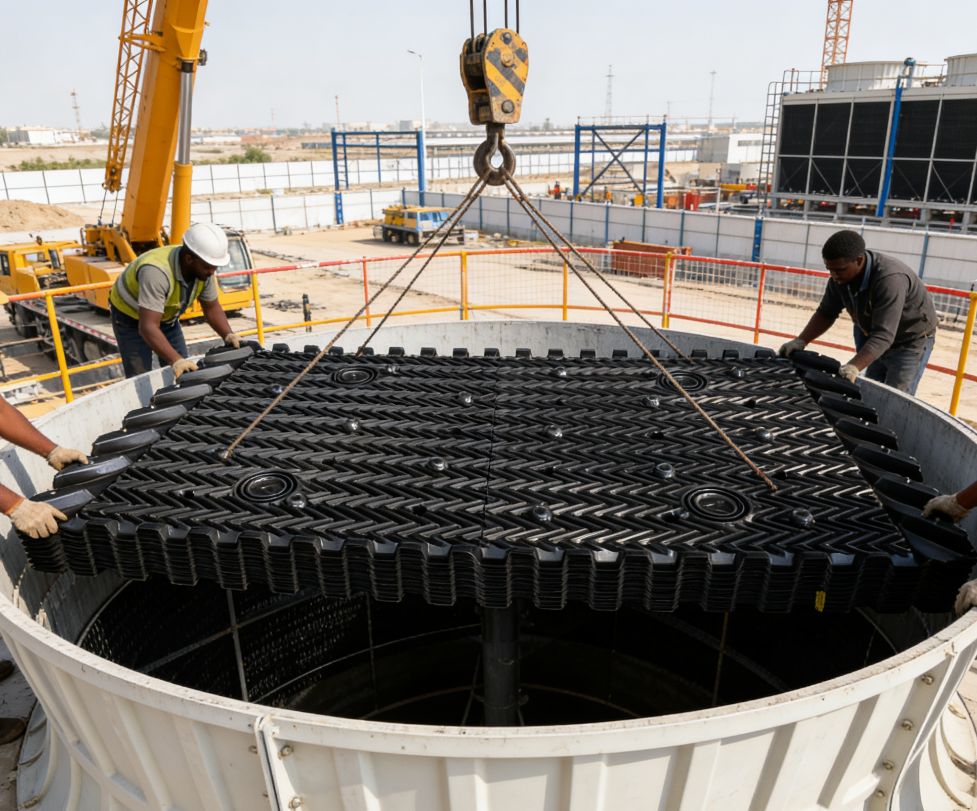
Film fill cooling tower systems use thin sheets of plastic—typically PVC or PP—arranged in close proximity. Water flows down these sheets as a thin film, creating a very large surface area for heat transfer. This is the most common type of fill in modern industrial cooling towers because it offers the highest thermal performance per unit volume.
However, film fill has a trade-off. The narrow passages between sheets make it susceptible to fouling. If your water contains suspended solids, biological material, or high scaling potential, film fill will clog faster than splash fill. I have seen cooling tower fill clogged with calcium carbonate deposits in as little as three months in towers with poor water treatment.
Film fill is the right choice when:
Splash fill works on a different principle. Instead of forming a film, water falls through layers of horizontal bars or grids, breaking into droplets at each level. This splash fill cooling tower design creates less surface area than film fill, but it is far more tolerant of dirty water.
In Southeast Asia and the Middle East, where cooling towers often operate with high-hardness makeup water or process water with entrained solids, splash fill is frequently the more reliable choice. The open structure allows debris to pass through rather than accumulate. While thermal efficiency is lower than film fill, the reduced maintenance burden often justifies the trade-off.
Splash fill is preferred when:
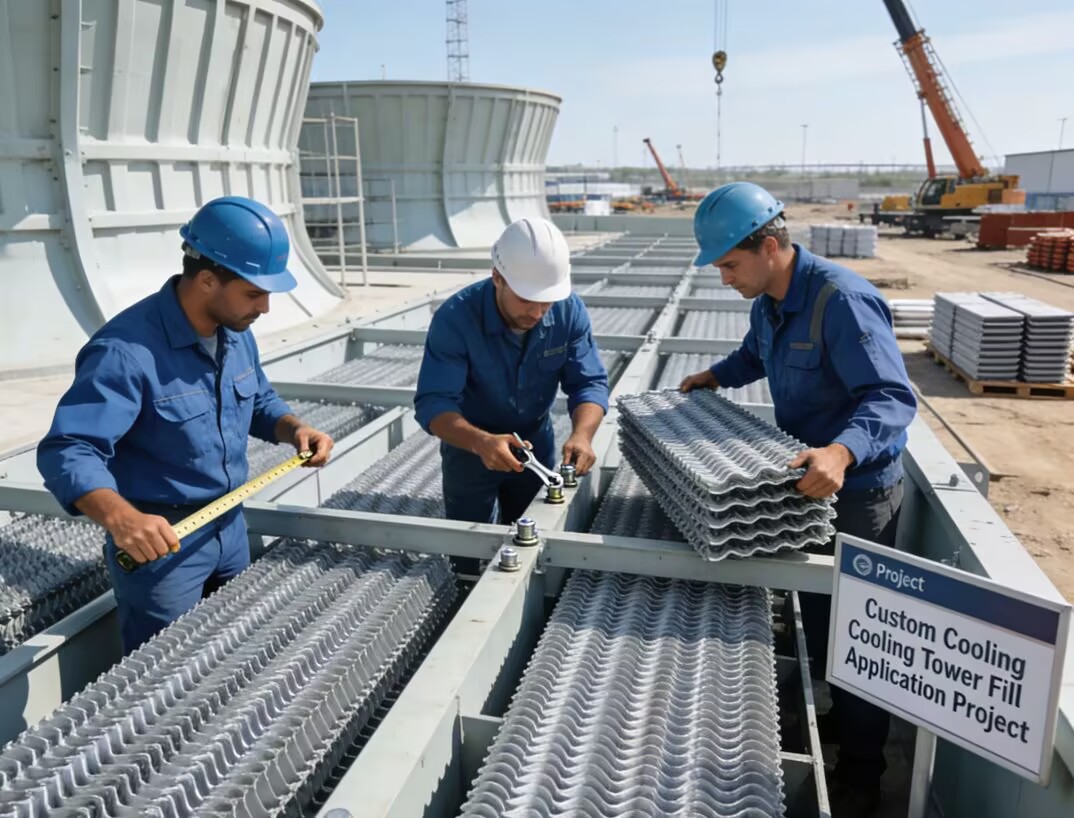
Corrugated fill refers to the geometric design of the fill sheets, characterized by alternating ridges and valleys. This pattern increases the structural rigidity of the fill pack while also improving water distribution across the surface. Most modern film fills use a corrugated design.
The corrugation angle, flute height, and sheet spacing are all design variables that affect thermal performance and fouling resistance. A steeper corrugation angle generally improves water spreading but increases pressure drop. Larger flute spacing reduces fouling risk but sacrifices some surface area. Cooling tower fill design is a balancing act between these competing factors.
For most industrial applications, a cross-fluted corrugated design with 60° corrugation angle offers a good balance of performance and fouling resistance. Tower fill with this geometry is widely used in both counterflow and crossflow towers across Asia and the Middle East.
The material you choose for your fill is just as important as the type. The two dominant materials in the market are PVC and PP. Each has distinct characteristics that make it suitable for different operating conditions.
PVC cooling tower fill is the industry standard for most applications. Polyvinyl chloride offers a good combination of cost, durability, and chemical resistance. It is the default choice for cooling tower fill material in HVAC and light industrial applications.
Key characteristics of PVC fill:
However, PVC has a temperature limit. If your tower routinely sees inlet water temperatures above 60°C—common in certain petrochemical and power generation applications—PVC fill will soften, deform, and fail prematurely. I have replaced PVC fills in Middle Eastern refineries where the cooling water inlet temperature regularly exceeded 65°C; the sheets had warped and collapsed within two years.
PP cooling tower fill (polypropylene) is the high-temperature alternative. PP can handle continuous operating temperatures up to 90°C and short-term spikes even higher. It also offers better chemical resistance to certain aggressive compounds.
When to choose PP over PVC:
The trade-off is cost—PP fill is more expensive than PVC. But in high-temperature applications, the extended service life usually justifies the premium. For projects in hot climates like the Middle East, where ambient temperatures already push cooling towers to their limits, PP is often the more prudent long-term choice.
Cooling tower fill efficiency is not a single number—it is a combination of thermal performance, pressure drop, and long-term reliability. The most thermally efficient fill in the world is worthless if it clogs within six months.
From a thermal perspective, the key metrics are:
Film fill typically offers 2–4 times the specific surface area of splash fill, which translates to significantly better thermal performance. However, film fill also has higher pressure drop—sometimes 2–3 times higher than splash fill for the same tower height. This means more fan power, which increases operating costs.
In practice, I have found that the best approach is to optimize for the specific operating conditions rather than chasing maximum thermal performance. A film fill might give you 15** better heat rejection than splash fill, but if it requires weekly cleaning to prevent cooling tower fill clogged issues, the total cost of ownership can quickly exceed the savings.
One often-overlooked factor is the impact of fill condition on efficiency. A new fill pack performs at its design rating. After two or three years of operation, fouling, scaling, and mechanical degradation can reduce cooling tower fill efficiency by 10–20**. Regular cooling tower fill maintenance is not optional—it is essential for maintaining design performance.
Selection is the most critical decision you will make regarding your cooling tower. Here is the framework I use when working with clients in Southeast Asia, the Middle East, and Japan:
This is non-negotiable. Get a complete water analysis:
If TSS exceeds 50 ppm, splash fill or a high-fouling-resistance film fill should be considered. If scaling indices (LSI, RSI) suggest aggressive scaling potential, film fill with wider flutes or a vertical flute design may be appropriate.
What is your target approach temperature? What is the design wet-bulb temperature for your location? In the Middle East, where wet-bulb temperatures can exceed 28°C, thermal performance is critical. In Japan, where wet-bulb is lower, you might prioritize fouling resistance over peak performance.
As discussed earlier, temperature dictates material choice. If your inlet water temperature regularly exceeds 60°C, PP is the only viable option. Below 60°C, PVC is the economical choice.
Do not just look at the initial fill cost. Consider:
In many cases, a slightly more expensive fill with better fouling resistance will have a lower total cost of ownership than a cheaper fill that requires frequent cleaning and early replacement.
After a decade in the field, I have seen the same problems surface repeatedly across different industries and regions. Understanding these problems is the first step to preventing them.
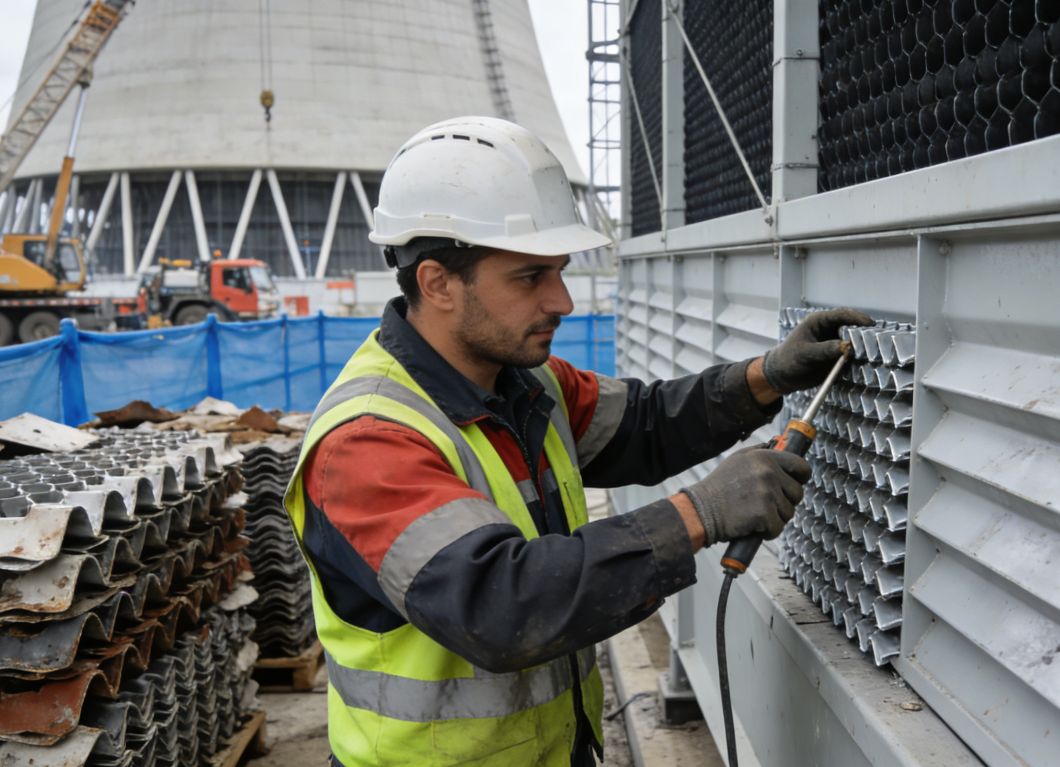
Cooling tower fill clogged with debris, scale, or biological growth is the most common issue I encounter. Film fill is particularly vulnerable because the narrow flutes trap particles. The symptoms are subtle at first—a gradual rise in cold-water temperature, increased fan runtime, higher approach temperature—but they escalate quickly.
Clogging has three primary causes:
In one Southeast Asian food processing plant, the cooling tower fill was clogged within eight months because the plant's water treatment program was inadequate for the local water source. The fill had to be replaced, and the plant lost three days of production. The cost of the replacement was minor compared to the lost revenue.
Scaling is the precipitation of dissolved minerals onto the fill surface. It is driven by:
Scale acts as an insulator, reducing heat transfer efficiency. It also physically reduces the open area in the fill, increasing pressure drop and reducing airflow. In severe cases, scale can bridge the flutes in film fill, completely blocking water flow.
I have seen cooling tower fill with scale deposits so thick that the fill sheets were fused together into solid blocks. There was no cleaning solution—the fill had to be cut out and replaced.
Even with perfect water chemistry and maintenance, fill does not last forever. PVC and PP both degrade over time due to:
Typical service life for PVC fill in good conditions is 8–12 years. PP can last 10–15 years. In harsh conditions—high temperature, poor water quality, high UV exposure—life can be as short as 3–5 years. Regular inspection and early replacement planning are essential.
Cooling tower fill maintenance is not complicated, but it requires discipline. Here is what I recommend to every client:
One practice I strongly recommend: keep a log of fill inspections, water chemistry data, and maintenance activities. This historical data is invaluable for predicting when cooling tower fill replacement will be needed and for justifying budget requests to management.
I want to share three actual projects I worked on. These are not hypothetical scenarios—they are real challenges from real plants, with real solutions.
A large food processing facility in Thailand had four cooling towers, each with PVC cooling tower fill in a cross-fluted film design. The towers were cooling ammonia condensers for cold storage. Within six months of commissioning, the approach temperature had risen from 4°C to 9°C. The plant was losing cooling capacity and had to run additional compressors to maintain temperature.
We inspected the fill and found severe cooling tower fill clogged conditions throughout the entire pack. The water source was a local river with high organic content and suspended solids. The original fill specification was for clean water—a classic mismatch.
The solution: replace the film fill with a splash fill design. Thermal performance dropped slightly, but the cooling requirement was still met. More importantly, the new fill has been operating for four years with only annual cleaning. The plant saved on energy costs (fewer compressor runs) and maintenance labor.
Lesson: Match the fill type to the water quality, not to the thermal performance you wish you had.
A petrochemical facility in Saudi Arabia had cooling towers handling process water at 68–72°C. The original fill was PVC. Within two years, the fill sheets had warped and collapsed under the heat. The plant was replacing fill every 18 months—an expensive and disruptive cycle.
We recommended a switch to PP cooling tower fill with a vertical flute design. The PP material could handle the temperature without deformation, and the vertical flute geometry reduced pressure drop, lowering fan energy consumption. The new fill has been in service for five years with no signs of degradation.
Lesson: Material selection matters. Do not cut corners on temperature rating—the cost of premature replacement far exceeds the initial savings.
A power station in Japan was using seawater for cooling. The seawater had high suspended solids and significant biological activity. The station had tried multiple fill types over the years, all of which experienced rapid cooling tower fill clogged issues.
We implemented a cooling tower fill for dirty water solution using a high-fouling-resistance film fill with larger flute spacing and a smooth surface finish to reduce biological attachment. We also installed a continuous side-stream filtration system to reduce suspended solids before they reached the fill.
The result: the fill has been in service for six years with no major clogging. Annual cleaning is sufficient to maintain performance. The upfront cost of the filtration system was recovered within two years through reduced maintenance and extended fill life.
Lesson: Sometimes the solution is not just the fill itself—it is the entire system. Address the root cause of the problem, not just the symptom.
| Feature | Film Fill | Splash Fill |
|---|---|---|
| Thermal efficiency | High (excellent surface area) | Moderate (lower surface area) |
| Fouling resistance | Low to moderate (narrow flutes) | High (open structure) |
| Pressure drop | Moderate to high | Low |
| Suitable water quality | Clean (TSS < 30 ppm) | Dirty (TSS > 50 ppm) |
| Material options | PVC, PP | PVC, PP |
| Maintenance frequency | Higher (regular cleaning required) | Lower (less frequent cleaning) |
| Service life (typical) | 8–12 years | 10–15 years |
| Best application | HVAC, clean industrial water | Dirty water, high-solids applications |
| Cost | Moderate | Moderate to high |
For more detailed specifications on different fill configurations, refer to industry standards such as those published by the Cooling Technology Institute (CTI) and ASHRAE. These organizations provide testing protocols and performance data that can inform your selection process.
Choosing the right cooling tower fill is one of the most consequential decisions you will make for your cooling system. The wrong choice leads to clogging, scaling, high energy costs, and premature replacement. The right choice—based on water quality, thermal requirements, operating temperature, and total cost of ownership—delivers reliable performance for a decade or more.
I have seen cooling tower fill replacement projects transform plant performance. In one case, replacing a clogged film fill with the correct type reduced approach temperature by 3°C, cut fan energy consumption by 12**, and eliminated unplanned maintenance outages. The fill paid for itself in less than 18 months.
My advice: invest the time upfront to get the selection right. Understand your water. Know your temperature profile. Consider the full lifecycle cost. And do not hesitate to consult with engineers who have field experience in your region and industry.
If you are evaluating a cooling tower fill replacement project or specifying fill for a new tower, I encourage you to look beyond the product data sheet and consider the real-world operating conditions. The best fill on paper is not always the best fill in practice.
For technical specifications, installation guidance, or replacement options, explore the cooling tower fill resources available online. And if you are dealing with related components such as Water Collector, Drift Eliminator, Mist Eliminator, Demister, Air Inlet Louvers, Air Inlet Grilles, Air Intake Screens, or Cooling Tower Intake Louvers, make sure the entire system is evaluated as a whole.
Typical replacement intervals are 8–12 years for PVC and 10–15 years for PP, assuming proper maintenance and water treatment. However, in harsh conditions—high temperature, poor water quality, high fouling potential—replacement may be needed every 3–5 years. Regular inspection is the best way to determine when cooling tower fill replacement is required. Look for signs of warping, cracking, severe scaling, or clogging that cannot be cleaned.
Film fill uses thin sheets to spread water into a thin film, maximizing surface area and thermal performance. Splash fill uses horizontal bars to break water into droplets, offering better fouling resistance but lower thermal efficiency. Film fill is preferred for clean water applications where thermal performance is critical. Splash fill is the better choice for cooling tower fill for dirty water or when water quality is variable.
In many cases, fill can be cleaned and restored to near-original performance. Light fouling can be addressed with low-pressure water washing. Scaling may require chemical cleaning. Biological fouling can be treated with biocides. However, if the fill is warped, cracked, or heavily scaled throughout the entire pack, replacement is usually more cost-effective than cleaning. Regular cooling tower fill maintenance prevents the need for premature replacement.
Water quality is the single most important factor in fill selection. High suspended solids, high hardness, and biological activity all increase the risk of cooling tower fill clogged conditions. For clean water (TSS under 30 ppm), film fill is appropriate. For dirty water (TSS over 50 ppm), splash fill or a high-fouling-resistance film fill should be used. Scaling potential affects flute spacing and material selection. Always obtain a complete water analysis before specifying cooling tower fill.
For applications with inlet water temperatures above 60°C, PP cooling tower fill is the appropriate choice. PVC softens and deforms above 60°C, leading to premature failure. PP can handle continuous temperatures up to 90°C and short-term spikes even higher. While PP is more expensive than PVC, the extended service life in high-temperature applications usually justifies the cost.
With over 10 years of experience in cooling tower engineering and fill media selection, I have worked on projects across Southeast Asia, the Middle East, Japan, and Korea. My background includes thermal performance analysis, fill replacement projects, and root-cause failure investigations for industrial cooling systems.
I hold a degree in Mechanical Engineering and have completed advanced training in heat exchanger design and water chemistry. I am a member of the Cooling Technology Institute (CTI) and regularly contribute to industry forums on cooling tower performance optimization.
This article reflects my practical experience in the field—not theoretical knowledge, but lessons learned from real projects, real failures, and real successes. I write for engineers who need actionable information they can trust.
We are professional cooling tower fills manufacturer, which can supply wide ranges of cooling tower fills with PVC, PP or CPVC materials.
The brake oil pipes we provide have multiple monitoring certifications and complete compliance documents to help your business smoothly enter the global market.
Fully automated production line, supporting individual customization. Combined with just-in-time logistics solutions, ensuring stable inventory.
A professional foreign trade technical team provides rapid response and is a trustworthy partner, offering everything from technical Q&A to market insights.

The cooling tower fill from this company has performed reliably in our systems. We appreciate the consistent quality and noticeable efficiency improvement.
CEO & Founder

As a CEO, I value partners who deliver on their promises. Their cooling tower fill is a solid product that contributes to stable operations.
CEO & Founder

We are satisfied with the performance of this cooling tower fill. It has integrated well into our existing setup with good results.
Manager

This company provides quality cooling tower fill that meets our operational needs. It's a dependable component in our infrastructure.
CEO & Founder

We are professional cooling tower fills manufacturer, which can supply wide ranges of cooling tower fills with PVC, PP or CPVC materials.

Instant Chat Support
+8615303180686
packingesale@gmail.com
Get the latest information
Scan the code to follow
Return to the top of the page