I have stood inside cooling towers in the middle of a Thai summer, staring at a cooling tower fill that had turned into a solid block of calcium scale. I have also seen a film fill cooling tower in a Japanese chemical plant operating at near-original efficiency after nine years of service. The difference between these two outcomes was not luck—it was the selection process.
When you are an engineer or procurement professional in Southeast Asia, the Middle East, Japan, or Korea, the stakes are high. Your cooling tower is often the single largest consumer of water and energy on site. The cooling tower fill you choose will determine your operating costs, maintenance burden, and production reliability for the next decade.
This article is a practical guide to selecting the right cooling tower fill for your specific conditions. It is based on real projects across Asia and the Middle East—not theory, but field experience. I will walk you through the engineering logic, the trade-offs, and the questions you need to ask before you make a decision.
The cooling tower fill media is the component that actually performs the heat exchange. The fan, the basin, the distribution system—they all support the fill. The fill is where the water meets the air. If the fill underperforms, nothing else can compensate.
Here is what happens when the fill is incorrectly specified:
I have seen each of these outcomes firsthand. In one Middle Eastern refinery, an incorrect fill selection led to a 15** increase in fan energy consumption and a replacement cycle shortened from ten years to three. The financial impact was in the hundreds of thousands of dollars—not counting the lost production during replacement.
The selection process is not difficult, but it requires discipline. You need to ask the right questions, gather the right data, and understand the trade-offs.
When I start a fill selection project with a client, the first decision is always type. The choice between film and splash fill sets the direction for everything that follows.
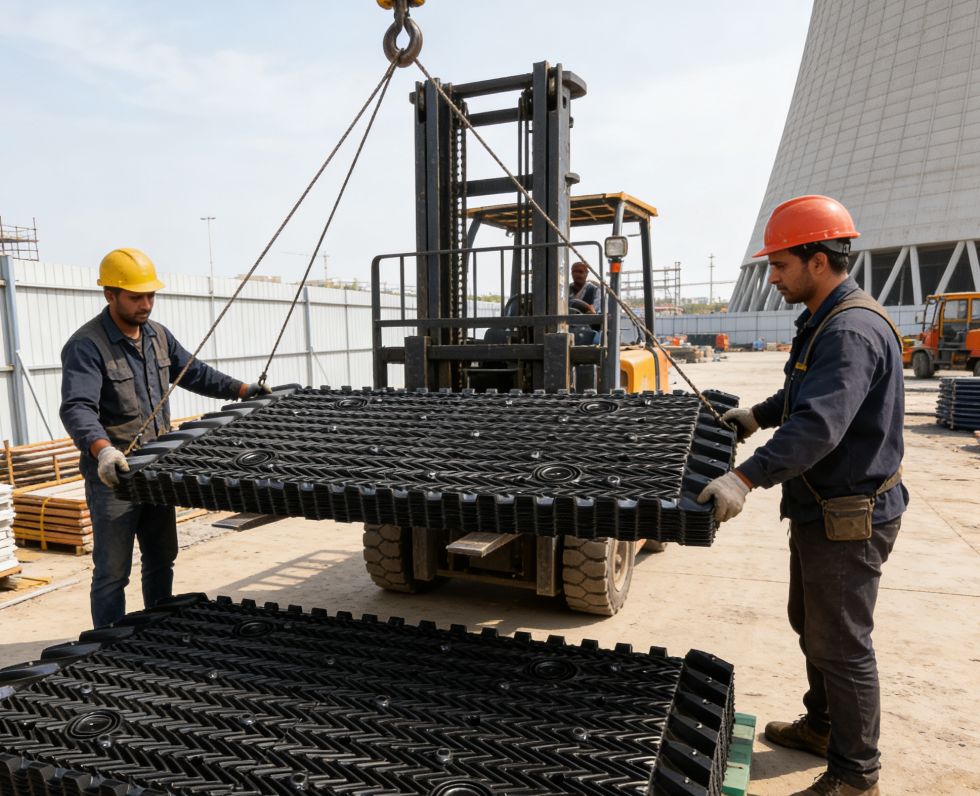
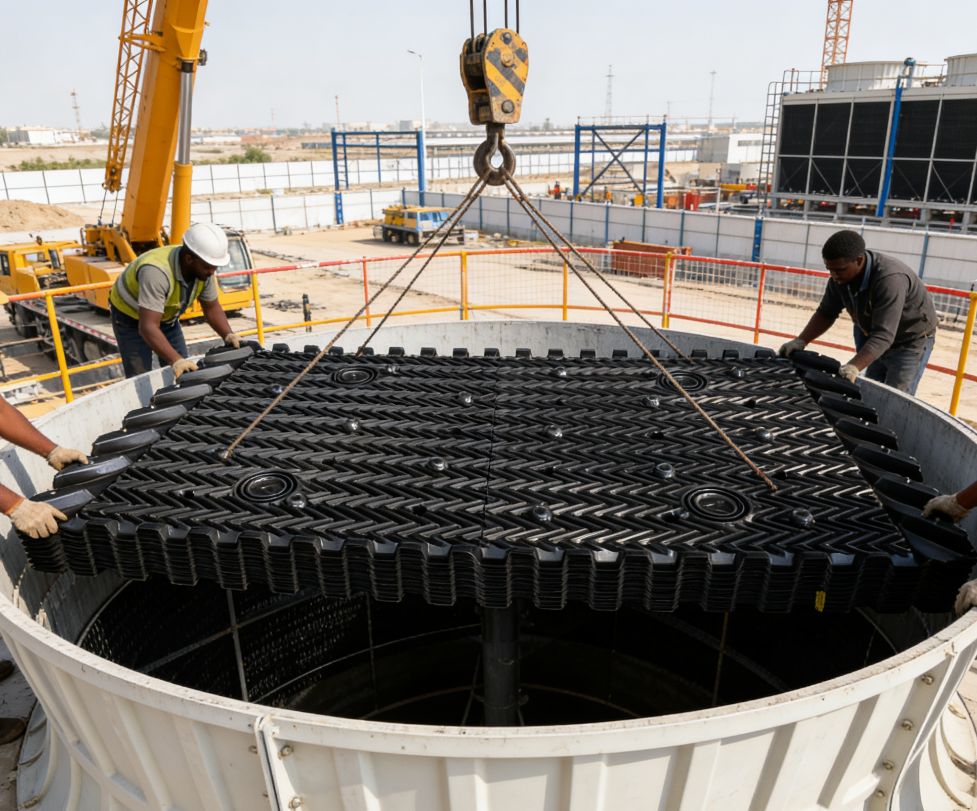
Film fill cooling tower systems dominate the industrial market for one reason: thermal performance. The thin film of water on the fill sheets creates a vast surface area for heat transfer. In a well-designed film fill pack, the specific surface area can exceed 200 m²/m³.
The limitation is fouling. The narrow passages between sheets trap suspended solids, scale, and biological material. If your water quality is not consistently excellent, you will face cooling tower fill clogged conditions sooner or later.
Film fill is the appropriate choice when:
For a splash fill cooling tower, water falls through layers of horizontal bars, breaking into droplets. The open structure means debris passes through rather than accumulating. This type is more forgiving of poor water quality, variable chemistry, and lapses in treatment.
The trade-off is thermal efficiency. Splash fill has less surface area per unit volume, so the tower must be larger to achieve the same cooling duty. In regions with high ambient wet-bulb temperatures—like the Middle East—this size penalty can be significant.
Splash fill is the better choice when:
Most modern film fills use a corrugated fill geometry. The alternating ridges and valleys serve multiple purposes:
The corrugation angle, flute spacing, and sheet thickness are not arbitrary—they are design variables that directly affect performance. A steeper angle generally improves water spreading but increases pressure drop. Wider flutes reduce fouling risk but sacrifice some surface area.
Tower fill with corrugated design is the industry standard for good reason. It balances thermal performance, structural integrity, and manufacturability. However, the specific corrugation geometry should be selected based on your water quality and thermal requirements, not treated as a standard commodity.
Once the type is determined, the next decision is material. PVC and PP are the two dominant options. The choice is driven primarily by operating temperature, followed by chemical exposure and cost.
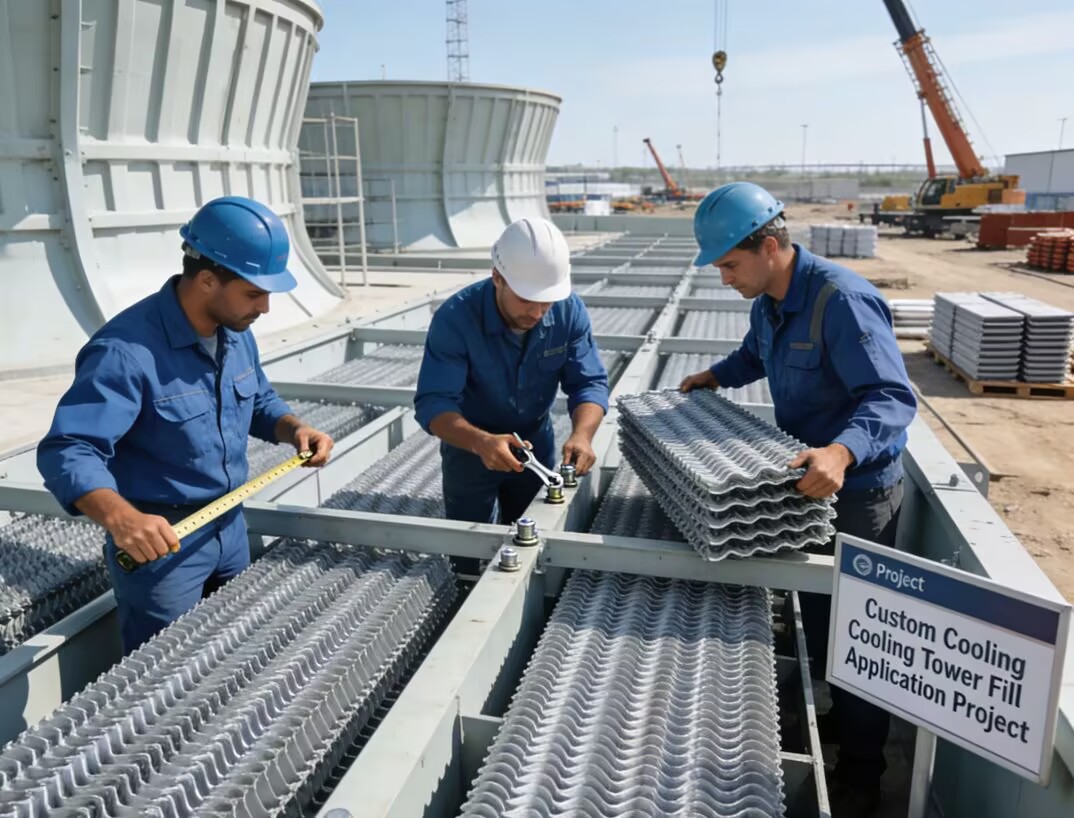
PVC cooling tower fill is the default for most industrial applications. It is cost-effective, durable, and widely available. For the majority of cooling tower applications in Southeast Asia and Japan—where water temperatures are below 60°C—PVC is a reliable choice.
Advantages:
Limitations:
PP cooling tower fill is the high-temperature solution. When inlet water temperatures exceed 60°C, PP is not optional—it is required. I have seen PVC fill warp and collapse in Middle Eastern refineries where water temperatures consistently run at 65–70°C. The cost savings of using PVC were completely erased by the premature replacement.
Advantages:
Limitations:
For projects in the Middle East, where ambient temperatures are already high and cooling water inlet temperatures often exceed 60°C, PP is the safer long-term choice. The higher upfront cost is quickly offset by reduced replacement frequency and fewer unplanned outages.
Cooling tower fill efficiency is a term that gets thrown around casually. In practice, efficiency is not one number—it is a combination of thermal performance, pressure drop, and operational reliability. You cannot optimize one without considering the others.
From an engineering standpoint, here is what matters:
This is measured by the fill's Merkel number or its characteristic curve. Higher thermal performance means your tower can achieve the required approach temperature with less fill volume or lower airflow. The key metric is the relationship between air-to-water ratio and approach temperature.
Film fill consistently outperforms splash fill on thermal performance. However, the incremental benefit of high-performance film fill diminishes as water quality degrades. A fill that is 15** more efficient on paper is worthless if it clogs after six months.
Pressure drop is the resistance that air experiences as it moves through the fill. Higher pressure drop means higher fan power consumption—a direct operating cost.
Film fill generally has higher pressure drop than splash fill. Within film fill designs, corrugation angle and flute spacing significantly affect pressure drop. A 60° corrugation angle might reduce pressure drop by 10–15** compared to a 45° angle, with only a small trade-off in thermal performance.
This is the most overlooked aspect of efficiency. A fill that resists scaling and clogging maintains its efficiency over time. A fill that fouls quickly loses efficiency from day one.
In practice, I have found that fouling resistance is often more important than initial thermal performance. A fill with slightly lower thermal performance but excellent fouling resistance will typically outperform a high-performance fill over its service life, because it stays clean longer and maintains its efficiency.
If you are evaluating cooling tower fill replacement for an existing tower, consider whether the original fill failed due to fouling or thermal inadequacy. The answer will guide your new selection.
Over the years, I have developed a systematic approach to fill selection. I use this framework with every client, regardless of industry or region.
Gather the following data:
This data is not optional. I have seen too many projects where the fill was selected based on a two-page summary instead of a full water analysis. The result was always the same: the fill did not perform as expected.
Based on water quality:
Based on operating temperature:
Do not stop at the purchase price. Consider:
In many cases, a higher-priced fill with better fouling resistance will have a lower total cost of ownership. I have seen this pattern repeatedly across Southeast Asia and the Middle East.
For projects in Japan and Korea, delivery timelines are often critical. Cooling tower fill material availability varies by region and supplier. Plan ahead and confirm lead times before finalizing your specification.
I always recommend visiting the factory. You learn more in one site visit than in a dozen catalog reviews. Look at the manufacturing process, quality control procedures, and material traceability. Ask about their experience with projects similar to yours.
I have encountered these problems repeatedly across different industries. Understanding them is essential for prevention.
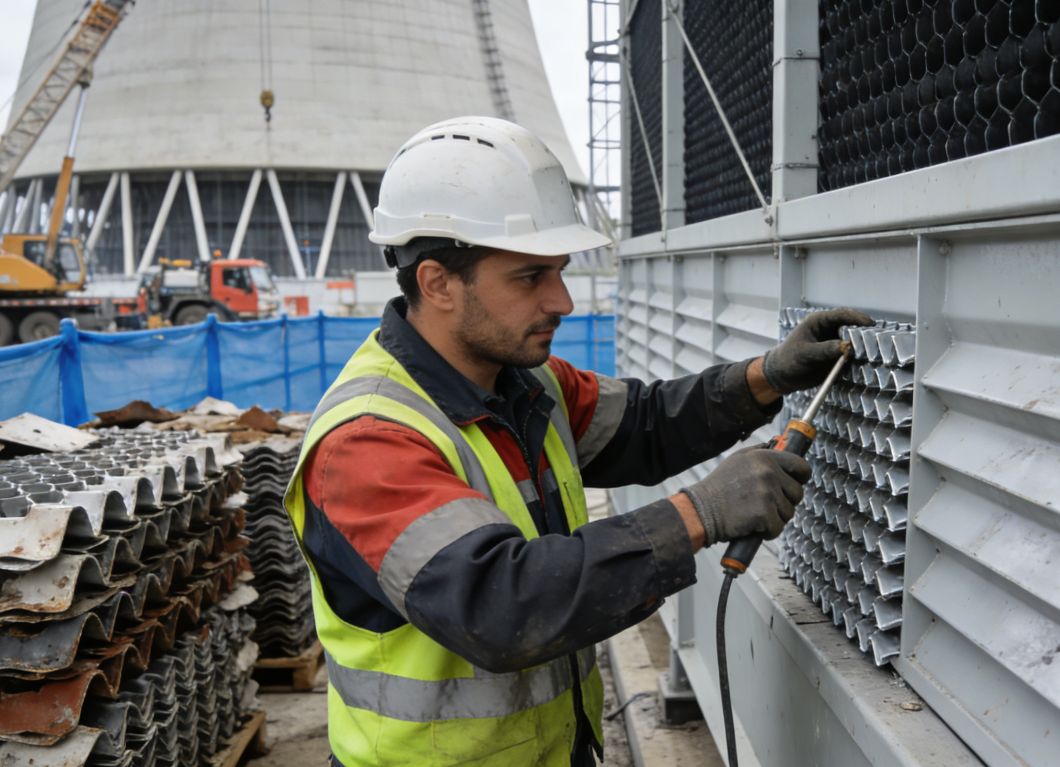
Clogging is by far the most common issue. Cooling tower fill clogged with debris, scale, or biofilm compromises both airflow and water distribution. The symptoms are familiar to any experienced engineer:
Clogging has three primary causes:
In one Southeast Asian plant, the fill was clogged within four months because the cooling tower was located near a road construction site. Dust and fine sand were drawn into the tower and deposited on the fill. The solution was not a different fill—it was better inlet screening and a side-stream filter.
Scaling is the precipitation of dissolved minerals onto fill surfaces. It reduces heat transfer efficiency and physically restricts airflow and water flow. High cycles of concentration, inadequate blowdown, and aggressive makeup water are the usual culprits.
I have seen scale layers 5–10 mm thick on fill sheets in towers with poor water treatment. The scale acted as an insulator, reducing thermal performance by an estimated 20–30**. Removing the scale required chemical cleaning and significant downtime.
Fill does not last forever. Cooling tower fill design and material selection directly affect service life. PVC and PP both degrade over time due to:
In the Middle East, UV degradation is a significant concern. Ensure that the fill edges are protected from direct sunlight, or consider UV-stabilized materials.
Cooling tower fill maintenance is a practical discipline, not a theoretical exercise. Here is what I recommend:
One practice I strongly recommend: keep a detailed log. Include inspection dates, photos, water chemistry data, and any maintenance actions. This log is invaluable for trend analysis and for justifying capital expenditures to management.
Here are three actual projects where fill selection was the key variable. These are not hypothetical scenarios—they are real problems with real solutions.
A chemical plant in Indonesia had a cooling tower with PVC cooling tower fill in a standard cross-fluted film design. The cooling water was drawn from a nearby river with high suspended solids, especially during the rainy season.
Within five months of operation, the approach temperature had increased from 5°C to 10°C. The cooling tower fill was clogged with sediment and organic debris. The plant had to shut down the tower every two weeks for cleaning—an unsustainable situation.
We replaced the fill with a splash fill cooling tower design using PVC bars. The thermal performance was lower, but the application did not require maximum thermal efficiency. The new fill has been in operation for three years with only quarterly cleaning. The plant recovered the replacement cost in reduced maintenance labor within the first year.
Key takeaway: When water quality is the constraint, fouling resistance matters more than thermal performance.
A power plant in the United Arab Emirates had a cooling tower handling water at 68°C. The original fill was PVC. Within 18 months, the fill sheets had warped and collapsed. The plant had replaced the fill twice in three years.
We recommended a switch to PP cooling tower fill with a modified corrugation angle to reduce pressure drop. The PP material handled the temperature without deformation. The wider flute spacing reduced scaling accumulation, and the modified corrugation angle lowered fan power consumption by approximately 10**.
The new fill has been in service for five years with no degradation. The plant estimates a total cost saving of over $200,000 compared to the previous cycle of frequent replacement and high energy consumption.
Key takeaway: Do not economize on material selection in high-temperature applications. The savings are illusory.
A semiconductor facility in Japan had stringent temperature control requirements. The cooling tower needed to deliver consistent 3°C approach temperature year-round. Water quality was excellent—deionized water with strict treatment.
We selected a film fill cooling tower with high-density corrugated fill, optimized for thermal performance. The fill achieved the required approach temperature with a compact tower footprint. The maintenance schedule was quarterly inspection and annual cleaning.
The fill lasted ten years before replacement was needed—a successful outcome by any measure. The plant saved space compared to a splash fill alternative and achieved the precise temperature control their process required.
Key takeaway: When water quality is excellent and thermal performance is critical, film fill is the right answer.
| Attribute | Film Fill | Splash Fill |
|---|---|---|
| Thermal performance | High (specific surface area 150–250 m²/m³) | Moderate (specific surface area 30–60 m²/m³) |
| Fouling resistance | Low to moderate | High |
| Pressure drop | Moderate to high (depending on geometry) | Low |
| Suitable water quality | TSS under 30 ppm, controlled chemistry | TSS under 50 ppm, variable chemistry |
| Material options | PVC, PP | PVC, PP |
| Maintenance frequency | Higher (quarterly inspection recommended) | Lower (semi-annual inspection typical) |
| Service life (typical) | 8–12 years | 10–15 years |
| Best application | Clean water, high thermal performance required | Dirty water, high reliability required |
| Relative cost | Moderate | Moderate to high |
Additional components of the cooling tower system should also be considered together with the fill. These include Water Collector, Drift Eliminator, Mist Eliminator, Demister, Air Inlet Louvers, Air Inlet Grilles, Air Intake Screens, and Cooling Tower Intake Louvers. Each component affects the overall system performance and should be selected with the fill in mind.
For detailed specifications and reference data, consult the Cooling Technology Institute (CTI) standards or ASHRAE handbooks. These organizations provide testing methods and performance criteria that are widely used in our industry.
Selecting the right cooling tower fill is a decision with long-term consequences. The wrong choice leads to increased energy consumption, higher maintenance costs, and unplanned outages. The right choice—based on water quality, operating temperature, and total cost of ownership—delivers reliable performance for a decade or more.
I have seen the full spectrum of outcomes, from the project where the fill exceeded all expectations to the project where the fill failed within months. The difference was always in the selection process. The projects that succeeded were the ones where the engineering team took the time to understand their operating conditions and made a deliberate choice.
Whether you are specifying fill for a new cooling tower or planning a cooling tower fill replacement for an existing one, I encourage you to follow the framework outlined in this article. Get the data. Understand your water. Consider the full lifecycle cost. And do not hesitate to consult with engineers who have experience in your region and industry.
The fill is not the most expensive component of your cooling tower, but it is the most consequential. Choose wisely.
Prioritize water quality, operating temperature, and total cost of ownership. Water quality determines whether you need film or splash fill. Operating temperature determines whether you need PVC or PP. Total cost of ownership balances initial cost, maintenance frequency, energy consumption, and service life. Cooling tower fill efficiency matters, but it should not be the only factor.
Signs of needed replacement include: approach temperature consistently above design, visible scaling or fouling that cannot be cleaned, warped or cracked fill sheets, uneven water flow across the fill, or a fill age exceeding the typical service life for your conditions. Regular inspection and data tracking are the best tools for determining when cooling tower fill replacement is required.
Typical service life is 8–12 years for PVC and 10–15 years for PP under good conditions. However, service life is highly dependent on operating conditions. In harsh environments—high temperature, poor water quality, high UV exposure—life can be as short as 3–5 years. Cooling tower fill material selection and cooling tower fill maintenance directly affect service life.
For applications with inlet temperatures above 60°C, PP is required—not optional. In these cases, the cost premium is justified by the longer service life and reduced risk of failure. For applications below 60°C, PVC is typically the more economical choice. Evaluate total cost of ownership, not just the initial material cost.
Prevention starts with proper water treatment and maintaining appropriate cycles of concentration. Install side-stream filtration to remove suspended solids. Ensure the water distribution system is evenly delivering water across the fill. Regularly inspect and clean the fill according to a maintenance schedule. When specifying new fill, choose a design with appropriate fouling resistance for your water quality. Cooling tower fill design and cooling tower fill maintenance are both critical to preventing clogging.
I am a mechanical engineer with over 10 years of experience in cooling tower engineering, specializing in fill media selection and thermal performance optimization. My work has taken me across Southeast Asia, the Middle East, Japan, and Korea, working on projects in petrochemical, power generation, food processing, and semiconductor manufacturing.
I am a member of the Cooling Technology Institute (CTI) and have completed advanced training in water chemistry and heat exchanger design. I regularly contribute to technical forums and industry publications on cooling tower performance and reliability.
This article reflects my practical experience—lessons learned from real projects, real failures, and real successes. I write for engineers who need information they can trust, based on field experience and sound engineering judgment.
We are professional cooling tower fills manufacturer, which can supply wide ranges of cooling tower fills with PVC, PP or CPVC materials.
The brake oil pipes we provide have multiple monitoring certifications and complete compliance documents to help your business smoothly enter the global market.
Fully automated production line, supporting individual customization. Combined with just-in-time logistics solutions, ensuring stable inventory.
A professional foreign trade technical team provides rapid response and is a trustworthy partner, offering everything from technical Q&A to market insights.

The cooling tower fill from this company has performed reliably in our systems. We appreciate the consistent quality and noticeable efficiency improvement.
CEO & Founder

As a CEO, I value partners who deliver on their promises. Their cooling tower fill is a solid product that contributes to stable operations.
CEO & Founder

We are satisfied with the performance of this cooling tower fill. It has integrated well into our existing setup with good results.
Manager

This company provides quality cooling tower fill that meets our operational needs. It's a dependable component in our infrastructure.
CEO & Founder

We are professional cooling tower fills manufacturer, which can supply wide ranges of cooling tower fills with PVC, PP or CPVC materials.

Instant Chat Support
+8615303180686
packingesale@gmail.com
Get the latest information
Scan the code to follow
Return to the top of the page