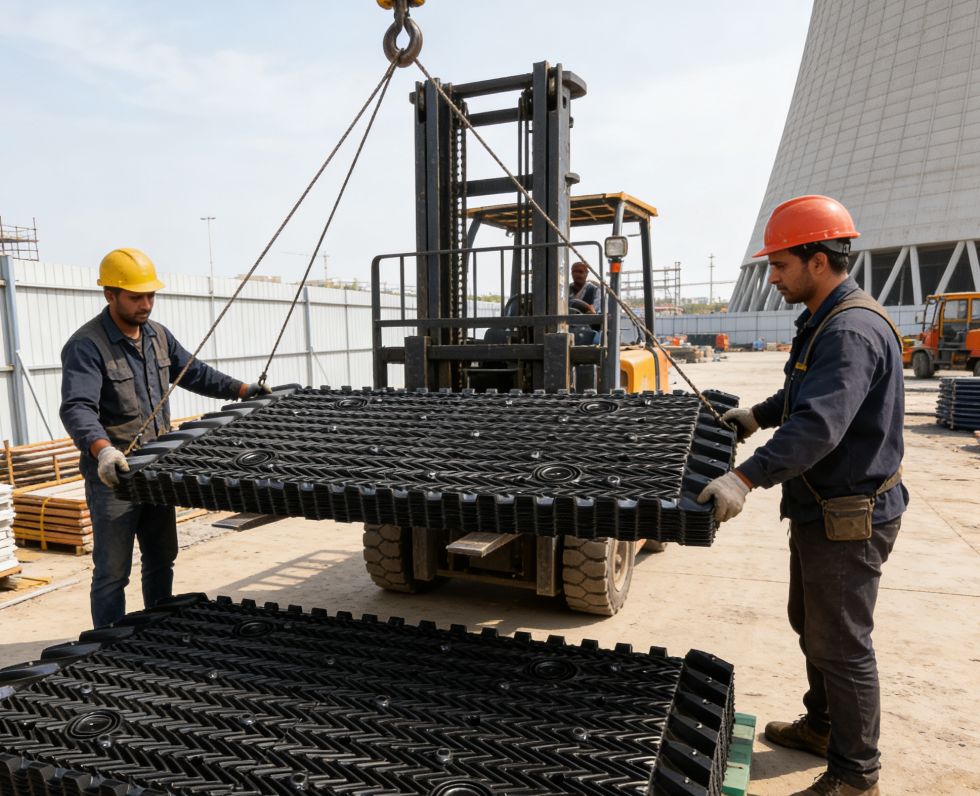
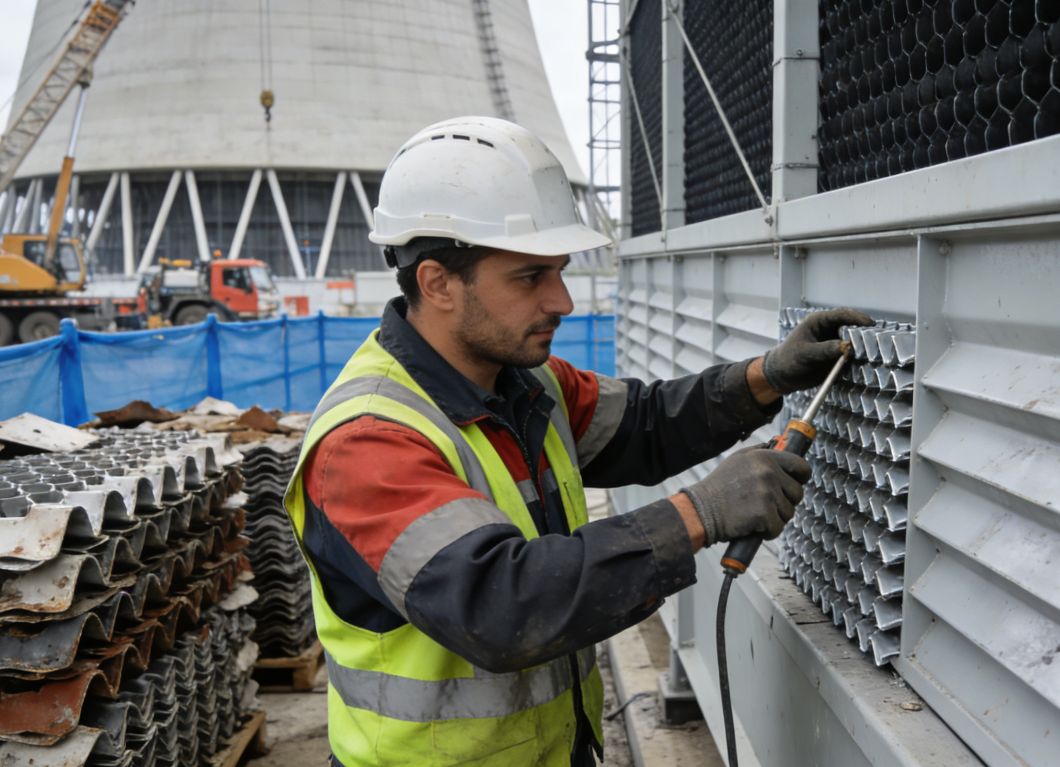
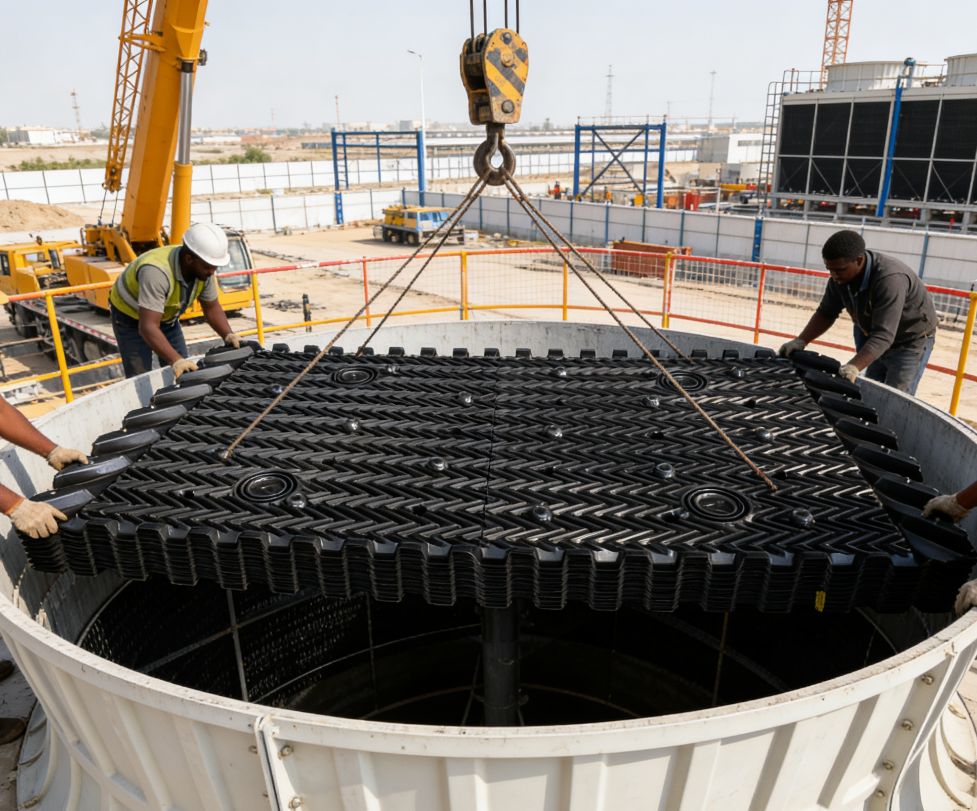
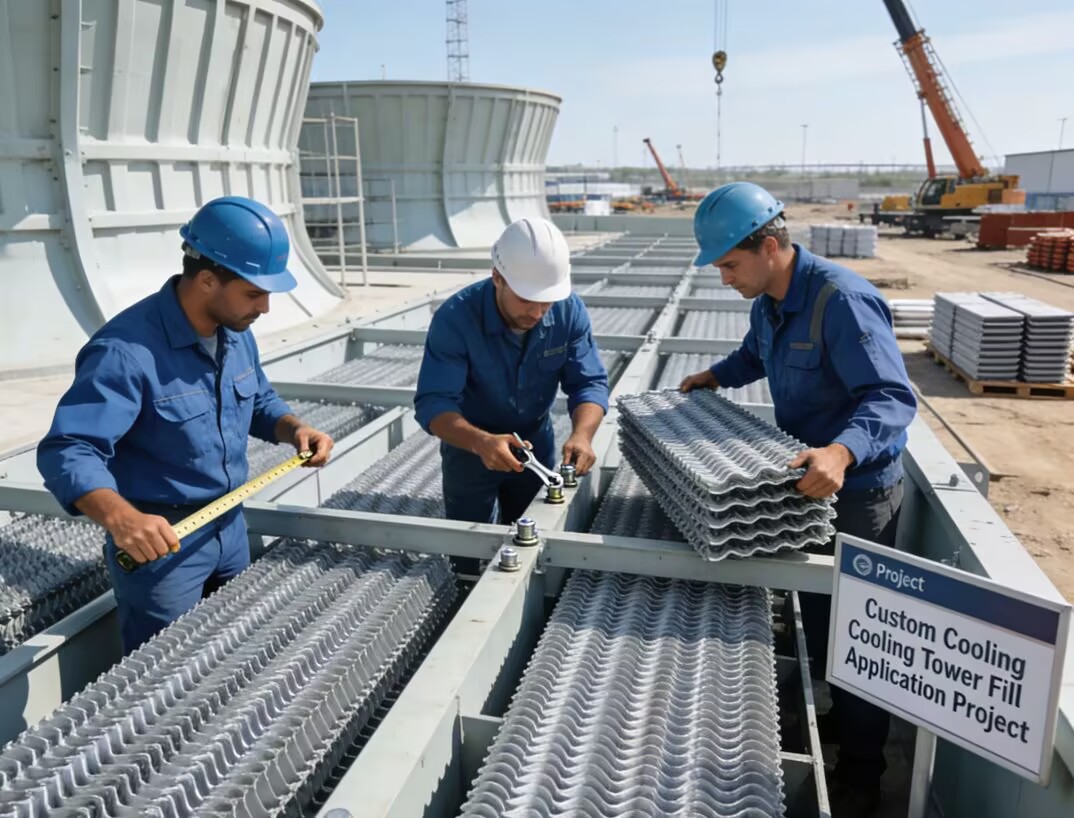
Cooling tower fill is one of the most important parts of the heat exchange section inside an industrial cooling tower. When clogging appears, the tower may lose stable water distribution, airflow can become restricted, and the cooling process may no longer perform as expected. In many plants, this problem develops slowly, so operators often notice the symptom before they identify the root cause.
From an engineering point of view, a cooling tower is only as reliable as the condition of its internal components. If the fill is blocked by suspended solids, scale, biofilm, or airborne debris, the tower cannot maintain the same level of contact between water and air. That is why cooling tower fill clogged issues should be treated as a maintenance and water-quality problem, not only as a component issue.
When the fill passages are restricted, water no longer spreads evenly across the fill pack. Some areas receive too much water while other areas stay partly dry. This uneven condition reduces the effective surface area for heat transfer and creates unnecessary pressure on the fan and pump system.
In practice, the result is often gradual rather than sudden. Operators may first see higher return water temperature, then longer cooling cycles, and later higher energy demand. In some cases, the tower still runs, but the performance decline becomes obvious during peak load or hot weather.
Particles such as dust, sand, rust, fibers, and process residues can settle inside the fill structure. Over time, these particles collect in narrow channels and reduce flow space. This is common in plants with unstable water treatment, open-loop systems, or nearby industrial activity.
Warm and wet internal conditions can support algae, slime, and biofilm. Once biofilm begins to form, it can trap more particles and accelerate blockage. This often happens when inspection intervals are too long or chemical control is inconsistent.
In hard-water systems, minerals can crystallize on the fill surface. The deposits may start as a thin layer, but after repeated operation they become harder and more difficult to remove. Scaling is especially problematic in systems that run with poor blowdown control.
Leaves, insects, dust, and surrounding debris may enter through the air intake area. If the intake design is weak, this material reaches the fill and combines with wet surfaces. That is why intake protection should be considered part of the fill maintenance strategy.
Blocked nozzles, damaged headers, or uneven spray patterns can cause local buildup. When water is not distributed correctly, some sections of the fill stay overloaded while other sections dry out. This condition encourages deposits and shortens service life.
Film fill cooling tower systems are efficient because water spreads into a thin layer across the fill surface. This design supports strong heat transfer, but it also means the flow passages are usually narrower.
In clean water applications, film fill works well. In dirty water systems, however, the same narrow channels may block faster if the water treatment plan is weak or solids load is too high.
tower fill used in splash-style designs normally provides larger open spaces. Water is broken into droplets rather than spreading in a thin film, so these systems often handle dirtier water better.
For plants with higher suspended solids or less stable water quality, splash fill can be a practical choice because it gives the system more tolerance before clogging becomes severe.
cooling tower fill media with a corrugated structure can balance cooling performance and operating tolerance. The geometry helps guide water flow while keeping the fill pack organized. In many projects, this type offers a middle path between high efficiency and reasonable fouling resistance.
That said, no fill design can avoid clogging completely. The right choice still depends on water quality, operating temperature, maintenance frequency, and the type of process fluid being cooled.
Water quality is the first point to review when a tower starts showing clogging symptoms. Suspended solids, hardness, pH drift, chemical imbalance, and biological activity all influence how fast the fill ages.
Good water treatment can slow down fouling, but it should not be treated as a substitute for inspection. The fill should be checked together with the distribution system, the eliminator section, and the air intake area. In many cases, the fill is blamed first, but the real problem begins elsewhere.
In one Southeast Asia project, the cooling tower operated in a warm and humid environment with frequent biological growth. The plant team noticed higher water temperature during daytime load, but early inspections did not show visible damage from outside.
After opening the tower, the fill section showed slime buildup and uneven water flow. Cleaning improved the condition for a short period, but the problem kept returning. The final solution combined improved water treatment, better inspection intervals, and a more suitable fill arrangement for the site condition.
This type of case is common in humid regions. The lesson is simple: when the climate supports biological growth, the maintenance plan must be stricter than the default schedule.
Another project involved a facility located near heavy outdoor dust activity. Even though the water treatment program was acceptable, the tower still showed repeated fouling.
Inspection found that airborne debris was entering through the intake area and settling in the fill. After improving the intake protection with Air Inlet Louvers, Air Inlet Grilles, and Air Intake Screens, the maintenance interval became more manageable.
That case showed an important point: fill clogging is not always caused by the fill material itself. Sometimes the tower is simply receiving too much outside contamination.
In a textile-related application, the water carried fine fibers and process particles. A film fill system was originally installed because the plant wanted better thermal performance. However, the channels blocked too easily, and cleaning was required too often.
After reviewing the operating environment, the tower was changed to a more suitable splash fill cooling tower arrangement. The result was more stable operation and lower cleaning pressure on the maintenance team.
This is a common industrial lesson: high efficiency is useful only when the operating water condition supports it. For dirty water, the most efficient design on paper is not always the best practical choice.
Water treatment should control scale, biological growth, and solids accumulation together. When one area is neglected, clogging can begin even if the tower looks clean from the outside.
Routine inspection helps identify early fouling before the problem grows. Small deposits are easier to manage than heavily blocked fill packs. Operators should not wait until the cooling performance has already dropped noticeably.
Uneven flow often comes from distribution problems rather than fill damage. Nozzles, headers, and spray arrangements should be inspected during maintenance. Stable distribution helps keep deposits from forming in one location.
Air intake components can help keep debris out of the tower. In many industrial sites, the combination of Cooling Tower Intake Louvers, intake screens, and grilles is a practical way to limit contamination.
For many industrial users, the choice between cooling tower fill options depends on water quality and temperature. PVC cooling tower fill is often selected for standard conditions, while PP cooling tower fill is often considered for more demanding operating environments.
The right material should support the real water condition, not only the design target.
Fill does not work alone. Other internal parts also affect performance and contamination control. A complete maintenance review should include:
When these parts are in poor condition, they can allow more carryover, more contamination, and more frequent fouling inside the tower body.
Light fouling can often be handled by cleaning if the fill structure is still intact. However, if the fill is deformed, brittle, heavily scaled, or repeatedly blocked after cleaning, replacement becomes the more practical option.
In real projects, replacement is often chosen when maintenance time is increasing but the cooling result is still declining. At that point, continued cleaning may cost more than installing a new fill pack with better suitability for the duty condition.
Cooling tower fill clogged problems usually develop from a combination of water quality issues, biological growth, scaling, airborne debris, and poor distribution. The most effective way to prevent the problem is to treat the tower as a complete system rather than focusing on a single internal part.
For engineers and procurement teams, the key is matching the fill type, material, and maintenance plan to the real operating condition. Clean water, dirty water, high temperature, and dusty environments all need different decisions. A suitable fill arrangement, supported by proper intake protection and maintenance, can help keep cooling performance stable over the long term.
Industrial plants often deal with suspended solids, scale, biofilm, and airborne debris. These factors gradually accumulate inside the fill and reduce open flow area.
Yes, if the fouling is still light and the fill structure remains sound. Severe scaling, deformation, or repeated clogging usually points to replacement.
Splash fill is usually more tolerant of dirty water because it has larger flow passages and less sensitivity to blockage.
Yes. Air intake protection can reduce the amount of dust and debris entering the tower, which helps protect the fill and extends maintenance intervals.
Start with the fill condition, water distribution, and water quality. These three items often reveal the real cause of the problem quickly.
We are professional cooling tower fills manufacturer, which can supply wide ranges of cooling tower fills with PVC, PP or CPVC materials.
The brake oil pipes we provide have multiple monitoring certifications and complete compliance documents to help your business smoothly enter the global market.
Fully automated production line, supporting individual customization. Combined with just-in-time logistics solutions, ensuring stable inventory.
A professional foreign trade technical team provides rapid response and is a trustworthy partner, offering everything from technical Q&A to market insights.

The cooling tower fill from this company has performed reliably in our systems. We appreciate the consistent quality and noticeable efficiency improvement.
CEO & Founder

As a CEO, I value partners who deliver on their promises. Their cooling tower fill is a solid product that contributes to stable operations.
CEO & Founder

We are satisfied with the performance of this cooling tower fill. It has integrated well into our existing setup with good results.
Manager

This company provides quality cooling tower fill that meets our operational needs. It's a dependable component in our infrastructure.
CEO & Founder

We are professional cooling tower fills manufacturer, which can supply wide ranges of cooling tower fills with PVC, PP or CPVC materials.

Instant Chat Support
+8615303180686
packingesale@gmail.com
Get the latest information
Scan the code to follow
Return to the top of the page