Cooling tower fill selection becomes particularly important when a cooling system operates with dirty water. While many industrial cooling towers achieve satisfactory performance under controlled water conditions, facilities handling wastewater, process water, recycled water, or water containing suspended solids often face additional challenges. In these situations, the choice between film fill and splash fill can directly affect maintenance frequency, cooling stability, and long-term operation.

Engineers frequently ask whether a film fill cooling tower or a splash fill cooling tower is better suited for dirty water systems. The answer depends on several factors, including water quality, operating conditions, maintenance resources, and cooling requirements. Understanding the strengths and limitations of each design helps operators make practical decisions based on actual site conditions.
Before comparing fill types, it is important to define what dirty water means in cooling tower applications.
Dirty water may contain:
These contaminants can accumulate inside the fill pack over time and reduce cooling efficiency if the fill structure is not suitable for the operating environment.
Industries commonly facing dirty water challenges include:
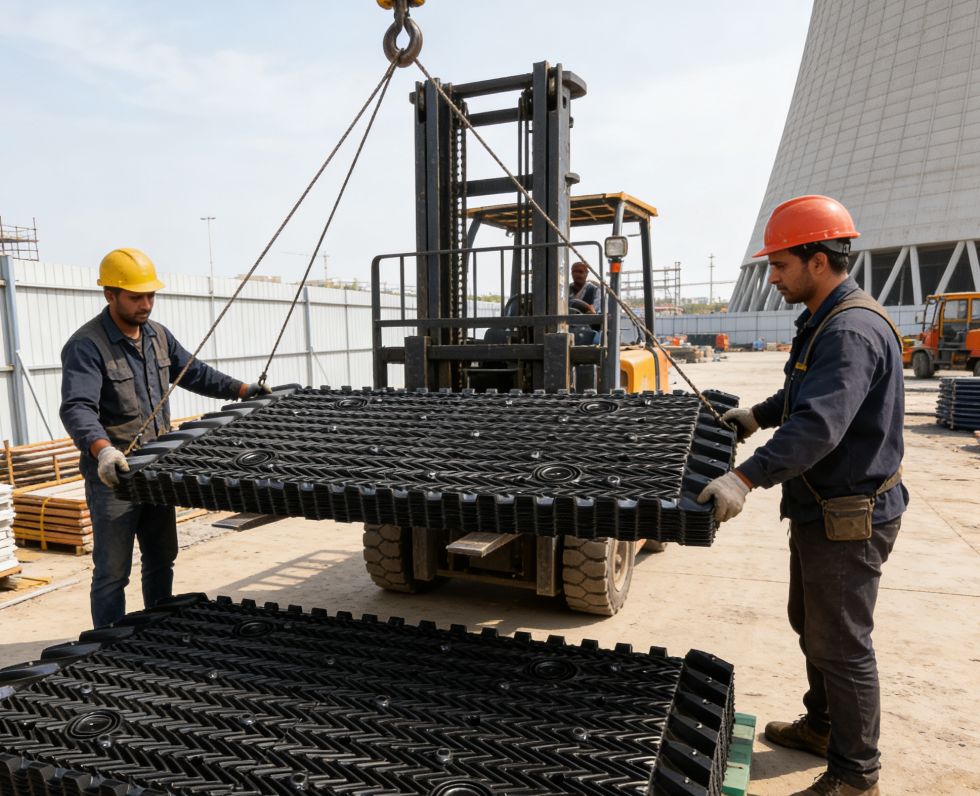
Film fill cooling tower systems use structured sheets designed to spread water into a thin film. This design increases the contact area between water and air, supporting efficient heat transfer.
The principle is straightforward. The larger the effective contact surface, the greater the opportunity for heat exchange. For this reason, film fill is widely used in many industrial cooling towers operating with relatively clean water.
Modern cooling tower fill media often incorporates corrugated surfaces that encourage uniform water distribution while maintaining airflow through the fill pack.
The structured surface encourages water to spread across a larger area. This helps maximize exposure to airflow and supports stable cooling performance.
Film fill systems often achieve required cooling performance within a relatively compact space. This can be useful where tower dimensions are limited.
Because of its effectiveness under suitable conditions, film fill remains a common solution across many industrial sectors.

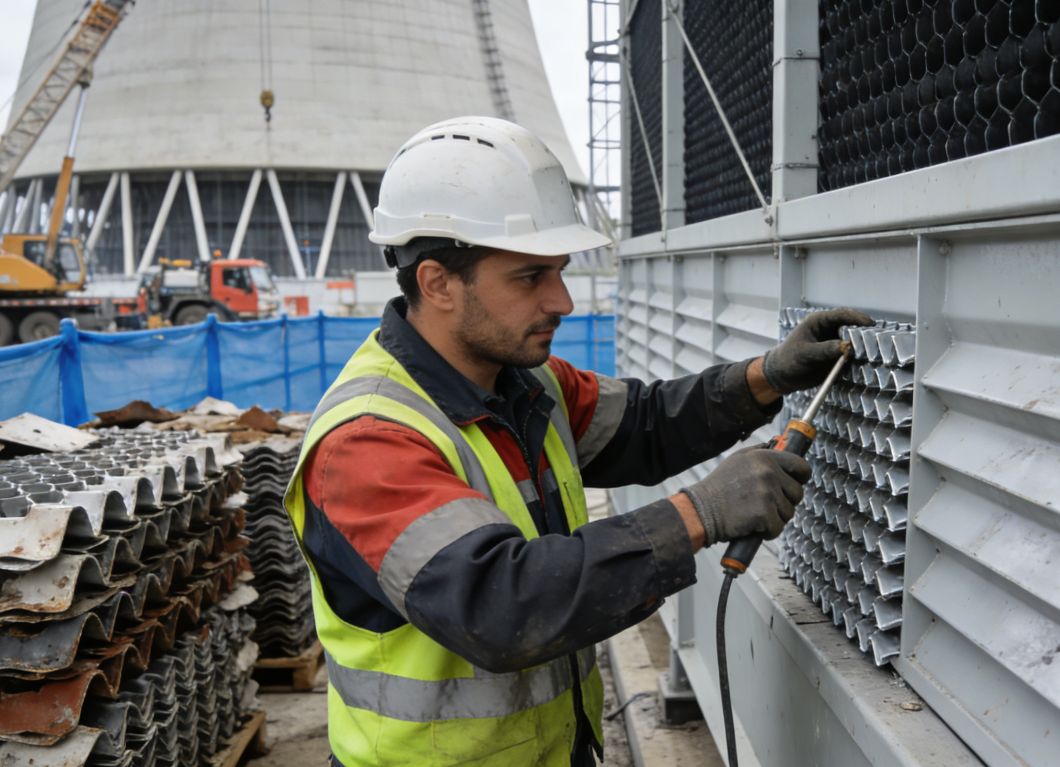
The narrow flow passages that contribute to heat transfer can also trap suspended solids. Over time, deposits may restrict water flow and airflow.
Biofilm, algae, and slime can develop inside fill channels. Once biological growth begins, it often captures additional debris and accelerates fouling.
In challenging water conditions, maintenance intervals may become shorter because the fill requires more frequent inspection and cleaning.
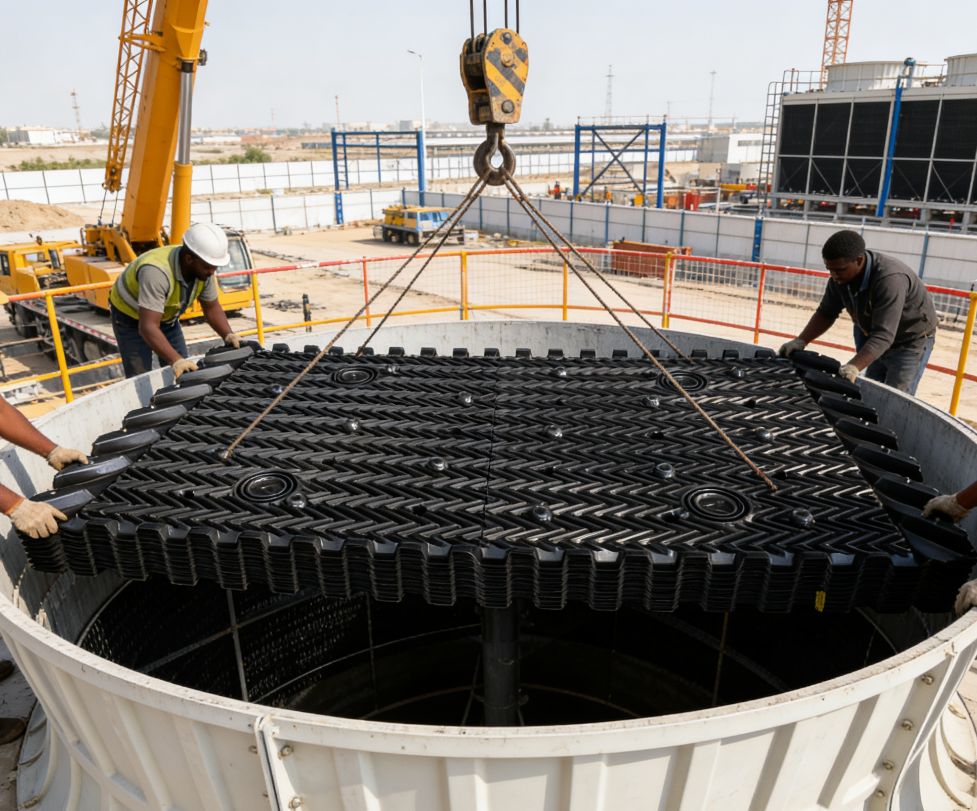
Tower fill configured as splash fill operates differently. Instead of spreading water into a continuous film, splash fill breaks water into droplets as it passes through a series of splash bars, grids, or support elements.
The objective is to increase surface area through repeated droplet formation and turbulence.
Because splash fill typically has larger open spaces, it often handles contaminated water better than tightly packed film fill systems.
Large open passages allow dirt, fibers, and solids to pass through more easily, reducing blockage risk.
Splash fill cooling tower systems are commonly selected for industrial operations where water quality cannot be tightly controlled.
Although fouling can still occur, splash fill generally provides more tolerance before performance is significantly affected.
Open structures are often easier to inspect and clean during routine maintenance activities.
Depending on the cooling duty, splash fill systems may require greater fill volume to achieve comparable thermal performance.
Cooling behavior differs from film fill systems, and tower design must account for those differences.
This does not mean splash fill performs poorly. It simply means that system design should match operating requirements.
In a manufacturing facility located in Southeast Asia, operators experienced recurring fouling inside an existing film fill system. The circulating water contained organic contaminants and seasonal biological growth.
Maintenance teams cleaned the fill regularly, but deposits returned quickly.
After evaluating operating conditions, engineers selected a splash-style arrangement more suitable for the site's water quality. The new configuration reduced maintenance frequency and provided more stable operation during humid weather conditions.
The lesson from this project was simple: water quality should influence fill selection from the beginning.
A textile plant operated with water containing fine fibers and suspended particles.
The original film fill system delivered acceptable cooling performance initially, but fouling became increasingly difficult to manage.
After reviewing maintenance records, engineers recommended transitioning to a splash fill cooling tower arrangement.
The change did not eliminate maintenance, but it reduced clogging pressure and helped the tower maintain more consistent operation.
In a heavy industrial environment, airborne dust entered the cooling tower despite filtration efforts.
The facility improved intake protection using Air Inlet Louvers, Air Inlet Grilles, and Air Intake Screens.
Combined with a more tolerant fill arrangement, the tower experienced fewer contamination-related interruptions.
This project highlighted the importance of viewing fill selection as part of a complete tower strategy rather than an isolated decision.
This is usually the most important factor.
If routine inspection and cleaning can be performed consistently, film fill may remain practical under certain conditions.
If maintenance opportunities are limited, a more tolerant splash design may be beneficial.
Cooling objectives, available space, and operating temperatures should all be considered when evaluating fill options.
The best fill choice is often the one that remains practical over years of operation rather than the one that appears most attractive during initial selection.
PVC cooling tower fill is commonly used in many industrial towers and can support both film and splash configurations depending on the design.
Material selection should always consider temperature, water chemistry, and operating conditions.
PP cooling tower fill is often considered where higher temperatures or more aggressive chemical environments exist.
As with any material, suitability depends on the actual application rather than a general preference.
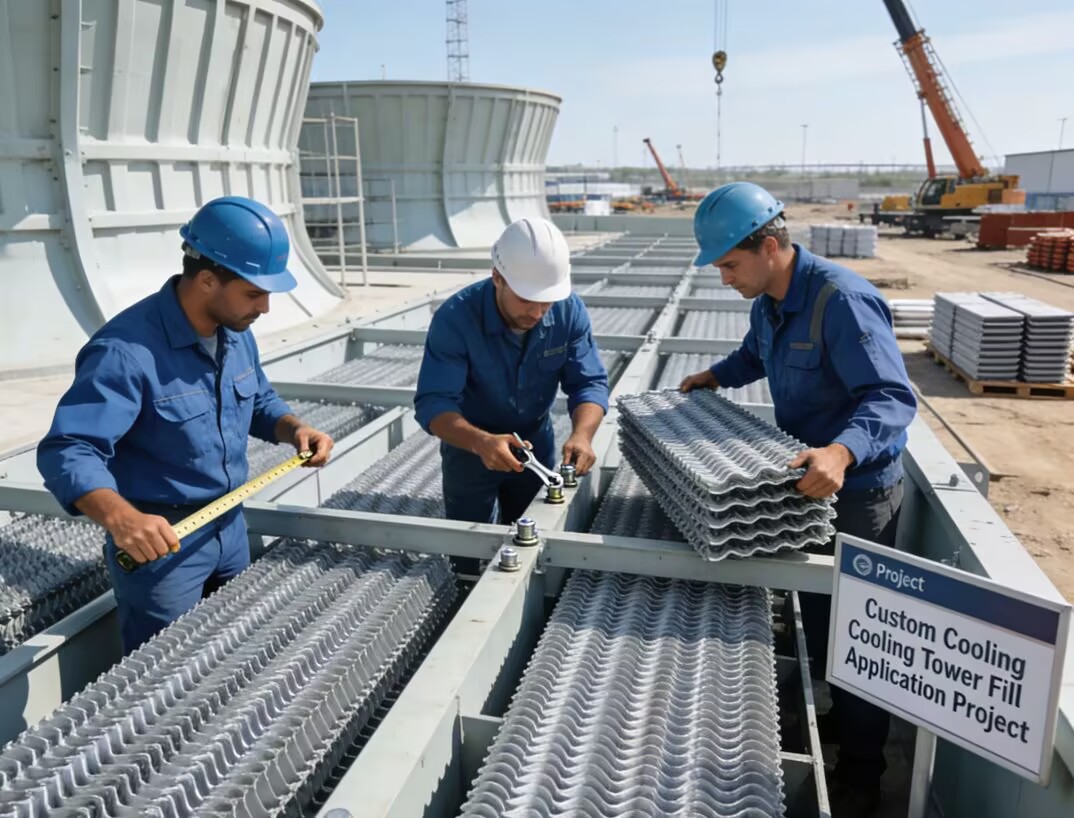
Fill selection should be supported by proper tower components.
These components help manage airflow, water carryover, and contamination entry, contributing to more stable operation.
Many long-term performance issues can be reduced through consistent inspection and preventive maintenance.
There is no universal answer to whether film fill or splash fill is better. The correct choice depends on water quality, maintenance capability, operating conditions, and long-term objectives.
For relatively clean water systems, film fill cooling tower designs often provide effective thermal performance. For dirty water applications containing suspended solids, fibers, or biological contamination, splash fill cooling tower systems frequently offer greater operating tolerance.
The most successful projects are usually those where fill selection reflects actual site conditions rather than assumptions. Matching the fill design to the water environment helps support reliable cooling performance and manageable maintenance requirements over time.
Splash fill is often preferred because its open structure is more tolerant of suspended solids and contamination.
Yes, but additional attention to water treatment and maintenance may be required to reduce fouling and clogging.
No. Splash fill can reduce sensitivity to contamination, but routine inspection and cleaning remain important.
Suspended solids, biological growth, and scale deposits can accumulate within narrow flow channels.
No. Water quality, maintenance capability, operating conditions, and long-term reliability should also be considered.
We are professional cooling tower fills manufacturer, which can supply wide ranges of cooling tower fills with PVC, PP or CPVC materials.
The brake oil pipes we provide have multiple monitoring certifications and complete compliance documents to help your business smoothly enter the global market.
Fully automated production line, supporting individual customization. Combined with just-in-time logistics solutions, ensuring stable inventory.
A professional foreign trade technical team provides rapid response and is a trustworthy partner, offering everything from technical Q&A to market insights.

The cooling tower fill from this company has performed reliably in our systems. We appreciate the consistent quality and noticeable efficiency improvement.
CEO & Founder

As a CEO, I value partners who deliver on their promises. Their cooling tower fill is a solid product that contributes to stable operations.
CEO & Founder

We are satisfied with the performance of this cooling tower fill. It has integrated well into our existing setup with good results.
Manager

This company provides quality cooling tower fill that meets our operational needs. It's a dependable component in our infrastructure.
CEO & Founder

We are professional cooling tower fills manufacturer, which can supply wide ranges of cooling tower fills with PVC, PP or CPVC materials.

Instant Chat Support
+8615303180686
packingesale@gmail.com
Get the latest information
Scan the code to follow
Return to the top of the page