I have spent more time in Southeast Asia than I can count. Bangkok, Jakarta, Ho Chi Minh City, Manila, Kuala Lumpur. The one thing every cooling tower operator in this region struggles with is the same: heat and humidity. When the ambient wet-bulb temperature stays high year-round, your cooling tower has to work much harder to achieve the same results.
Selecting the right High-Efficiency Cooling Tower Media is not just about picking a product off a catalog. It requires understanding your specific operating conditions, water quality, and long-term maintenance capabilities. Let me walk you through what actually works in Southeast Asian conditions.
Most cooling tower design standards were developed in temperate climates. When you take those designs and install them in Bangkok or Jakarta, the real-world performance often falls short of expectations. The reason is simple: cooling towers reject heat by evaporating water into the air stream. When the incoming air is already hot and humid, the driving force for evaporation is reduced.
In practical terms, a cooling tower that achieves a seven-degree approach to wet-bulb temperature in a temperate climate might only achieve a four or five-degree approach in Southeast Asian conditions. This means your leaving water temperature is higher than design, which directly impacts chiller efficiency and overall plant energy consumption.
The solution is not to buy a larger cooling tower. The solution is to optimize the cooling tower fill for the specific conditions you actually face.
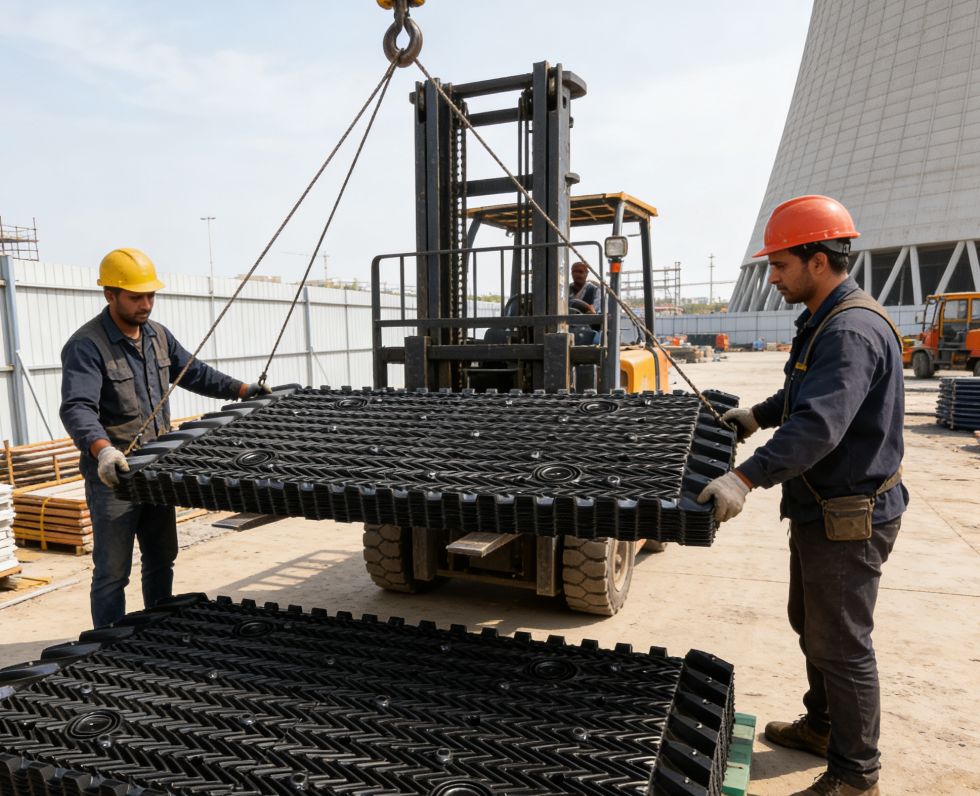
Film fill cooling tower media is designed to spread water into thin films across the fill surface, maximizing water-air contact area. In clean water applications, film fill offers superior heat transfer efficiency compared to traditional splash fill. However, tropical climates present unique challenges for film fill.
High humidity reduces evaporative cooling potential, which means you need more heat transfer surface area to achieve the same cooling effect. Modern high-density film fill with increased flute density can provide that additional surface area without requiring a larger tower footprint.
I have seen film fill installations in Thailand that achieved cooling improvements of fifteen to twenty percent compared to the old splash fill they replaced. The key was selecting the right flute geometry and material for the specific water chemistry.
But film fill is not always the answer. In applications with poor water quality, high suspended solids, or significant biological growth potential, film fill can become fouled quickly. The narrow gaps between fill sheets trap sediment and biofilm, leading to increased pressure drop, reduced airflow, and eventually, cooling performance that is worse than the old splash fill.
This is why water quality testing is essential before selecting film fill for any Southeast Asian application.
Splash fill breaks water into droplets through successive layers of splash bars. It is less efficient per unit volume than film fill, but it is much more tolerant of fouling and biological growth. If your cooling tower operates with recirculated water that has visible turbidity or if you have struggled with biofilm in the past, splash fill might be your best option.
I worked with a food processing plant in Indonesia that had terrible water quality. Their recirculated water was full of organic matter from the production process, and they were replacing their cooling tower fill every eighteen months because of fouling. We switched them from standard film fill to a high-performance splash fill design, and the fill life extended to more than five years. Yes, the cooling efficiency was slightly lower, but the reduction in maintenance costs and downtime more than made up for it.
Splash fill is particularly well-suited for:
Heat and UV exposure are major factors in cooling tower fill life in Southeast Asia. Standard PVC fill is suitable for many applications, but it has limitations.
PVC performs well up to about fifty degrees Celsius. In most Southeast Asian cooling tower applications, water temperatures stay within this range. However, PVC is susceptible to UV degradation if exposed to direct sunlight. For this reason, cooling tower fill should always be shaded by the tower casing or by covers during installation. UV-stabilized PVC formulations are available and recommended for outdoor installations.
PVC also has limitations in high-temperature applications. If your process water regularly exceeds fifty-five degrees, PVC fill can soften and deform. In these cases, polypropylene fill is a better choice.
Polypropylene fill offers superior high-temperature resistance, withstanding sustained temperatures up to eighty degrees Celsius in many formulations. PP also has excellent chemical resistance and is less prone to degradation in aggressive water chemistries.
The trade-off is higher material cost. But in high-temperature applications or facilities with aggressive water treatment chemistries, the longer life of PP fill often justifies the higher upfront investment.
For Southeast Asian installations, I generally recommend:
Fouling is the number one cause of cooling tower fill failure in Southeast Asia. Between suspended solids, biological growth, and scaling from hard water, the conditions are ideal for fill degradation.
Even minimal fouling can have a significant impact on cooling performance. Research has shown that mineral scale layers of less than half a millimeter can reduce heat transfer efficiency by ten percent or more. As fouling accumulates, the effect compounds.
Here is what I recommend to minimize fouling in Southeast Asian cooling towers:
Proper water treatment is the single most important factor in cooling tower fill life. This includes:
Facilities that skimp on water treatment always end up paying more in fill replacement costs and energy penalties from fouled fill.
Air intake louvers and screens are often overlooked, but they play a critical role in keeping cooling tower fill clean. Without proper air intake screens, airborne debris, insects, and dust can enter the cooling tower and accumulate in the fill.
I have seen cooling towers in industrial areas where the fill was completely clogged with manufacturing dust and debris within two years because the plant had inadequate air intake louvers. Installing proper air intake screens and louvers is a low-cost investment that pays for itself quickly through extended fill life.
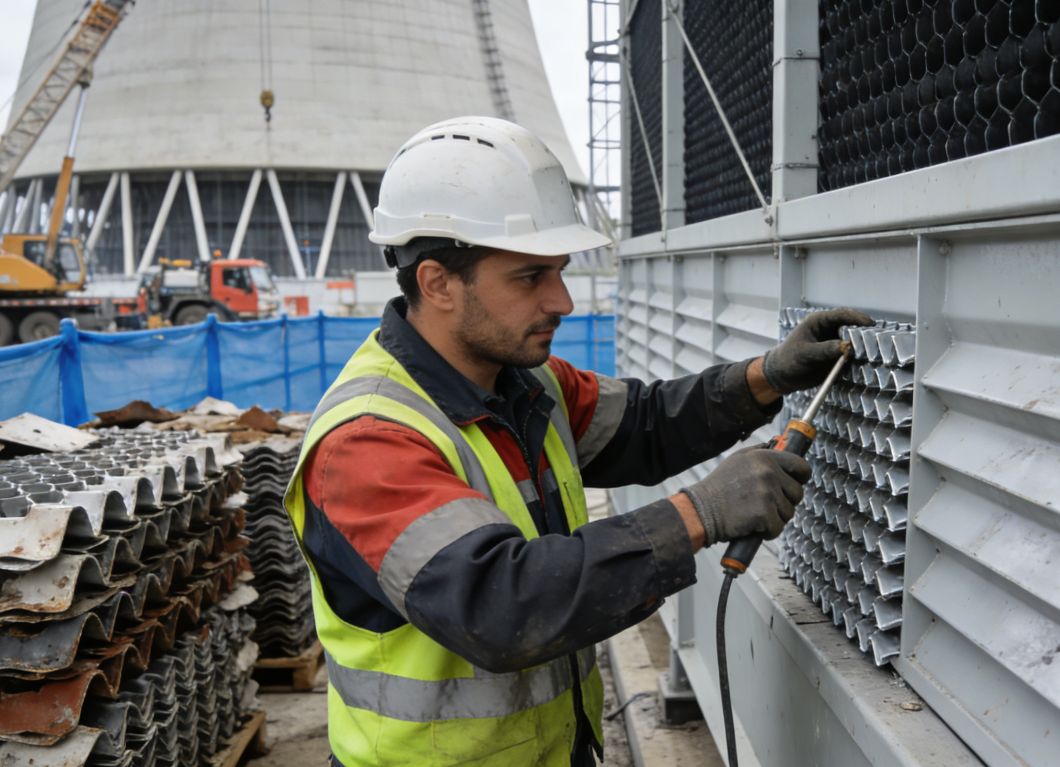
Even with good water treatment and air intake protection, cooling tower fill requires periodic inspection and cleaning. The frequency depends on operating conditions, but a visual inspection every six months is a good baseline.
Look for signs of fouling, scaling, biological growth, or physical damage. If you see significant deposits, schedule a cleaning before performance degrades further. Professional fill cleaning services are available in most Southeast Asian industrial areas.
A large beverage manufacturer in Thailand was struggling with cooling tower performance. Their fill was more than eight years old and heavily fouled. The outlet water temperature was consistently four degrees above design, and the chiller plant was running at reduced efficiency.
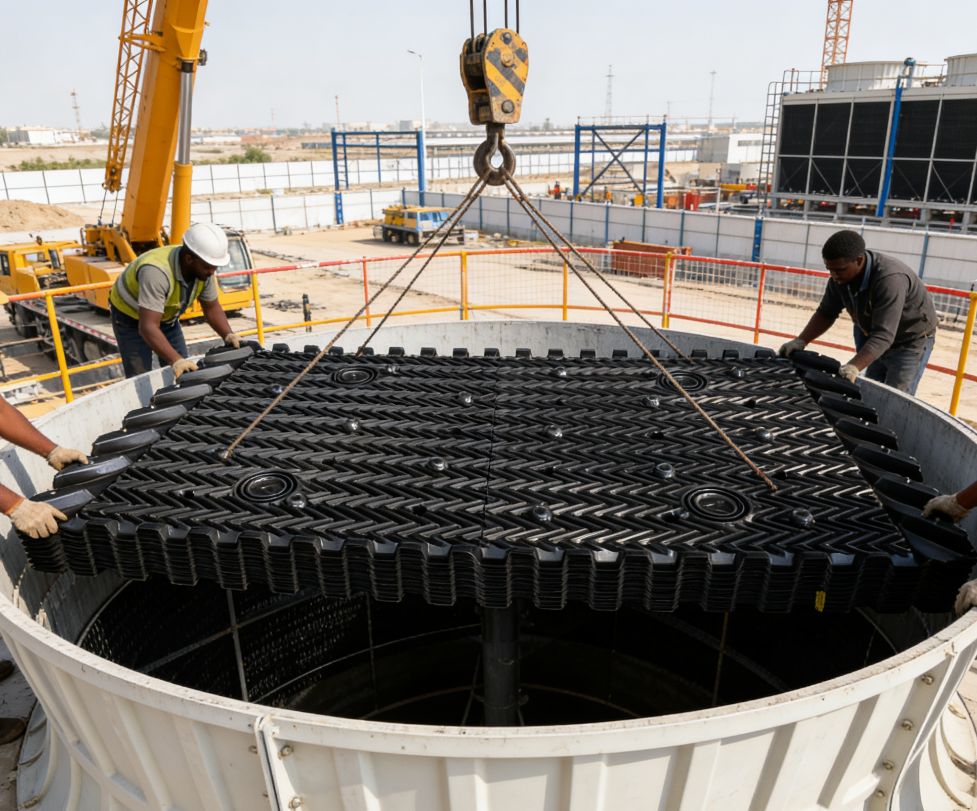
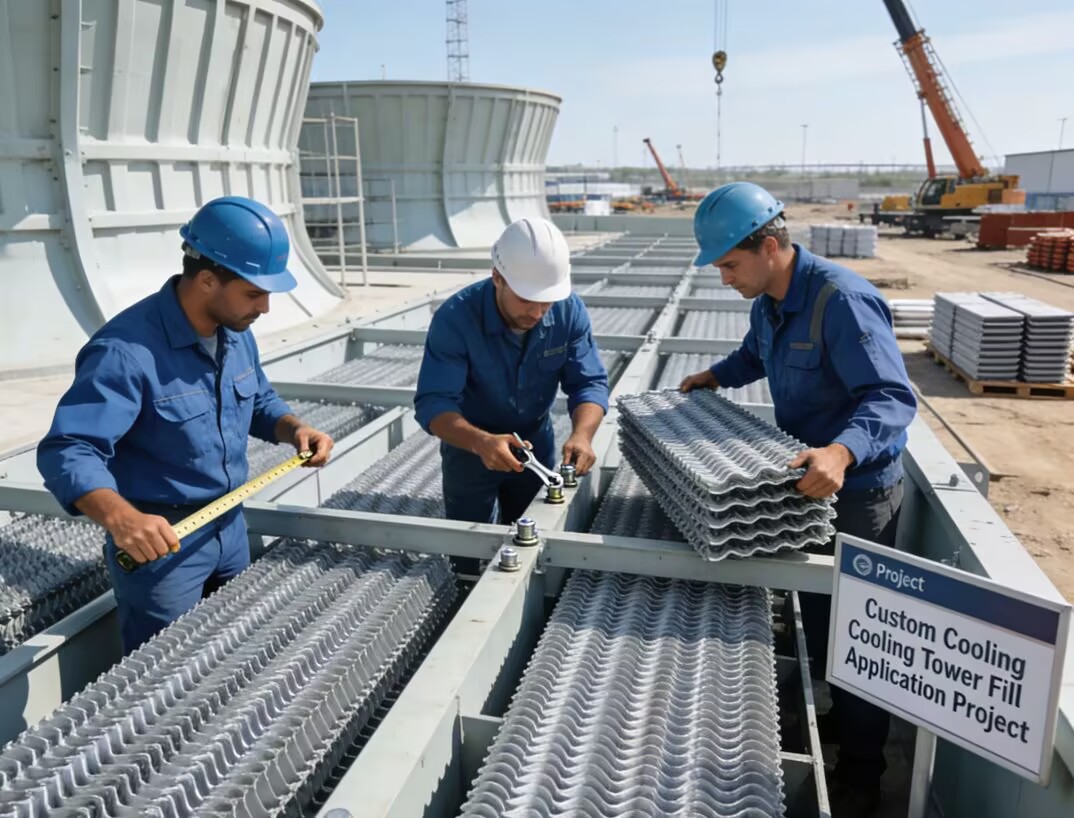
We recommended a complete fill replacement using high-density PVC film fill with UV stabilizers. The installation was completed during a scheduled maintenance shutdown, taking just three days. After startup, the outlet water temperature dropped by nearly four degrees, and the facility reported monthly electricity savings of over fifty thousand Thai baht.
The payback period for the fill replacement was less than one year.
An Indonesian power plant had been running with the same cooling tower fill for nearly a decade. The fill sheets were warped, many were cracked, and the overall heat transfer performance had degraded significantly. The plant was struggling to maintain full generating capacity during peak summer months.
We replaced their old fill with new polypropylene film fill designed for high-temperature operation. The new fill restored cooling performance to better than original design, and the plant was able to ramp production back to full capacity. The fill replacement cost was less than ten percent of what a new cooling tower would have cost.
When you are selecting a cooling tower fill manufacturer for Southeast Asian conditions, look for several key qualifications:
The right cooling tower fill manufacturer will not just sell you a product. They will help you assess your operating conditions, recommend the optimal fill type and material, and provide guidance on installation and ongoing maintenance.
Let me be direct about cost. The cheapest cooling tower fill is rarely the most economical choice. I have seen too many customers buy low-cost fill only to replace it two years later, paying twice for the same cooling performance.
When evaluating cooling tower fill options, consider the total cost of ownership:
In most applications, spending twenty to thirty percent more for higher-quality cooling tower fill is justified by longer life and better performance. The energy savings alone often pay for the quality upgrade within the first two years.
For a typical industrial cooling tower, a high-efficiency fill upgrade can reduce chiller energy consumption by ten to fifteen percent. On a large chiller plant, that translates to hundreds of thousands of dollars in annual savings.
Under good operating conditions with proper water treatment, quality cooling tower fill should last five to seven years in Southeast Asian climates. In harsh conditions with poor water quality or high temperatures, expect three to five years. Annual inspections will help you determine when replacement is needed.
Yes, in many cases cooling tower fill can be cleaned and reused. Professional cleaning services use high-pressure water and chemical treatments to remove scale, biofilm, and deposits. However, if the fill is physically degraded, warped, or cracked, cleaning will not restore performance and replacement is necessary.
Polypropylene is the best choice for sustained high-temperature operation. PP fill can withstand water temperatures up to eighty degrees Celsius without deformation. For standard applications below fifty degrees, PVC is sufficient and more economical.
To summarize, here is my practical advice for cooling tower fill selection in Southeast Asia:
Cooling tower fill is not a set-it-and-forget-it component. With proper selection and maintenance, it will deliver years of reliable service. Choose poorly or neglect maintenance, and you will pay the price in higher energy bills and unplanned downtime.
If you are planning a cooling tower fill replacement or new installation in Southeast Asia, I encourage you to contact us. We have extensive experience across the region and can help you select the optimal cooling tower media for your specific conditions.
Tropical climates demand specialized cooling tower fill solutions. Our engineering team has extensive experience across Thailand, Indonesia, Vietnam, Philippines, and Malaysia. We can help you select the optimal fill media for your water quality, operating temperature, and maintenance capabilities.
Contact Us Here →We are professional cooling tower fills manufacturer, which can supply wide ranges of cooling tower fills with PVC, PP or CPVC materials.
The brake oil pipes we provide have multiple monitoring certifications and complete compliance documents to help your business smoothly enter the global market.
Fully automated production line, supporting individual customization. Combined with just-in-time logistics solutions, ensuring stable inventory.
A professional foreign trade technical team provides rapid response and is a trustworthy partner, offering everything from technical Q&A to market insights.

The cooling tower fill from this company has performed reliably in our systems. We appreciate the consistent quality and noticeable efficiency improvement.
CEO & Founder

As a CEO, I value partners who deliver on their promises. Their cooling tower fill is a solid product that contributes to stable operations.
CEO & Founder

We are satisfied with the performance of this cooling tower fill. It has integrated well into our existing setup with good results.
Manager

This company provides quality cooling tower fill that meets our operational needs. It's a dependable component in our infrastructure.
CEO & Founder

We are professional cooling tower fills manufacturer, which can supply wide ranges of cooling tower fills with PVC, PP or CPVC materials.

Instant Chat Support
+8615303180686
packingesale@gmail.com
Get the latest information
Scan the code to follow
Return to the top of the page