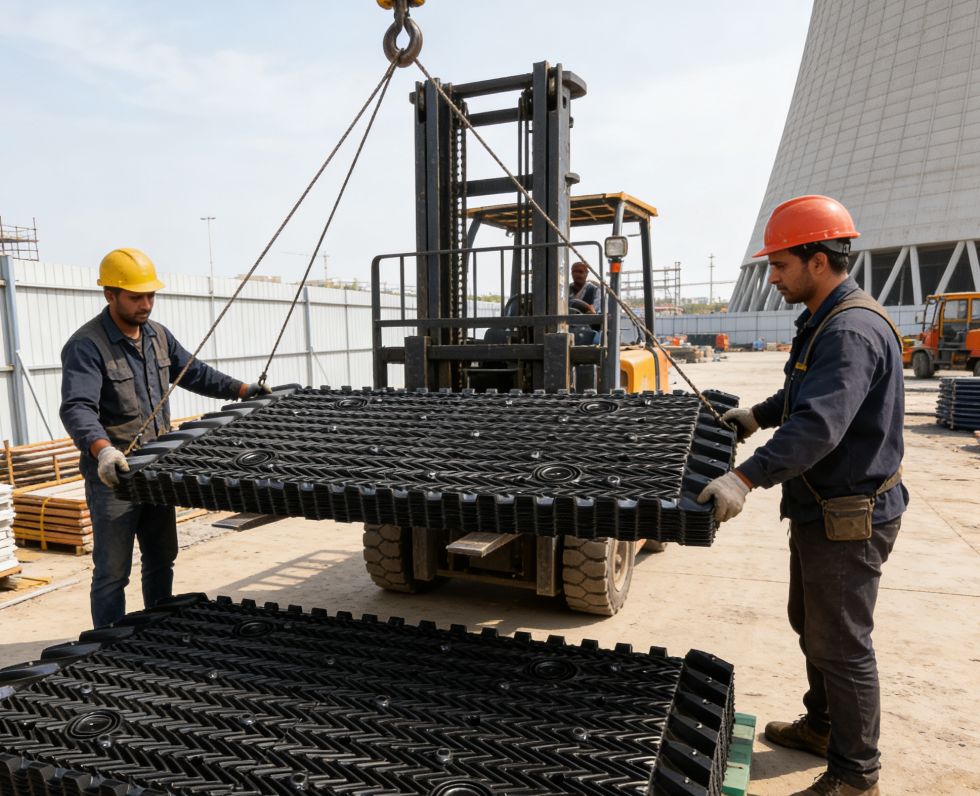
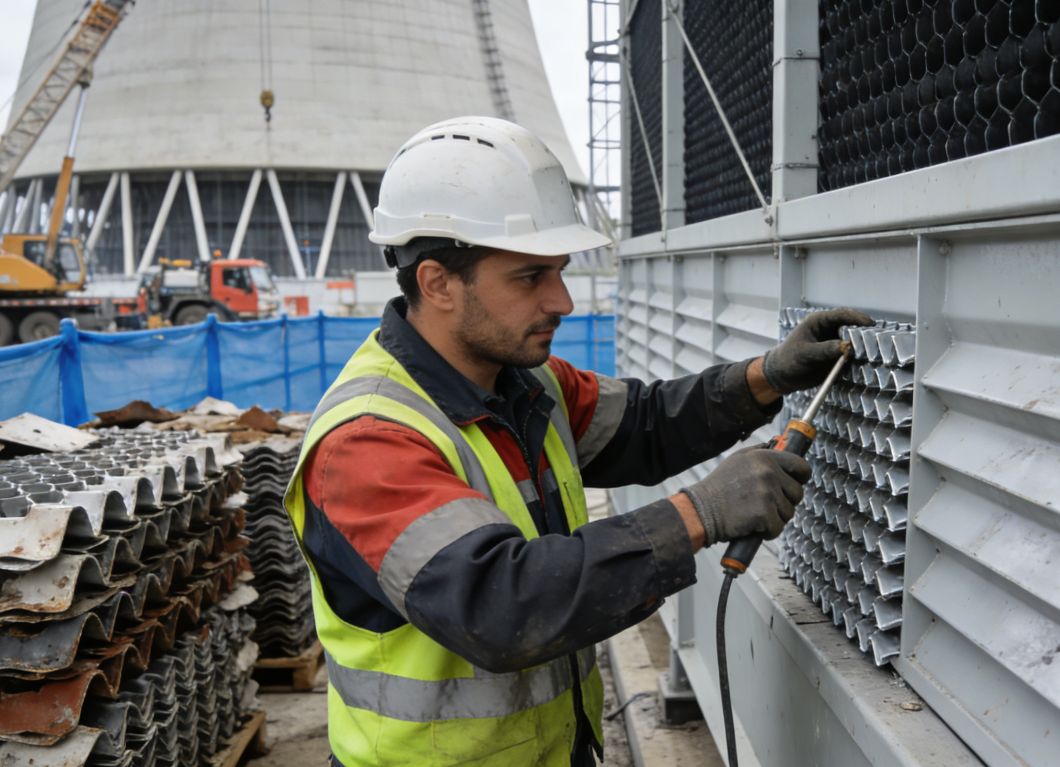
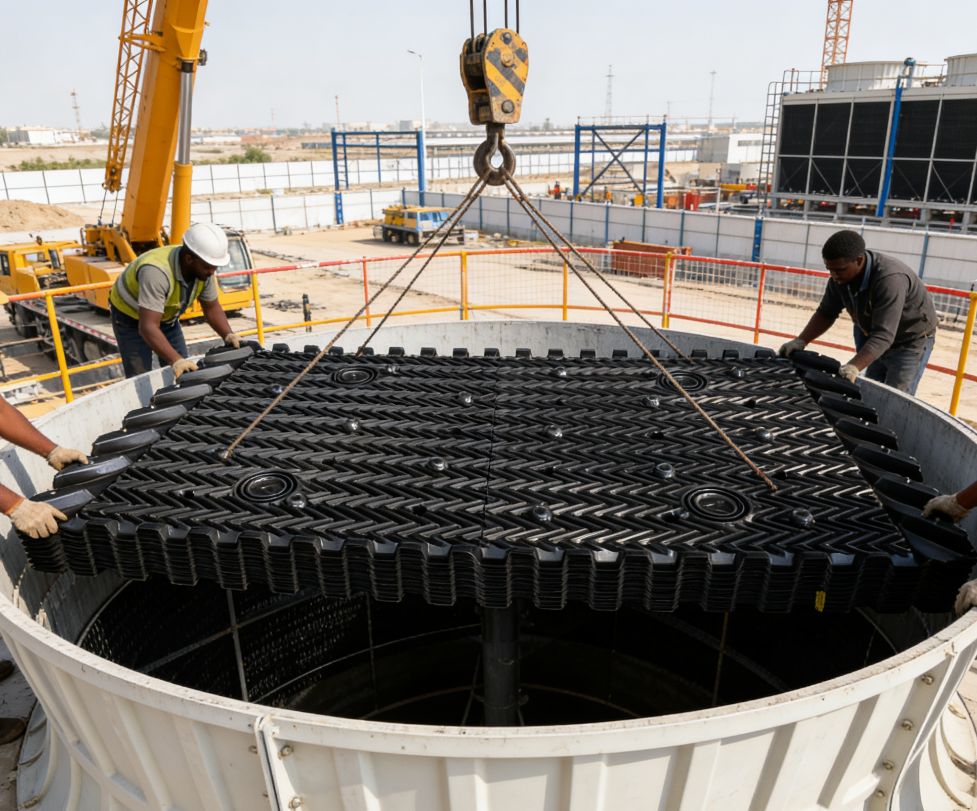
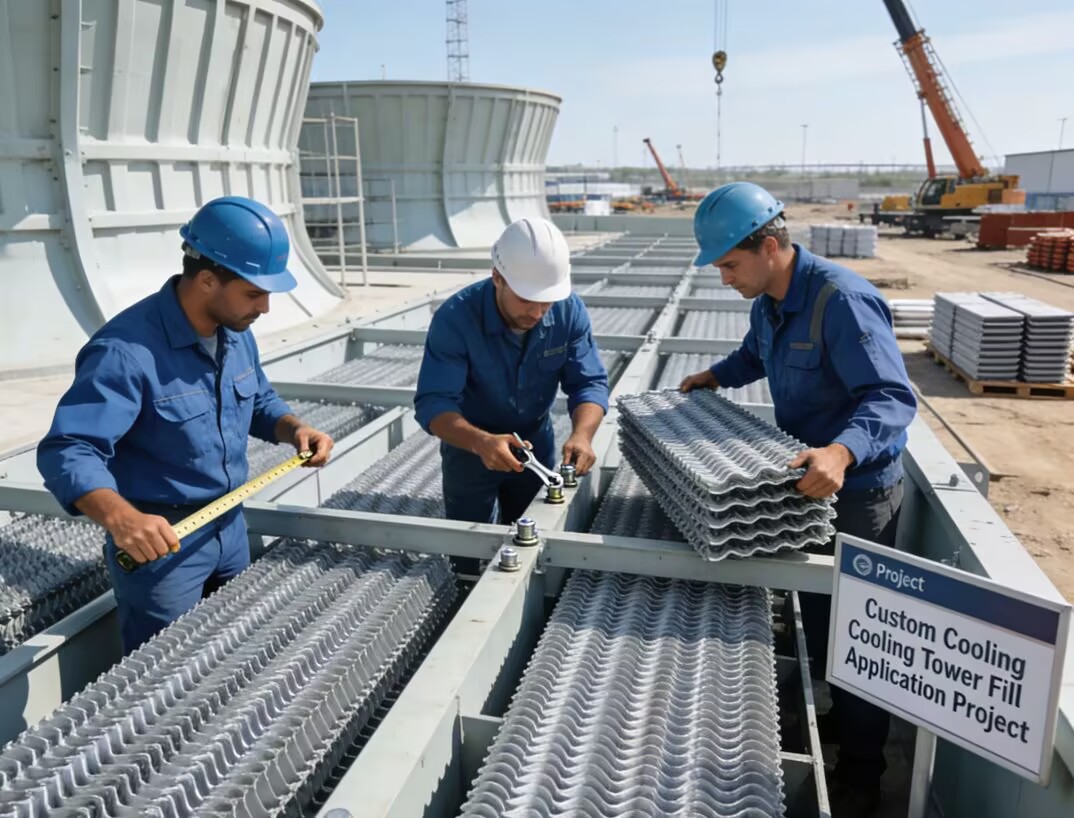
Cooling tower fill technology has continued to develop as industrial facilities require more stable and efficient cooling solutions. Among different fill structures, film fill cooling tower designs are widely applied in many industrial systems because they provide a large contact area between water and air.
In Southeast Asia, the Middle East, and East Asia, engineers often select fill solutions based on actual operating conditions rather than simply choosing the highest heat transfer design. Water quality, maintenance capability, temperature range, and tower structure all influence the final decision.
This article explains how film fill technology works, where it is suitable, and what engineers should consider when selecting cooling tower fill media for modern industrial applications.
A film fill cooling tower uses specially formed sheets to create a continuous water film across the surface of the fill media.
Unlike splash-type structures that break water into droplets, film fill relies on surface spreading to increase the contact area between water and air.
The main purpose of film fill design is to:
The internal structure of film fill contains multiple channels created through forming and bonding processes.
During operation:
The performance of the system depends on the relationship between surface design, water distribution, and airflow movement.

Film fill structures create extensive contact surfaces where water and air interact.
This helps improve cooling performance when operating conditions are suitable.
A well-designed surface pattern helps spread water evenly across the fill area.
Uniform wetting reduces dry zones and supports consistent cooling performance.
Because film fill provides efficient heat exchange through surface contact, some cooling systems can achieve required performance within limited space.
Crossflow systems allow air to move horizontally through the fill while water flows vertically downward.
This design is commonly used where easy maintenance access and visual inspection are important.
Counterflow systems use opposite movement directions between air and water.
The fill structure must maintain suitable airflow passages to achieve stable operation.
PVC film fill is commonly used in many industrial cooling applications because it provides stable forming characteristics and suitable chemical resistance under many operating environments.
The surface pattern and thickness selection influence the long-term performance of the fill structure.
PP cooling tower fill is often considered for systems requiring improved temperature resistance.
Material selection should always match actual operating conditions rather than being based on one single factor.
Film fill systems are commonly considered for applications with:
However, engineers should carefully evaluate water conditions before selecting narrow-channel fill designs.
One common concern is cooling tower fill clogged situations caused by suspended solids, biological growth, or mineral deposits.
Blocked channels reduce water flow distribution and may affect heat transfer performance.
Mineral deposits can gradually build on fill surfaces.
This changes the surface condition and reduces effective cooling area.
Even a suitable fill design requires proper nozzle operation and water distribution control.
Uneven water flow can reduce the overall performance of the cooling system.
A manufacturing plant in Southeast Asia upgraded its cooling tower system after production expansion increased cooling demand.
Engineers reviewed the existing tower structure, water quality, and operating conditions before selecting a new film fill solution.
The improved configuration provided more stable cooling performance during changing production loads.

An industrial facility in a high-temperature region required reliable operation during long summer periods.
The engineering team focused on selecting suitable fill material and maintaining airflow balance.
The final solution improved operational consistency under demanding conditions.
A precision manufacturing facility required stable cooling conditions to support continuous production.
Engineers evaluated water quality, fill structure, and maintenance requirements together.
The selected film fill cooling tower configuration helped maintain predictable operation.
Professional selection usually considers:
A film fill cooling tower uses structured sheets to spread water into thin films for heat transfer.
Film fill usually requires better water quality management because of its structured channels.
PVC and PP are common materials selected according to operating requirements.
Regular inspection, proper water treatment, and suitable maintenance help maintain performance.
Water quality, temperature conditions, maintenance practices, and operating environment all influence service life.
We are professional cooling tower fills manufacturer, which can supply wide ranges of cooling tower fills with PVC, PP or CPVC materials.
The brake oil pipes we provide have multiple monitoring certifications and complete compliance documents to help your business smoothly enter the global market.
Fully automated production line, supporting individual customization. Combined with just-in-time logistics solutions, ensuring stable inventory.
A professional foreign trade technical team provides rapid response and is a trustworthy partner, offering everything from technical Q&A to market insights.

The cooling tower fill from this company has performed reliably in our systems. We appreciate the consistent quality and noticeable efficiency improvement.
CEO & Founder

As a CEO, I value partners who deliver on their promises. Their cooling tower fill is a solid product that contributes to stable operations.
CEO & Founder

We are satisfied with the performance of this cooling tower fill. It has integrated well into our existing setup with good results.
Manager

This company provides quality cooling tower fill that meets our operational needs. It's a dependable component in our infrastructure.
CEO & Founder

We are professional cooling tower fills manufacturer, which can supply wide ranges of cooling tower fills with PVC, PP or CPVC materials.

Instant Chat Support
+8615303180686
packingesale@gmail.com
Get the latest information
Scan the code to follow
Return to the top of the page