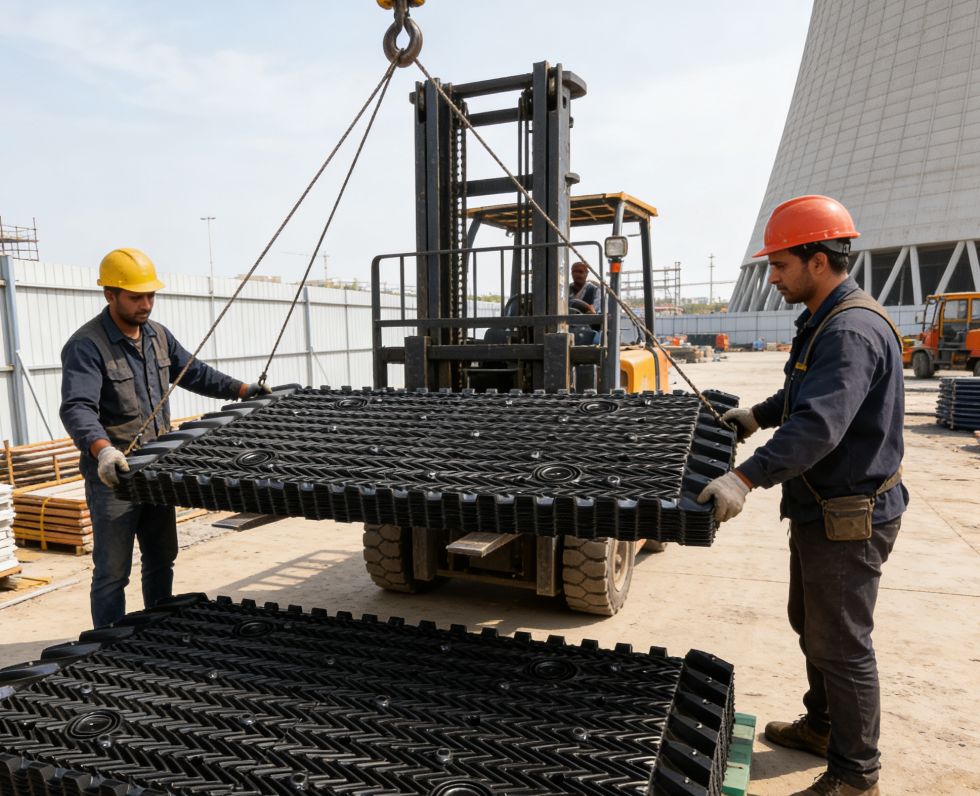
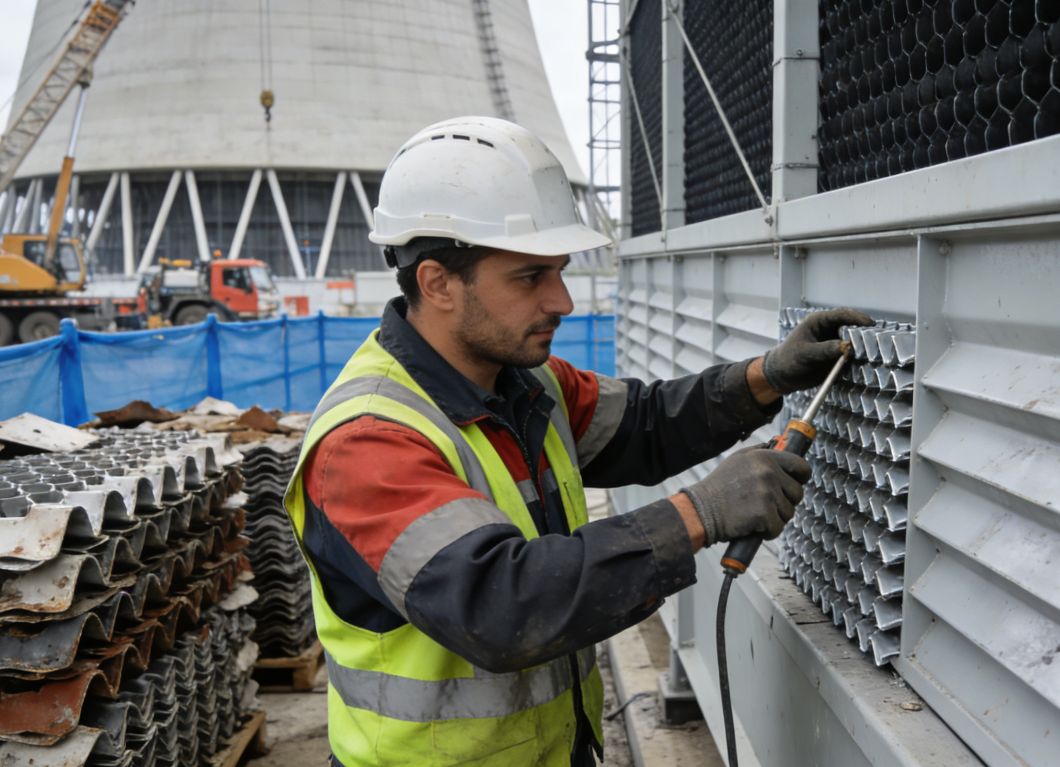
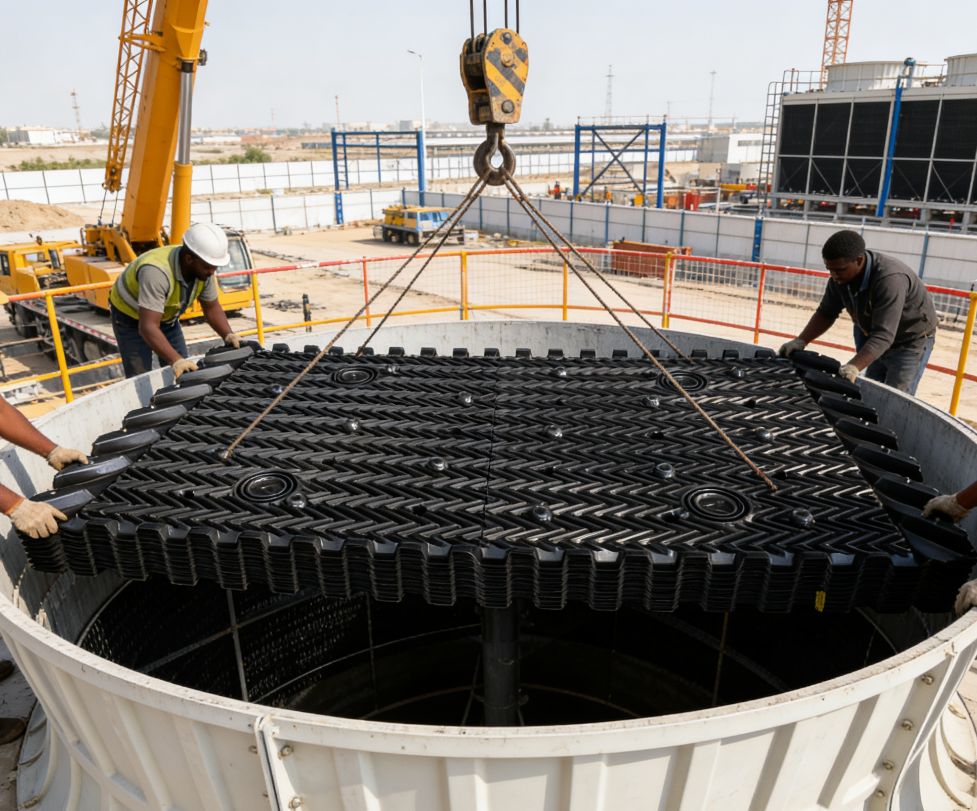
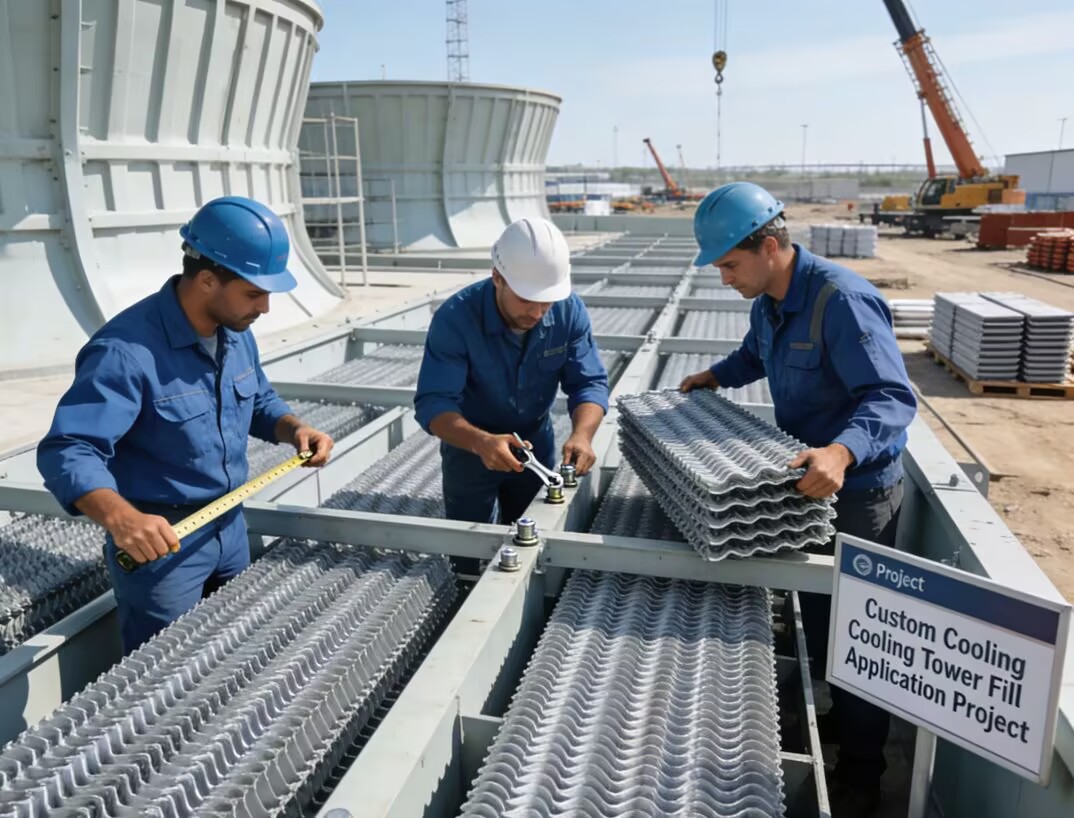
Cooling tower fill clogging is one of the most common but often underestimated problems in industrial cooling systems. It does not happen suddenly. In most real cases across Southeast Asia, the Middle East, and East Asia, clogging develops gradually and is only noticed when cooling efficiency has already dropped significantly.
Engineers often find that the system is still running, but the heat exchange capacity is already reduced due to internal blockage, uneven water flow, and restricted airflow inside the fill structure.
This article explains how clogging develops, what early signs to look for, and how to diagnose it before it becomes a serious operational issue.
Cooling tower clogging is not just physical blockage. It includes multiple performance-related issues such as:
Even a properly designed cooling tower fill can develop clogging over time depending on operating conditions.

Small particles in circulating water begin to attach to fill surfaces.
At this stage, performance change is usually not noticeable.
Deposits gradually build up inside narrow channels of the fill structure.
This leads to reduced water distribution efficiency and early signs of uneven cooling.
As blockage increases, airflow resistance rises inside the system.
Fan load may increase slightly without obvious mechanical issues.
At this stage, cooling efficiency becomes unstable and system operation may require load reduction.
Particles carried in circulating water gradually accumulate inside the fill structure.
This is one of the most common causes of long-term clogging.
Warm water environments support algae and biofilm formation.
This creates sticky layers that trap more particles over time.
Mineral deposits form solid layers on fill surfaces, reducing effective flow area.
Uneven water flow causes certain zones to become overloaded while others remain dry.
This imbalance accelerates localized clogging.

Film Fill Cooling Tower systems are highly efficient but more sensitive to clogging due to narrow flow channels and film-based heat transfer.
Tower Fill designs are generally more resistant to clogging because of their open structure and impact-based water breakup.
Cooling Tower Media selection plays a major role in how quickly clogging develops under real operating conditions.
A manufacturing facility experienced gradual cooling efficiency loss over one year without obvious equipment failure.
Inspection revealed internal clogging caused by suspended solids that entered the system through inconsistent filtration.
After improving filtration and cleaning fill sections, system performance stabilized.
An industrial cooling system operating in a dusty region showed rapid fouling inside the fill structure.
The main issue was airborne particles entering through insufficient air intake protection.
After upgrading air intake control and cleaning cycles, clogging rate decreased significantly.
A precision production plant experienced uneven clogging across different cooling tower zones.
Root cause analysis showed uneven water distribution rather than uniform system failure.
Correcting distribution balance improved cooling stability.
Engineers typically evaluate clogging conditions using:
Main causes include suspended solids, scaling, and biological growth.
Yes. It usually develops slowly over time.
Yes. It increases airflow resistance and fan load.
In many cases, yes if clogging is not too severe.
Splash-type fills are generally more resistant due to open structure.
We are professional cooling tower fills manufacturer, which can supply wide ranges of cooling tower fills with PVC, PP or CPVC materials.
The brake oil pipes we provide have multiple monitoring certifications and complete compliance documents to help your business smoothly enter the global market.
Fully automated production line, supporting individual customization. Combined with just-in-time logistics solutions, ensuring stable inventory.
A professional foreign trade technical team provides rapid response and is a trustworthy partner, offering everything from technical Q&A to market insights.

The cooling tower fill from this company has performed reliably in our systems. We appreciate the consistent quality and noticeable efficiency improvement.
CEO & Founder

As a CEO, I value partners who deliver on their promises. Their cooling tower fill is a solid product that contributes to stable operations.
CEO & Founder

We are satisfied with the performance of this cooling tower fill. It has integrated well into our existing setup with good results.
Manager

This company provides quality cooling tower fill that meets our operational needs. It's a dependable component in our infrastructure.
CEO & Founder

We are professional cooling tower fills manufacturer, which can supply wide ranges of cooling tower fills with PVC, PP or CPVC materials.

Instant Chat Support
+8615303180686
packingesale@gmail.com
Get the latest information
Scan the code to follow
Return to the top of the page