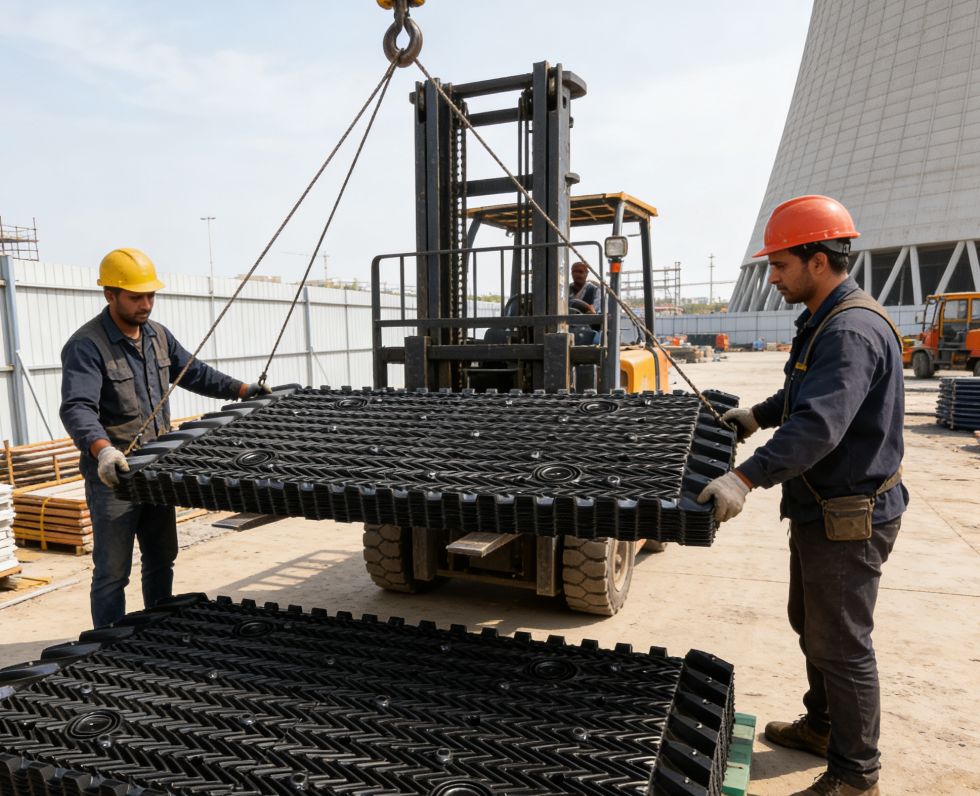
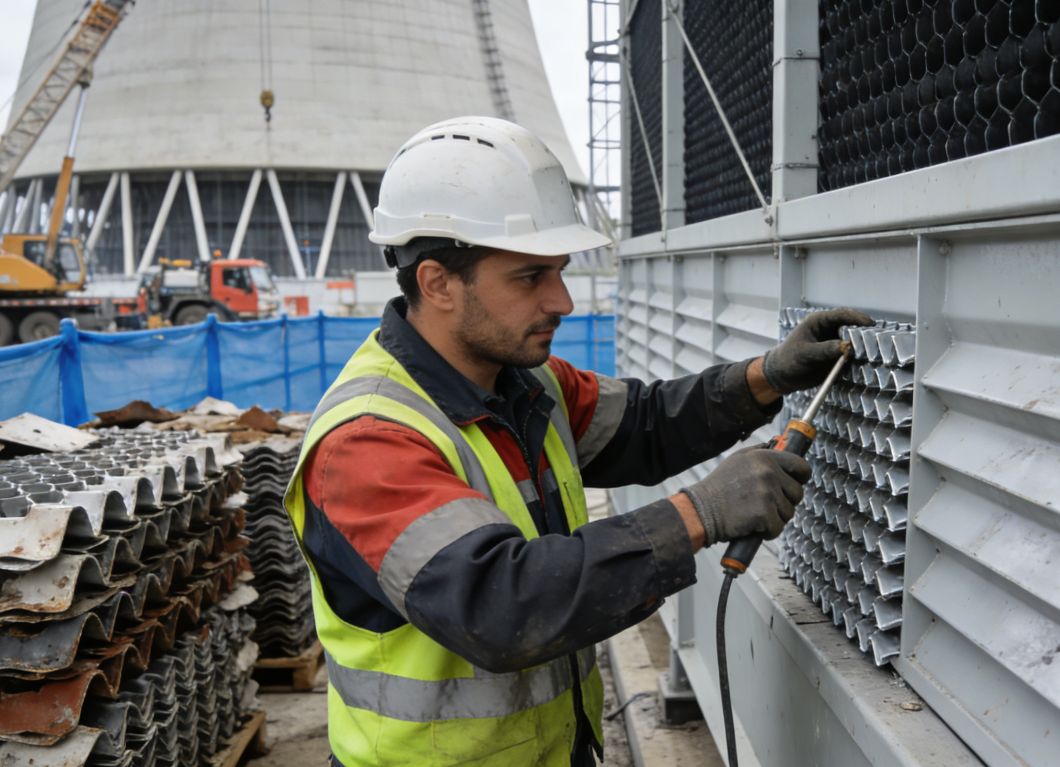
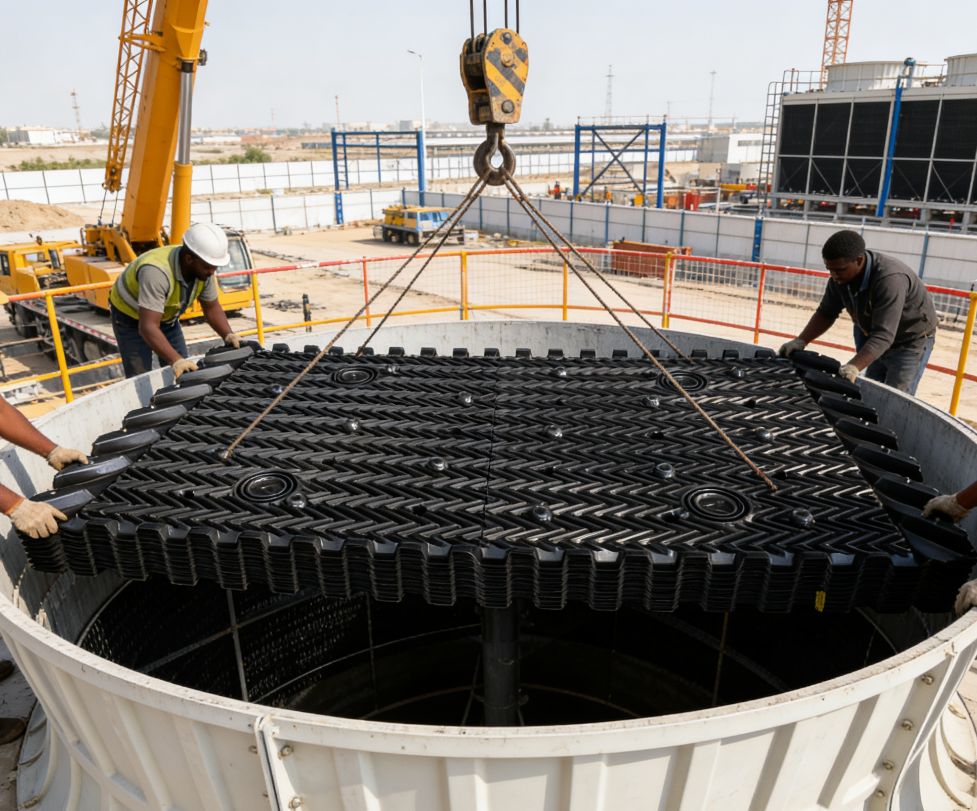
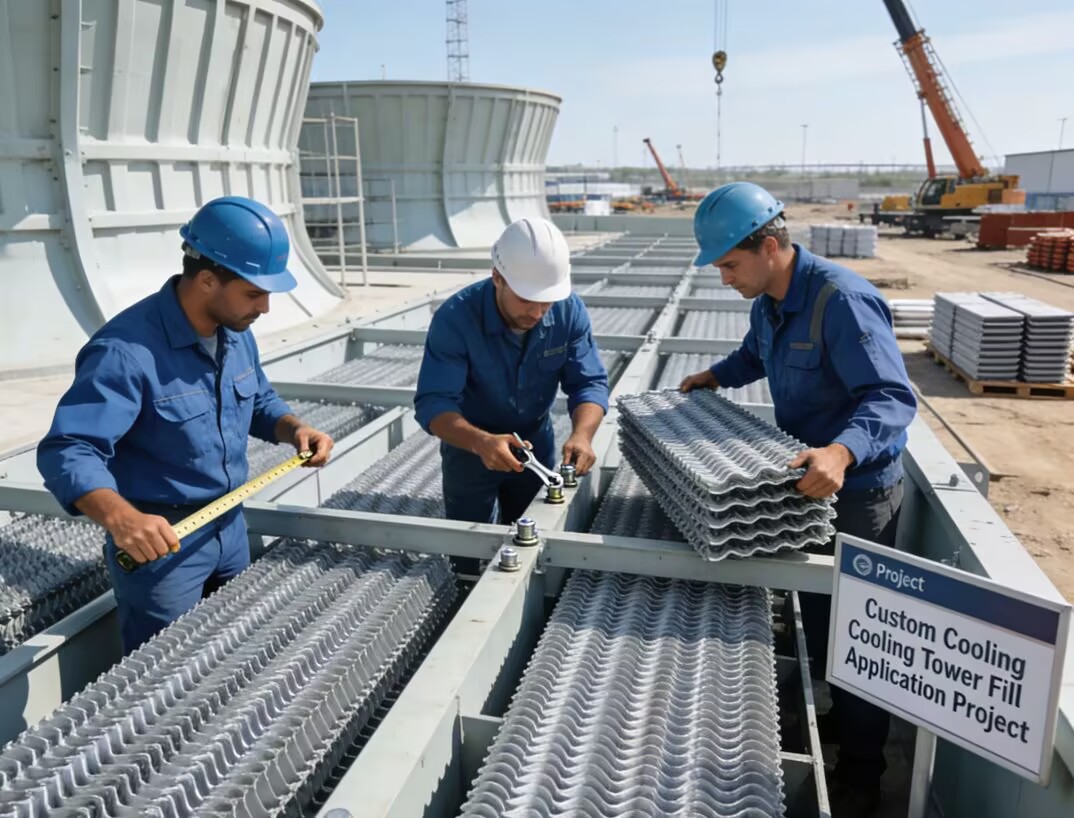
In many cooling tower projects, people spend most of their time choosing the fill and the fan, but the Cooling tower water collector is just as important. On site, this part is responsible for catching water droplets before they leave the tower with the exhaust air. Whether engineers call it water collector, drift eliminator, mist eliminator, or demister, the goal is the same: reduce water loss and keep the surrounding area dry and clean.
In Southeast Asia and Middle Eastern regions, where cooling towers often run under high temperature and high humidity, uncontrolled drift loss means higher water consumption and more corrosion risk around the tower structure. This is why experienced engineers always treat the water collector as a functional component, not just an accessory.

In counterflow cooling towers, hot saturated air moves upward and passes directly through the Cooling tower water collector. For this type, multi-pass blade structures are commonly used to force air to change direction several times. This helps capture fine droplets and reduce visible plume loss.
Crossflow towers discharge air horizontally. Here, the water collector must balance low airflow resistance with good droplet separation. Wider blade spacing is often chosen to avoid increasing fan load.
In power plants and petrochemical facilities, air volume is large and drift control standards are stricter. High-efficiency drift eliminator designs are usually required to meet environmental and water-saving regulations.
PVC is the most common material for Cooling tower water collector. It provides good corrosion resistance and stable shape under long-term wet conditions.
PP material is used when chemical resistance is more important, such as in wastewater treatment plants or chemical cooling systems.
FRP is selected for large industrial cooling towers where higher mechanical strength is required, especially in outdoor installations with strong wind load.
Multi-pass blade design forces air to change direction several times. Water droplets, due to inertia, hit the blade surface and fall back into the tower basin. This structure is widely used in modern mist eliminator systems.
Chevron-shaped blades increase the contact surface between air and blade walls. This improves capture efficiency without significantly increasing pressure drop.
Some demister designs use honeycomb channels to stabilize airflow while collecting moisture. This structure is more common in special industrial applications.
A properly designed Cooling tower water collector reduces drift loss and helps maintain stable water circulation. Less water escaping from the tower means lower makeup water consumption and fewer chemical losses.
It also protects nearby equipment and buildings from moisture damage. In many tropical installations, this directly reduces corrosion on steel structures and electrical systems.
Most water collector units are produced in standard panel sizes that fit common cooling tower designs. These modules are easy to replace during routine maintenance.
For special tower dimensions or airflow conditions, customized Cooling tower water collector based on drawings can be provided. Blade angle and spacing can be adjusted to achieve better separation efficiency.
Check for broken blades, deformation, or blockage. Accumulated dirt on mist eliminator surfaces can reduce separation efficiency.
Regular water washing removes scale and dust. In industrial environments, light chemical cleaning can be applied when needed.
When blades become brittle or heavily deformed, replacement should be planned instead of short-term repair to maintain stable performance.
The water collector works closely with other cooling tower components such as:

Do not only look at price. Low-cost collectors with poor blade design lead to higher water loss in long-term operation.
Material choice should match water chemistry and temperature. Blade thickness also affects service life.
Uneven installation of the Cooling tower water collector can create airflow shortcuts and reduce drift control efficiency.
The Cooling tower water collector plays a key role in reducing drift loss and protecting the surrounding environment. Proper material selection, structural design, and regular maintenance help cooling towers operate more efficiently and economically, especially in hot climate regions.
If you have any questions about cooling tower water collectors or need custom solutions, feel free to send us your drawings and requirements. Our team is ready to assist you in selecting the right components for your cooling system.
Get in touch with us for expert guidance and tailored solutions to meet your cooling tower needs.
Contact Us HereWe are professional cooling tower fills manufacturer, which can supply wide ranges of cooling tower fills with PVC, PP or CPVC materials.
The brake oil pipes we provide have multiple monitoring certifications and complete compliance documents to help your business smoothly enter the global market.
Fully automated production line, supporting individual customization. Combined with just-in-time logistics solutions, ensuring stable inventory.
A professional foreign trade technical team provides rapid response and is a trustworthy partner, offering everything from technical Q&A to market insights.

The cooling tower fill from this company has performed reliably in our systems. We appreciate the consistent quality and noticeable efficiency improvement.
CEO & Founder

As a CEO, I value partners who deliver on their promises. Their cooling tower fill is a solid product that contributes to stable operations.
CEO & Founder

We are satisfied with the performance of this cooling tower fill. It has integrated well into our existing setup with good results.
Manager

This company provides quality cooling tower fill that meets our operational needs. It's a dependable component in our infrastructure.
CEO & Founder

We are professional cooling tower fills manufacturer, which can supply wide ranges of cooling tower fills with PVC, PP or CPVC materials.

Instant Chat Support
+8615303180686
packingesale@gmail.com
Get the latest information
Scan the code to follow
Return to the top of the page