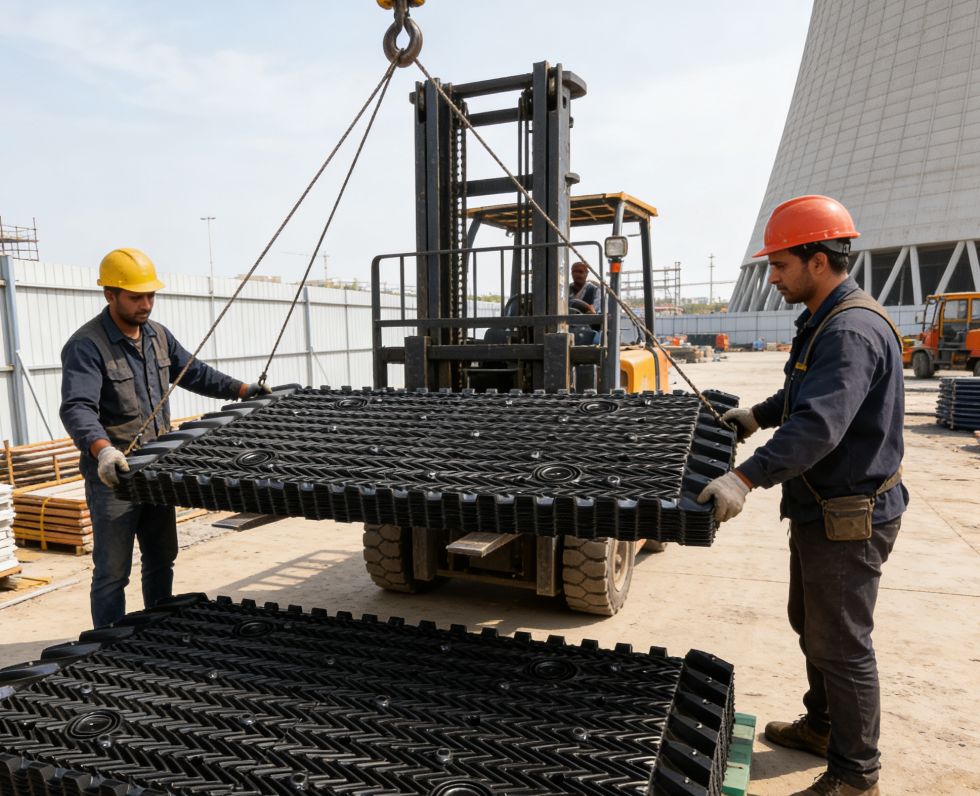
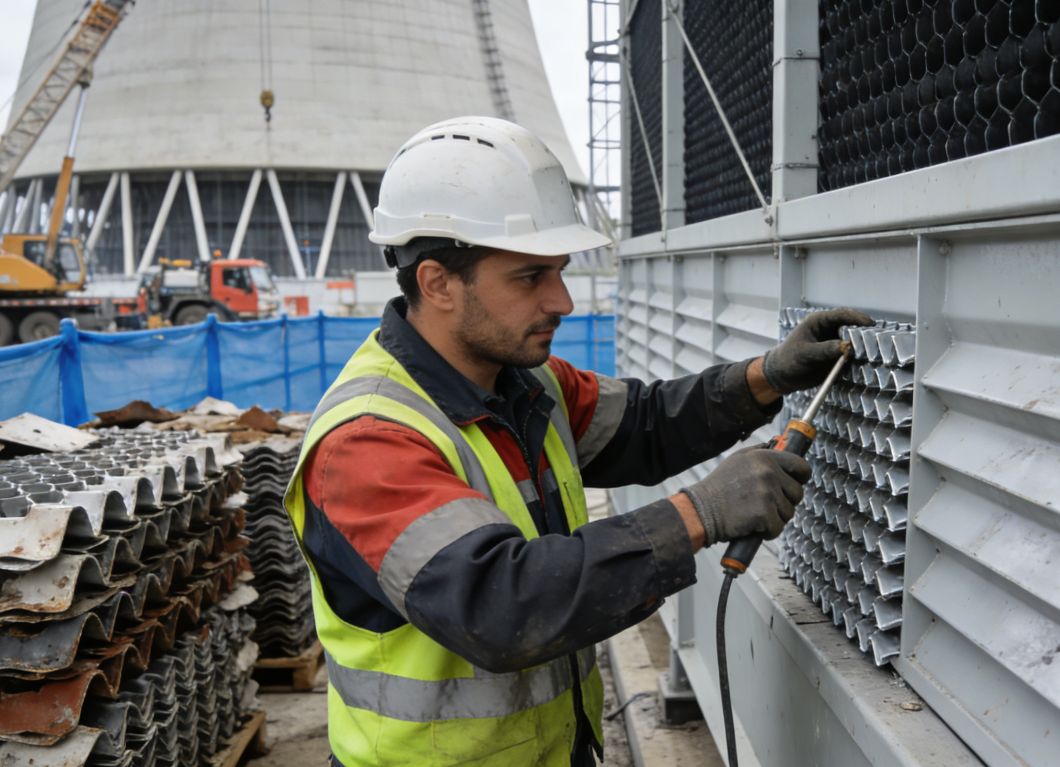
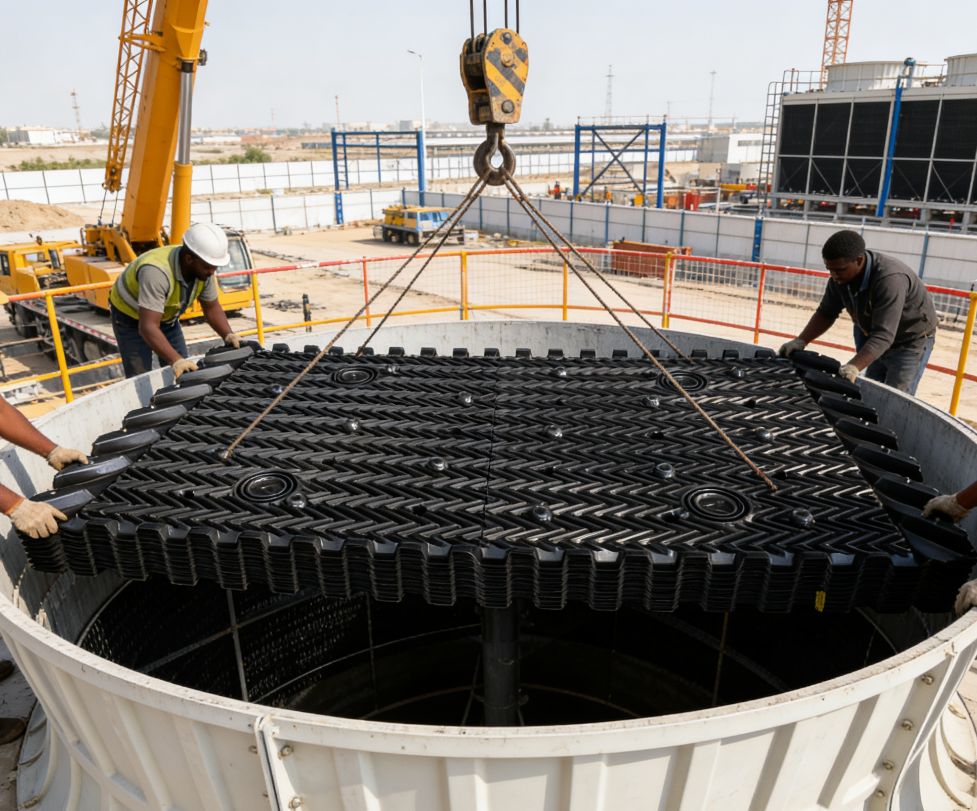
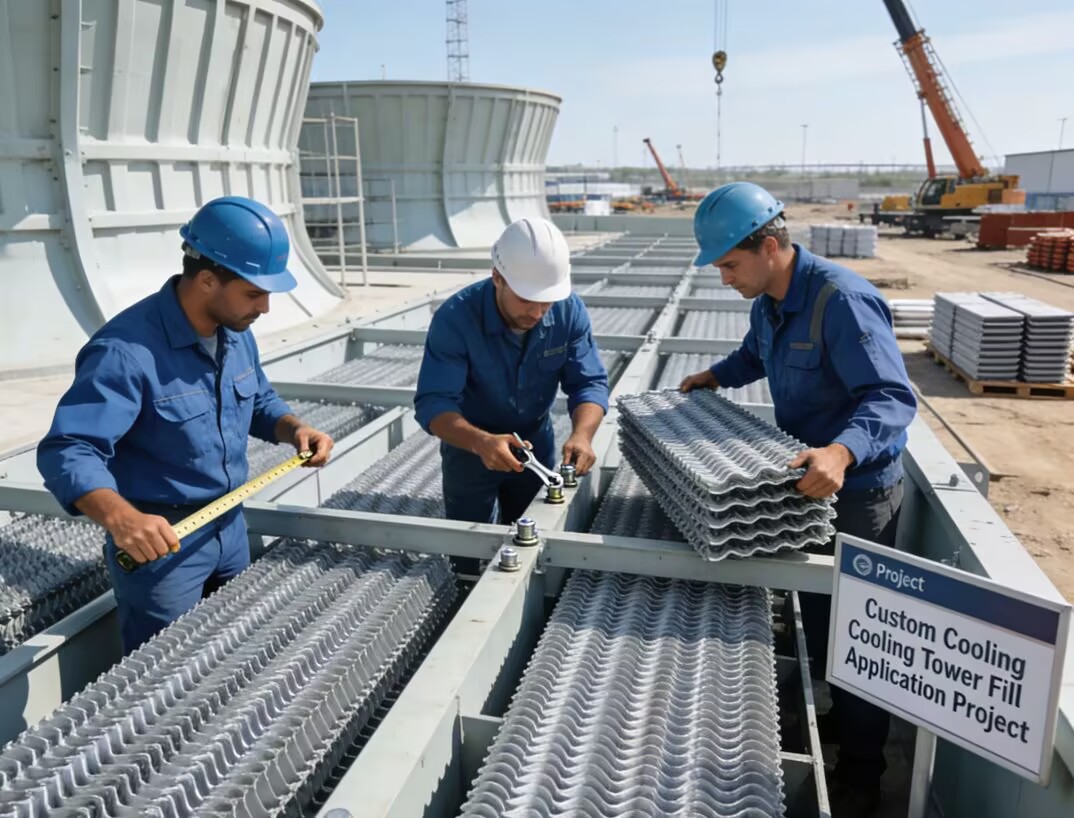
Cooling tower fill is not only a heat transfer component, but also a key factor influencing overall system energy consumption. In industrial cooling systems, energy usage is mainly driven by fans, pumps, and water circulation resistance inside the tower. The fill structure directly affects airflow resistance and water distribution efficiency, which in turn impacts energy demand.
In many industrial plants across Southeast Asia, the Middle East, and East Asia, engineers often focus on mechanical equipment optimization while overlooking the influence of internal fill design on long-term energy performance.
This article explains how fill geometry, material, and system compatibility influence energy consumption, and how engineers can optimize cooling tower performance from a design perspective.
The cooling process depends on continuous interaction between air and water. The fill section creates resistance to airflow while increasing water contact time.
This means energy consumption is influenced by:
Even a small change in cooling tower fill design can influence long-term operating energy requirements.

Different fill structures create different levels of resistance to airflow. Higher resistance increases fan workload and energy consumption.
Engineers must balance:
In systems using Film Fill Cooling Tower designs, water forms a thin film over the surface.
When film formation is stable, heat transfer becomes more efficient, reducing unnecessary recirculation and improving energy performance.
Tower Fill used in splash configurations generally has lower resistance but different thermal behavior.
Engineers often evaluate whether lower airflow resistance or higher heat transfer efficiency is more suitable for the application.
Uneven water distribution increases localized resistance and reduces effective heat transfer area.
This may indirectly increase pump and fan energy demand over time.
Proper selection of cooling tower fill can help improve system efficiency without modifying major mechanical equipment.
Engineers typically evaluate:
A manufacturing plant observed increasing energy consumption in its cooling system over time without significant changes in production load.
Inspection revealed that partial fouling inside the fill increased airflow resistance, causing higher fan energy consumption.
After cleaning and partial replacement of fill sections, system resistance decreased and energy stability improved.
An industrial cooling tower operating in a high-temperature environment required continuous fan operation at higher loads during summer.
Engineers reviewed fill structure and found that design selection contributed to higher-than-expected airflow resistance.
After adjusting the fill configuration, fan energy demand became more stable during peak conditions.
A precision manufacturing plant required stable cooling performance with controlled energy consumption.
Engineers optimized fill selection to balance thermal efficiency and airflow resistance, resulting in more consistent energy usage patterns.
Film Fill Cooling Tower systems provide high heat transfer efficiency but require careful control of water quality to maintain performance stability.

Tower Fill designs are more tolerant to water conditions and often show different airflow resistance behavior.
Cooling Tower Media selection should consider both thermal efficiency and long-term energy balance.
Many of these issues develop gradually and are often linked to fill condition and maintenance practices.
These methods help identify inefficiencies in the cooling process.
If you are analyzing energy consumption in cooling systems, engineering evaluation of fill structure, airflow resistance, and water distribution can help identify optimization opportunities.
Cooling tower fill design has a direct influence on energy consumption in industrial cooling systems. Proper selection and maintenance can reduce fan load, stabilize water distribution, and improve long-term operational efficiency.
Engineering evaluation should always consider both thermal performance and energy behavior to achieve balanced system design.
Yes. It influences airflow resistance and heat transfer efficiency.
Because it increases airflow resistance and fan load.
It depends on water quality and system design conditions.
Yes. Removing fouling can reduce airflow resistance.
Both are important and should be evaluated together.
We are professional cooling tower fills manufacturer, which can supply wide ranges of cooling tower fills with PVC, PP or CPVC materials.
The brake oil pipes we provide have multiple monitoring certifications and complete compliance documents to help your business smoothly enter the global market.
Fully automated production line, supporting individual customization. Combined with just-in-time logistics solutions, ensuring stable inventory.
A professional foreign trade technical team provides rapid response and is a trustworthy partner, offering everything from technical Q&A to market insights.

The cooling tower fill from this company has performed reliably in our systems. We appreciate the consistent quality and noticeable efficiency improvement.
CEO & Founder

As a CEO, I value partners who deliver on their promises. Their cooling tower fill is a solid product that contributes to stable operations.
CEO & Founder

We are satisfied with the performance of this cooling tower fill. It has integrated well into our existing setup with good results.
Manager

This company provides quality cooling tower fill that meets our operational needs. It's a dependable component in our infrastructure.
CEO & Founder

We are professional cooling tower fills manufacturer, which can supply wide ranges of cooling tower fills with PVC, PP or CPVC materials.

Instant Chat Support
+8615303180686
packingesale@gmail.com
Get the latest information
Scan the code to follow
Return to the top of the page