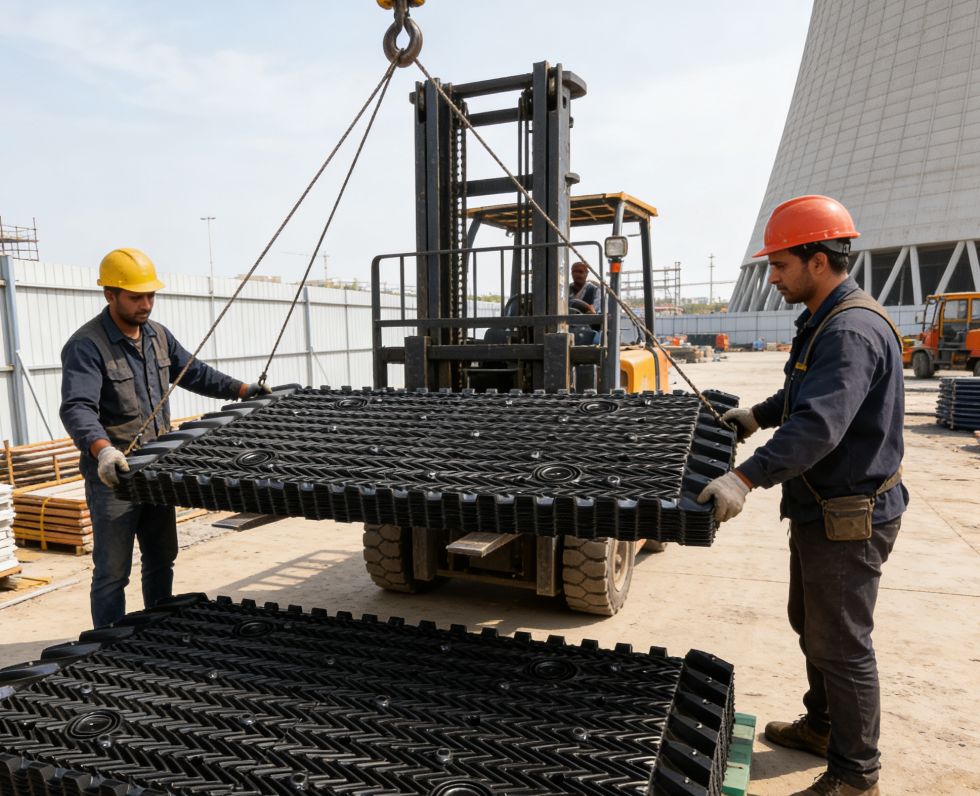
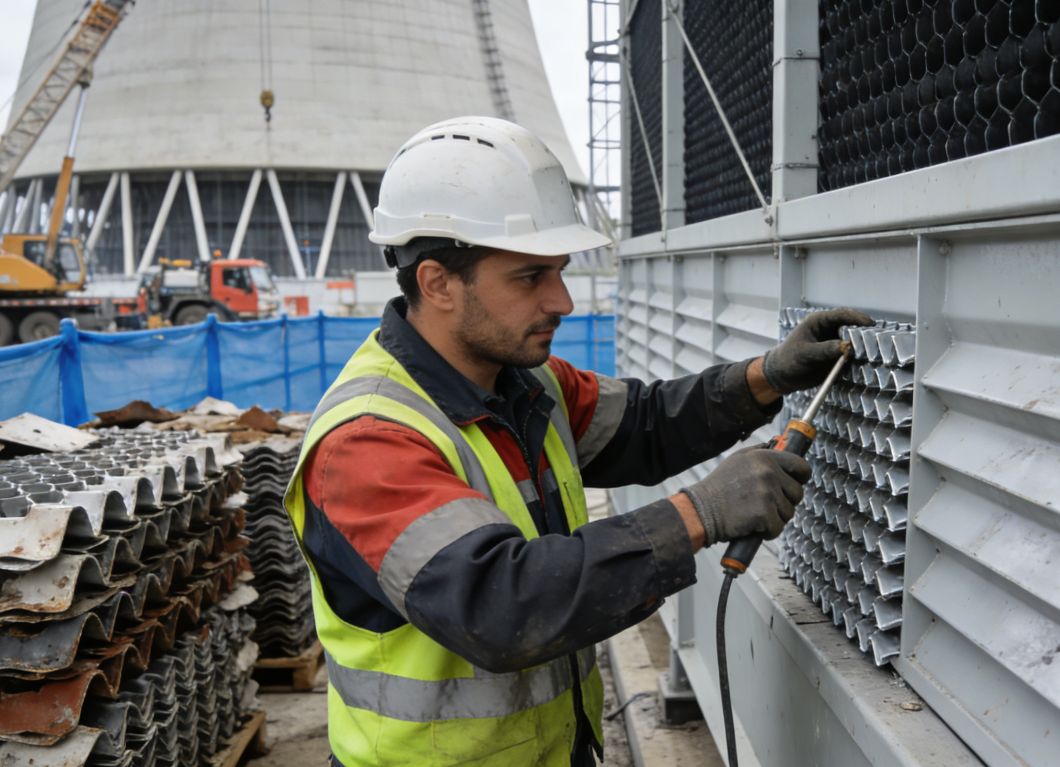
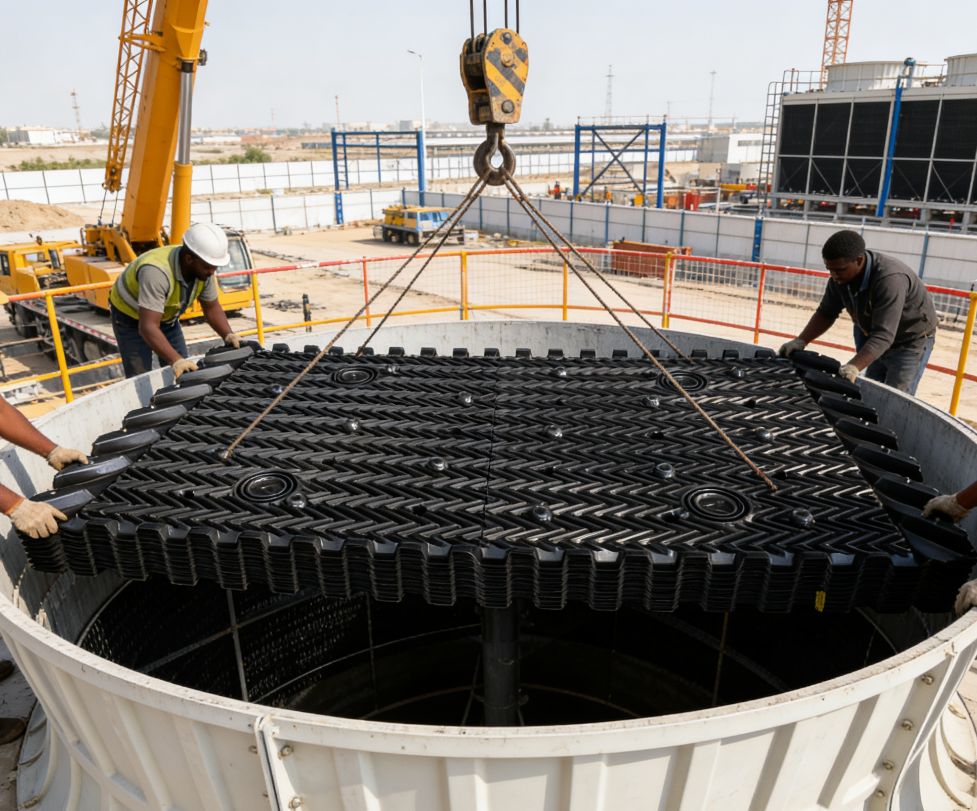
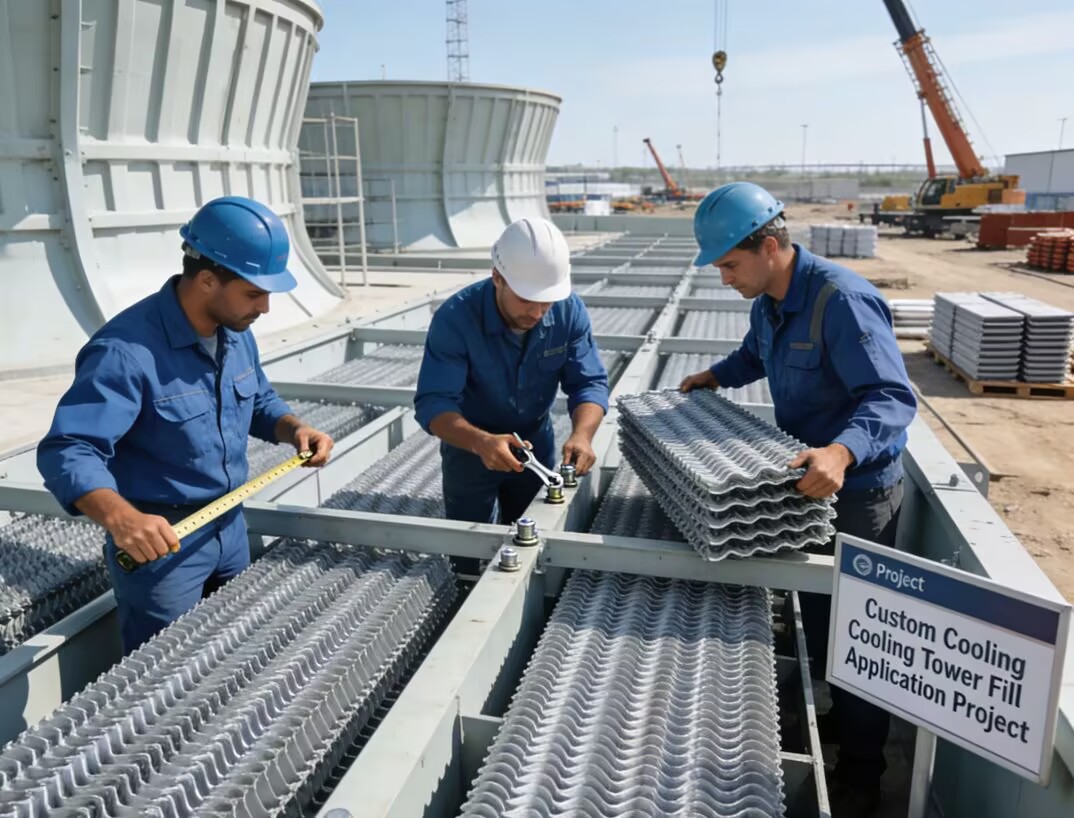
Cooling tower fill can only perform well when water is distributed evenly across the fill surface. In industrial cooling towers, many performance losses are not caused by the fill media itself, but by poor water spread, blocked nozzles, uneven flow, or weak basin design. When distribution becomes unstable, the fill receives too much water in some areas and too little in others, which affects thermal performance and service life.
For engineers and maintenance teams, water distribution should be treated as part of the fill system, not as a separate detail. A well-selected fill can still underperform if the water is not delivered correctly. In practice, this is one of the most common reasons a tower begins to show uneven cooling behavior over time.
The purpose of cooling tower fill is to create contact between water and air. That contact depends on the water reaching the fill in a stable, controlled pattern. If the water arrives unevenly, the fill cannot create a consistent film or splash pattern, and heat transfer becomes less reliable.
In field operation, poor distribution often leads to the following issues:
Even when the fill design is correct, the system may still fail to perform as expected if distribution is weak.
Uneven distribution changes the way water moves through the tower. Some channels remain fully wetted while others receive little flow. This creates uneven thermal loading across the fill pack.
When that happens, the tower may still operate, but cooling performance becomes less stable. Operators often notice that the system performs better at some times and worse at others, even though the main equipment has not changed.
Over time, poor distribution can also increase maintenance needs. Areas with heavy flow may foul faster, while dry areas may age differently. The result is an uneven wear pattern that reduces the useful life of the fill.
Film fill cooling tower systems are sensitive to distribution quality because the water is expected to spread into a thin, uniform film across the fill surface. When the water is delivered correctly, the design supports strong heat transfer and compact tower performance.
If the distribution is inconsistent, however, film fill can develop dry channels or heavily loaded sections. This makes the fill less effective and may accelerate local fouling.
tower fill used in splash arrangements is generally more tolerant of uneven water conditions. Because the structure is more open, the tower can still function even if the water pattern is not perfect.
That does not mean distribution is unimportant. It simply means splash fill is often more forgiving in difficult industrial environments, especially where suspended solids or recycled water are involved.
cooling tower fill media with corrugated geometry depends heavily on balanced distribution. The channel shape helps guide water flow, but it still needs steady loading to perform well.
Good corrugated fill design works best when water arrives in a consistent pattern. If the distribution system is weak, even a well-made fill pack may not deliver the expected operating result.
Nozzles can become blocked by scale, rust, algae, or suspended solids. When this happens, water flow patterns change and the fill begins to receive uneven coverage.
Blocked nozzles are common in towers that operate with unstable water treatment or poor filtration.
Cracked or corroded headers may leak water before it reaches the fill. This reduces delivery consistency and creates localized dry areas inside the tower.
If water flow is too low, the fill may not wet properly. If flow is too high, the fill can become overloaded and lose the benefit of controlled distribution. Both situations affect performance.
A poorly designed basin may deliver water unevenly across the tower footprint. This is often seen during retrofit projects where the distribution system no longer matches the original fill layout.
When maintenance intervals are too long, minor distribution issues can grow into major operational problems. Regular cleaning and inspection help prevent this progression.
Fill longevity depends not only on material quality but also on how water enters the system. When distribution is good, the fill is loaded more evenly and tends to age in a more predictable way.
When distribution is poor, some sections may be overstressed while others remain underused. This uneven loading can shorten service life and make cleaning less effective.
For many industrial sites, this is one of the main reasons cooling tower fill replacement is needed earlier than expected.
PVC cooling tower fill is often selected for standard operating environments where water quality is reasonably controlled. It can perform well when water distribution is stable and maintenance practices are consistent.
In towers with poor distribution, however, PVC-based fill may show uneven aging faster than expected because some areas receive heavier loading.
PP cooling tower fill is often considered for more demanding applications. It may be used where temperature exposure or process conditions place additional stress on the tower system.
Even with PP material, the distribution system still matters. A durable material cannot fully compensate for poor water delivery.
In one Southeast Asia project, a cooling tower serving an industrial plant showed uneven thermal performance even though the fan and pump systems were functioning normally.
Inspection revealed that several distribution nozzles had become partially blocked by biological deposits. Some parts of the fill were heavily wetted while other sections remained underloaded.
After cleaning the distribution system and reviewing the fill arrangement, the plant restored more stable operation. The case showed that the fill was not the root problem; the water delivery pattern was.
Another site operated in a warm and humid climate where biological growth developed quickly inside the distribution system. The fill itself was still structurally acceptable, but the water pattern became irregular because several nozzles were fouled.
The maintenance team increased inspection frequency and improved water treatment control. That combination helped the tower maintain more consistent fill wetting and reduced performance fluctuation during seasonal load changes.
In a retrofit project, the original distribution system did not match the replacement fill layout. Water entered the fill unevenly because the basin and header arrangement had not been adjusted after the upgrade.
After the distribution components were corrected, the new fill began to operate much more effectively. This project is a reminder that fill selection and water distribution must be designed together.
Clean and check nozzles during maintenance shutdowns. A small blockage can create a large performance difference inside the tower.
Stable water treatment helps reduce the formation of scale, biofilm, and solids that can obstruct the distribution system.
Headers should be inspected for leakage, corrosion, or uneven flow. A damaged header often causes the first signs of distribution loss.
Operating flow should match the fill design. Too much or too little flow can both create problems.
Dust and debris entering the tower can also affect distribution components. In many industrial sites, the use of Air Inlet Louvers, Air Inlet Grilles, and Air Intake Screens helps reduce contamination.
Water distribution is closely connected to other internal tower parts. When these parts are maintained properly, the fill usually performs more consistently.
These components help control carryover, reduce debris entry, and support a cleaner internal operating environment.
Simple inspection habits often prevent larger performance issues later.
Water distribution has a direct influence on how well cooling tower fill performs and how long it lasts. Even a well-made fill pack can lose effectiveness if the water is not spread evenly. For this reason, engineers should treat the fill and distribution system as one working unit.
When fill type, material, and water delivery are matched correctly, the tower is more likely to maintain stable cooling performance, lower maintenance pressure, and longer service life. In industrial cooling systems, that practical balance matters more than any single specification on its own.
Because the fill depends on even water spread to create the surface contact needed for effective heat transfer.
Some fill areas become overloaded while others stay too dry, which reduces cooling performance and can shorten service life.
Yes. Blocked nozzles are a common cause of uneven water flow and often lead to poor cooling results.
Splash fill is often more tolerant of uneven conditions, but proper distribution is still important for reliable operation.
Start with the nozzles, headers, water quality, and fill wetting pattern before assuming the fill itself is the only issue.
We are professional cooling tower fills manufacturer, which can supply wide ranges of cooling tower fills with PVC, PP or CPVC materials.
The brake oil pipes we provide have multiple monitoring certifications and complete compliance documents to help your business smoothly enter the global market.
Fully automated production line, supporting individual customization. Combined with just-in-time logistics solutions, ensuring stable inventory.
A professional foreign trade technical team provides rapid response and is a trustworthy partner, offering everything from technical Q&A to market insights.

The cooling tower fill from this company has performed reliably in our systems. We appreciate the consistent quality and noticeable efficiency improvement.
CEO & Founder

As a CEO, I value partners who deliver on their promises. Their cooling tower fill is a solid product that contributes to stable operations.
CEO & Founder

We are satisfied with the performance of this cooling tower fill. It has integrated well into our existing setup with good results.
Manager

This company provides quality cooling tower fill that meets our operational needs. It's a dependable component in our infrastructure.
CEO & Founder

We are professional cooling tower fills manufacturer, which can supply wide ranges of cooling tower fills with PVC, PP or CPVC materials.

Instant Chat Support
+8615303180686
packingesale@gmail.com
Get the latest information
Scan the code to follow
Return to the top of the page