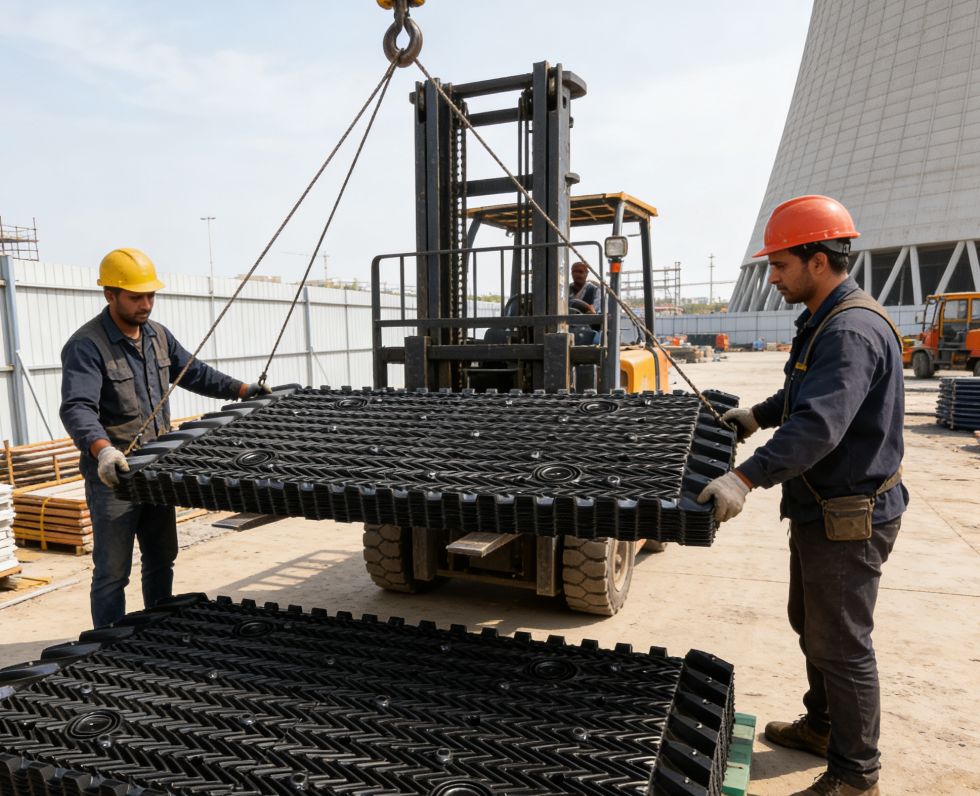
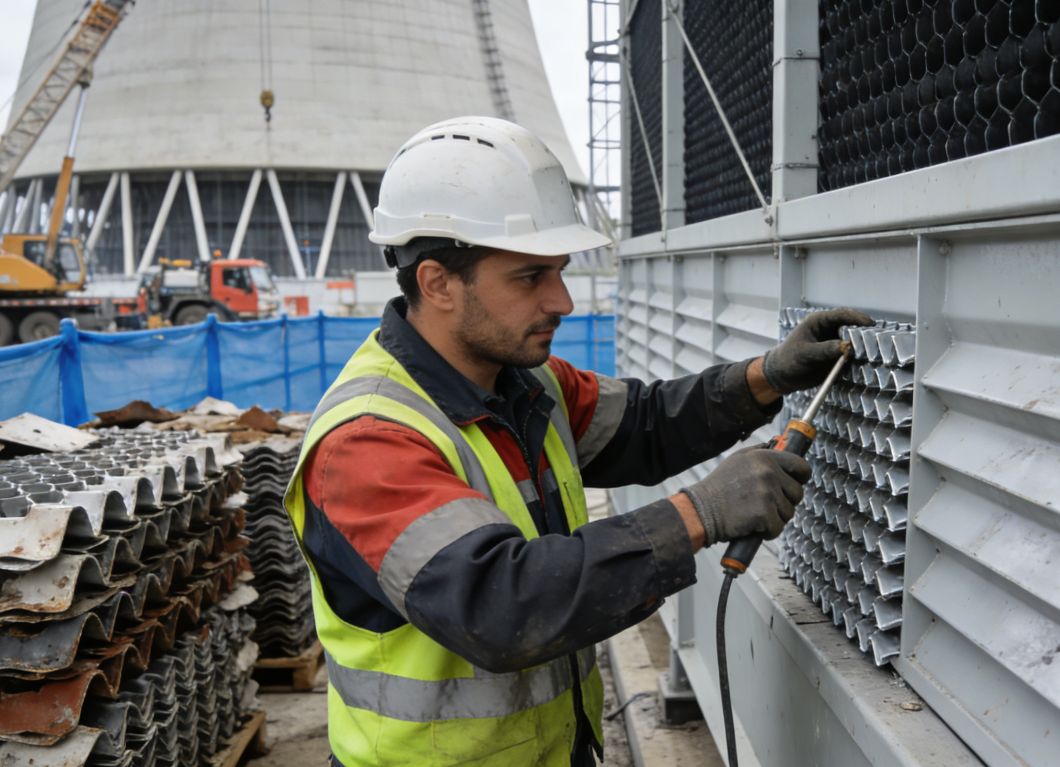
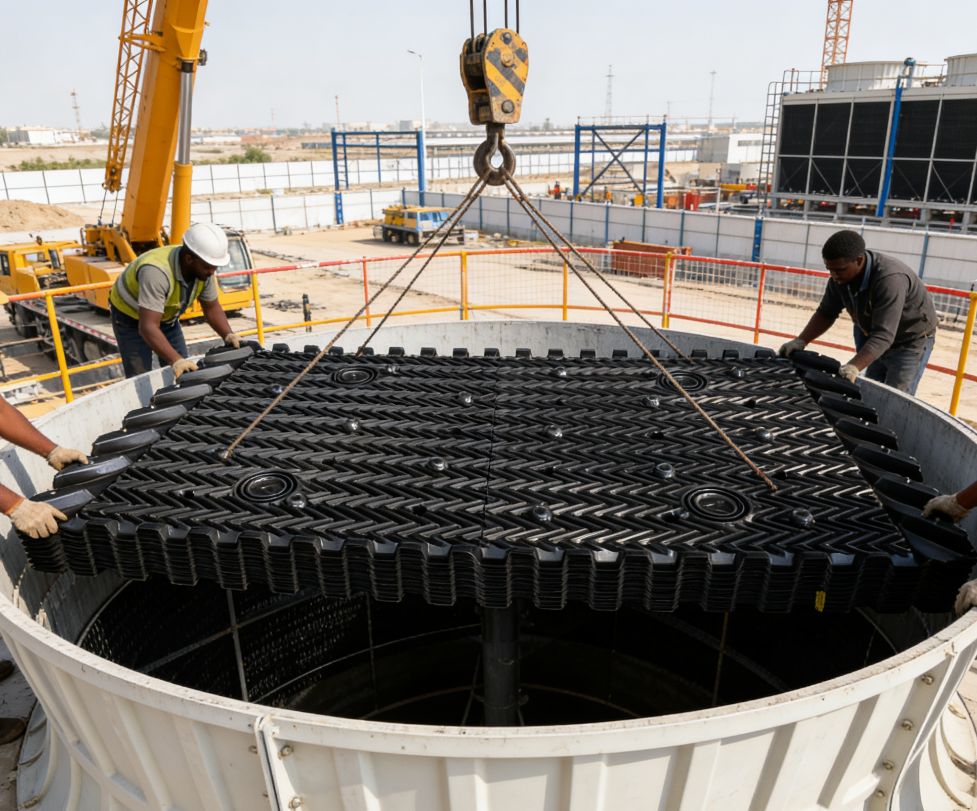
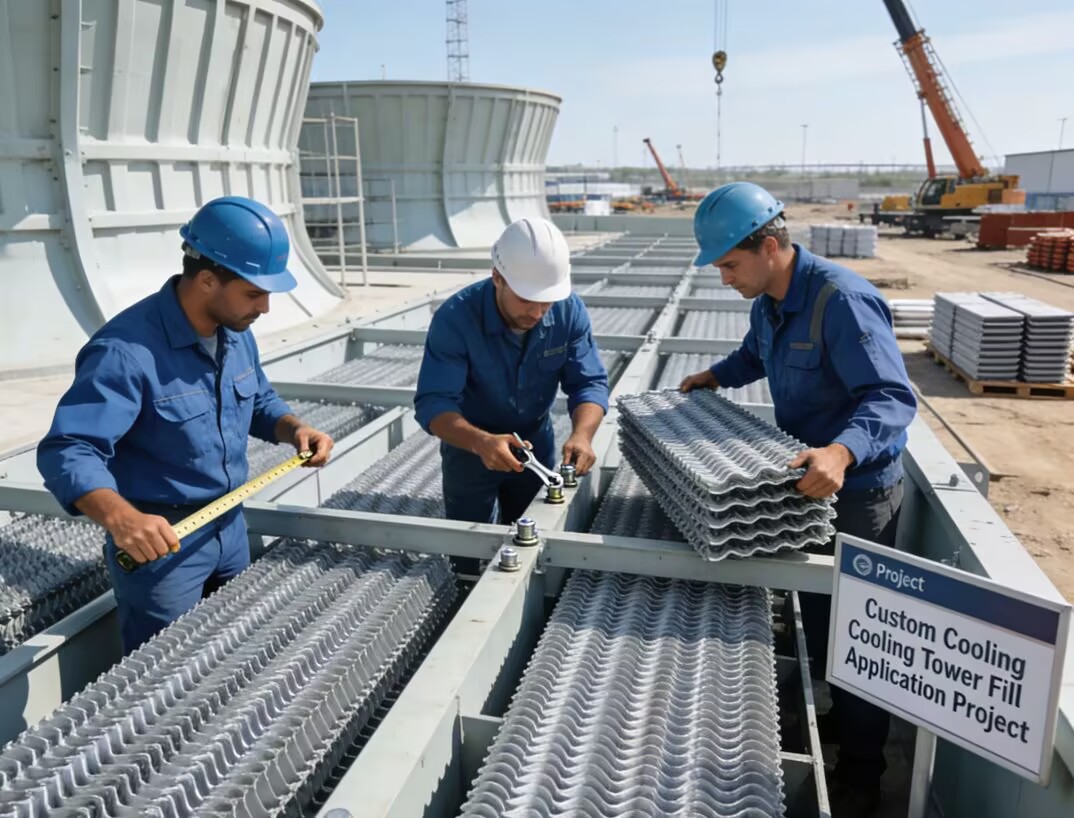
Your cooling tower fan is probably one of the largest electricity consumers in your facility. I have seen plants spend thousands on chiller efficiency upgrades while ignoring fan power – and leaving big savings on the table. The cooling tower fill you choose has a direct and significant impact on fan energy consumption. Let me explain how to select Tower Fill that minimizes fan power without sacrificing cooling capacity.
Fan power is proportional to the cube of airflow. That means a small increase in pressure drop requires a much larger increase in fan power to maintain the same airflow. If your fill pressure drop increases by 10**, fan power must increase by about 10** to maintain the same airflow – and if you have to increase airflow to compensate for reduced heat transfer, the penalty is even greater.
The difference between a clean fill and a fouled fill can be dramatic. Standard film fill might have a clean pressure drop of 15 Pa at design air velocity. A fouled fill – with scale, biofilm, or debris – might have 30 Pa or more. That doubling of pressure drop requires roughly 26** more fan power (since fan power scales with pressure drop raised to approximately the 1.5 power for most fans). Multiply that by 8,000 operating hours per year at $0.10/kWh, and a single 100 HP fan can waste $15,000-$20,000 annually.
Research demonstrates how over 50** of energy savings can be realized by optimizing the fan operation of induced draft cooling towers[reference:52]. Optimized fan configurations significantly improve heat rejection and reduce circulating water temperature[reference:53].
Let me give you a concrete example. A hospital in Florida had four cooling tower cells, each with a 50 HP fan. The fill was 7 years old and moderately fouled. Pressure drop was 35 Pa compared to a clean baseline of 18 Pa. Fan amperage had increased from 4** to 58A per fan – a 29** increase. Annual fan energy cost had risen by $12,000 across all four cells. After replacing the fill with a modern low-pressure-drop design, pressure drop dropped to 16 Pa – actually lower than the original clean fill. Fan amperage dropped to 42A. The hospital saved $12,000 annually in electricity, and the fill paid for itself in 14 months.
If fan energy is a priority for you – and it should be – here is what to look for in cooling tower fill. First, wider flute spacing. Tight-flute film fill (12-16mm) has high surface area but also high pressure drop. Wide-flute fill (25mm or larger) has lower pressure drop but requires more fill volume for the same cooling duty. For most applications, 19-25mm flutes offer the best balance.
Second, smooth surface finish. Fill with rough surfaces – from recycled material or poor manufacturing – creates more turbulence and higher pressure drop. Virgin material with a smooth finish is better. Third, high void fraction. The percentage of open space in the fill pack. Higher void fraction means lower resistance to airflow. Look for fill with void fraction above 95**. Fourth, straight-through air passages. Some fill designs have zigzag patterns that increase heat transfer but increase pressure drop. For low-energy applications, choose simpler geometry.
Recent research has shown that fan arrangement layout is more critical than individual fan power. Studies found that with a total auxiliary fan power of 200 kW, optimized fan configurations increased ventilation rate, water temperature drops, cooling efficiency, and Merkel number[reference:54]. This means that for facilities with multiple fans per tower, how you operate them matters as much as the fan power rating.
A novel optimal control method for cooling water systems uses derivative control strategy by decoupling water flow rate optimization and airflow rate optimization, making the total power of chillers, pumps, and fans approach a minimum[reference:55]. For building operators, this approach maximizes the energy efficiency of induced draft and hybrid draft cooling towers by optimizing fan operation[reference:56].
I recommend working with your building automation system provider to implement these control strategies. The savings from optimal fan control often exceed the savings from fill replacement alone – and when you combine both, the results are dramatic.
Here is a simple field test you can do today to see if your fill is robbing you of fan energy. With the tower running at full load, measure fan motor amperage. Write it down. When you clean or replace fill, measure fan amperage again under the same conditions. If you see a reduction of 10** or more, you have confirmed that old fill was costing you fan energy.
I also recommend installing a pressure differential gauge across the fill if your tower has provisions for it. Many larger towers come with pressure taps above and below the fill. If yours does not, consider adding them during your next fill replacement. Measuring pressure drop directly is more accurate than inferring from amperage.
I worked with a hyperscale data center in Northern Virginia that was running 24 cooling tower fans 24/7/365. Their original specification called for high-density 12mm film fill to minimize tower footprint. After five years, the fill was moderately fouled, and fan power had increased by 18**. An energy audit recommended replacing the fill with a 25mm wide-flute design, even though it meant adding one additional cooling tower cell to maintain capacity. The upfront cost was significant – $350,000 – but the annual fan energy saving was $210,000. The project paid back in 20 months. The facility now has lower fan power and a spare cell for redundancy. That is smart engineering.
You cannot just minimize pressure drop at all costs – you still need adequate heat transfer. The optimization problem is finding the fill that gives you the required cooling at the lowest total energy cost (fan + chiller). For most facilities, a 1°C increase in approach temperature costs 2-3** in chiller energy. So you need to compare. A fill that reduces fan energy by 10** but increases approach by 0.5°C might not be a net win if chiller energy costs dominate.
I use a simple spreadsheet model to compare options. Input fan power cost per HP-hour, chiller efficiency (kW/ton), and expected approach temperature change. The model calculates total annual operating cost for each fill option. In most cases, the optimal fill is not the one with the lowest pressure drop or the highest heat transfer – it is the one that minimizes the sum of both.
Do not ignore fan energy. It is often half of cooling tower operating cost. Choose fill that balances heat transfer and pressure drop, monitor fan power trends, and replace fill before it becomes a drag on your electricity bill. We can help you model the trade-offs.
We help you select low-pressure-drop fill and optimize fan control strategies. Free energy savings model for your tower. Just send us your current fan power and operating hours.
Contact Us Here →We are professional cooling tower fills manufacturer, which can supply wide ranges of cooling tower fills with PVC, PP or CPVC materials.
The brake oil pipes we provide have multiple monitoring certifications and complete compliance documents to help your business smoothly enter the global market.
Fully automated production line, supporting individual customization. Combined with just-in-time logistics solutions, ensuring stable inventory.
A professional foreign trade technical team provides rapid response and is a trustworthy partner, offering everything from technical Q&A to market insights.

The cooling tower fill from this company has performed reliably in our systems. We appreciate the consistent quality and noticeable efficiency improvement.
CEO & Founder

As a CEO, I value partners who deliver on their promises. Their cooling tower fill is a solid product that contributes to stable operations.
CEO & Founder

We are satisfied with the performance of this cooling tower fill. It has integrated well into our existing setup with good results.
Manager

This company provides quality cooling tower fill that meets our operational needs. It's a dependable component in our infrastructure.
CEO & Founder

We are professional cooling tower fills manufacturer, which can supply wide ranges of cooling tower fills with PVC, PP or CPVC materials.

Instant Chat Support
+8615303180686
packingesale@gmail.com
Get the latest information
Scan the code to follow
Return to the top of the page