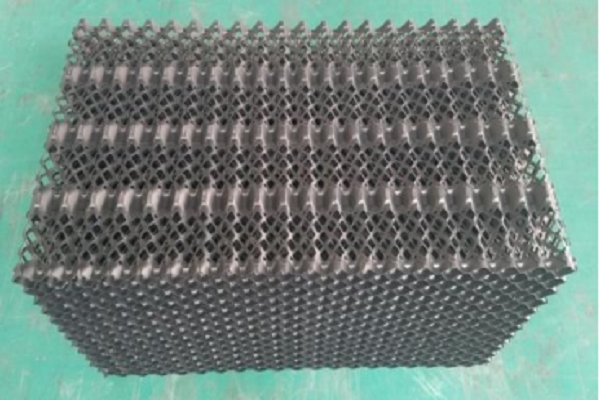
Name: cooling tower splash fill
Description: Our cooling tower splash fill is designed for challenging water conditions, including high solids, scaling potential, or fibrous debris. The grid‑style splash bars break water into countless small droplets, maximizing air‑to‑water contact and heat rejection without the clogging risks associated with film fill. Constructed from durable, UV‑resistant PVC, it withstands harsh thermal and mechanical stress while providing easy maintenance access. Ideal for industrial applications, pulp and paper mills, and steel plants, our splash fill delivers reliable thermal performance, reduced fouling, and extended service life even in the dirtiest water streams.
Splash fill is one of the earliest types of fill media used in cooling towers. It remains a practical choice for applications involving poor water quality, high fouling potential, or elevated temperatures. Unlike film fill, which relies on thin water films over closely spaced sheets, splash fill breaks falling water into small droplets through repeated impact with horizontal bars or grids. This droplet formation increases the air-water contact area, enabling effective heat transfer even in challenging operating conditions.
In a splash fill system, hot water is distributed from the top of the cooling tower and falls onto successive layers of splash bars. As water impacts these bars, it is broken into numerous small droplets, significantly increasing the total surface area exposed to the air stream. Air moves horizontally (in crossflow towers) or vertically (in counterflow towers) across these droplets, promoting evaporative and convective cooling. The repeated splashing action ensures continuous droplet regeneration, maintaining high heat transfer efficiency throughout the fill depth[reference:0]. This mechanism is particularly effective in crossflow cooling towers, where air travels perpendicularly to the water flow[reference:1].
Splash fill has evolved significantly from its origins of simple wooden slats suspended in grid systems. Modern splash fill designs incorporate advanced geometries and materials to improve thermal performance while preserving the anti-fouling characteristics that define this fill category[reference:2].
Traditional splash bars include V-bar, Kelly bar, and PVC lath designs. These consist of elongated profiles arranged in horizontal layers, typically supported by grid structures. While effective at breaking water into droplets, traditional designs often produce non-uniform droplet distribution, leading to water agglomerations where droplets combine into larger droplets or streams[reference:3].
Modern splash bars, such as the SpiraBar, feature pulse-extruded tubular profiles with diamond-shaped openings. This design provides the most uniform droplet distribution of any splash bar, enabling thermal performance equal to or better than conventional options. Advanced bars can be installed without staggered configurations, simplifying installation and reducing labor time[reference:4].
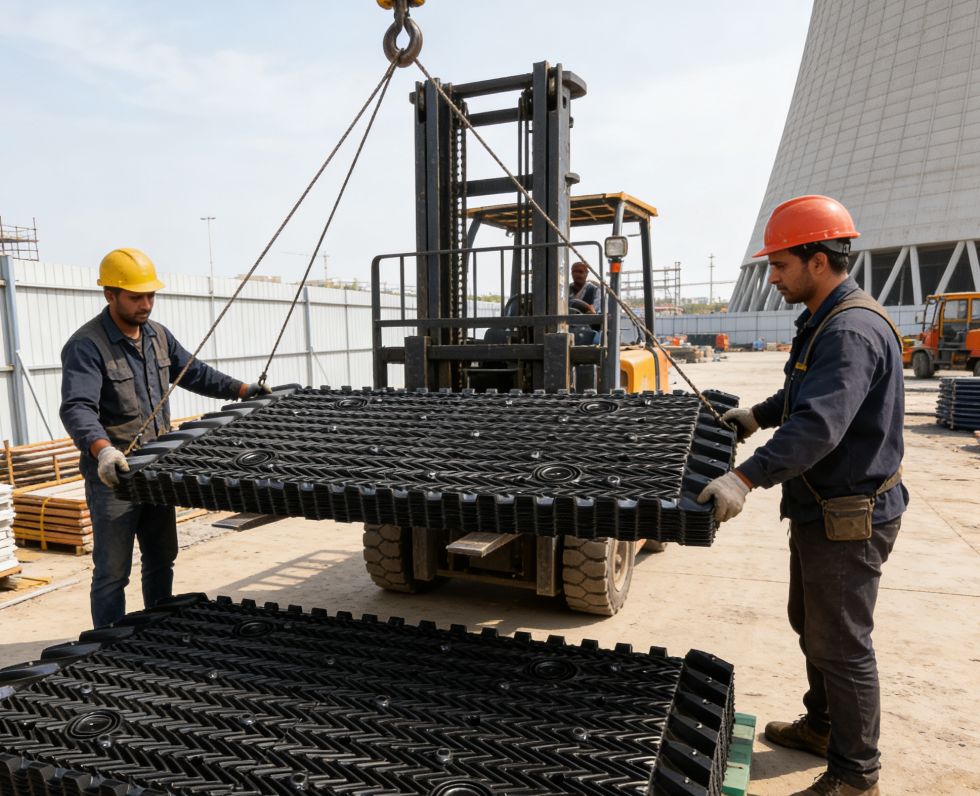
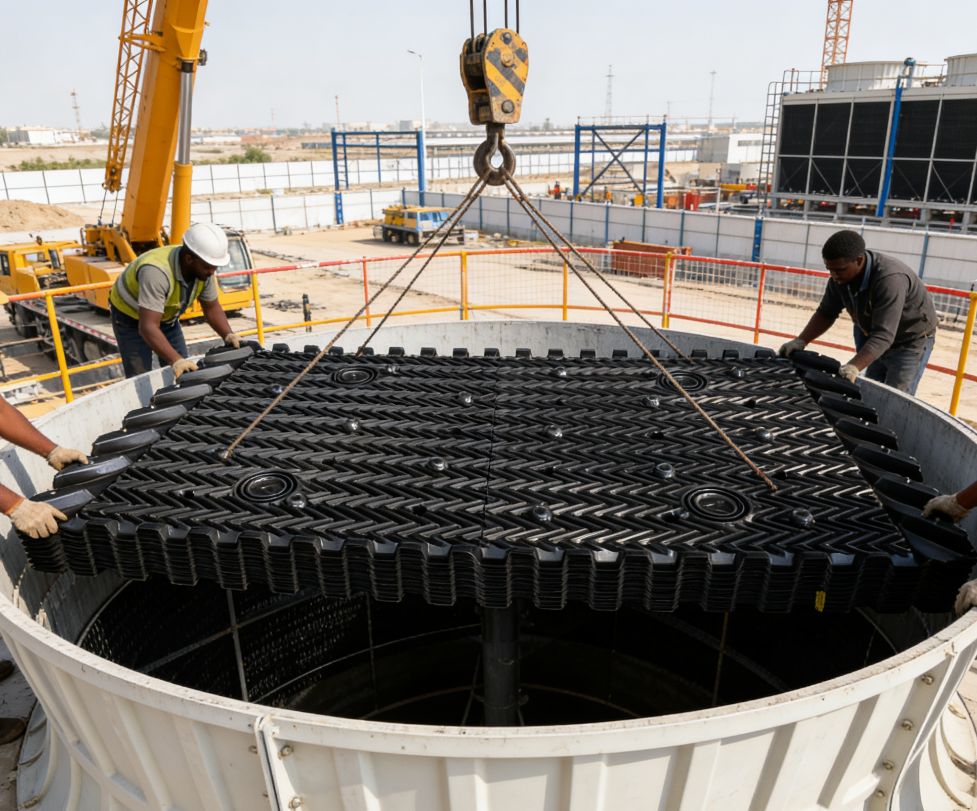
Modular splash fills like TurboSplash and HTP25 consist of injection-molded polypropylene panels assembled into hinged bundles. These systems offer high performance in heavily contaminated water applications, including power generation, refining, petrochemical, steel, chemical, pulp and paper, and food processing industries[reference:5].
The two most common polymers used in cooling tower fills are polyvinyl chloride and polypropylene[reference:6]. PVC is widely used due to its low cost, durability, good wetting characteristics, and inherently low flame spread rate[reference:7]. Polypropylene offers superior temperature resistance, with continuous operation up to 75°C and short-term tolerance to 80°C[reference:8]. For extremely demanding applications, stainless steel splash grids provide maximum corrosion resistance and structural integrity[reference:9]. Traditional wood splash bars, typically treated for durability, remain in use for some industrial applications[reference:10].
Splash fill is the design of choice for cooling towers operating with water that has a high fouling tendency[reference:11]. It is commonly specified for power plants, industrial process cooling, steel mills, chemical plants, and other facilities where circulating water contains suspended solids, biological matter, or scaling potential. Splash fill is significantly less susceptible to clogging and fouling from debris, algae, and salts compared to film fill[reference:12]. While splash fill generally offers lower thermal efficiency than modern film fills, its extended service life in dirty water conditions often offsets the initial performance difference[reference:13]. For clean water applications such as HVAC systems, film fill remains the preferred choice due to its higher thermal performance and compact design[reference:14].
Film fill induces cooling water to form a thin film on closely spaced sheet surfaces, maximizing liquid surface area and achieving significantly higher thermal efficiency than splash fill[reference:15]. However, the narrow channels in film fill are prone to clogging when exposed to poor-quality water. Splash fill, being less dense and more open, offers superior fouling resistance at the cost of lower thermal performance[reference:16]. The selection between these two fill types requires balancing efficiency requirements against water quality constraints and maintenance considerations.
Splash fill remains a vital technology in the cooling tower industry, particularly for applications involving challenging water conditions. Continuous innovations in splash bar geometry, grid systems, and materials have substantially improved thermal performance while preserving the anti-fouling advantages that define this fill category. For engineers and facility operators facing poor water quality, high temperatures, or fouling concerns, splash fill provides a reliable, durable, and cost-effective heat transfer solution.
We are professional cooling tower fills manufacturer, which can supply wide ranges of cooling tower fills with PVC, PP or CPVC materials.
The brake oil pipes we provide have multiple monitoring certifications and complete compliance documents to help your business smoothly enter the global market.
Fully automated production line, supporting individual customization. Combined with just-in-time logistics solutions, ensuring stable inventory.
A professional foreign trade technical team provides rapid response and is a trustworthy partner, offering everything from technical Q&A to market insights.

The cooling tower fill from this company has performed reliably in our systems. We appreciate the consistent quality and noticeable efficiency improvement.
CEO & Founder

As a CEO, I value partners who deliver on their promises. Their cooling tower fill is a solid product that contributes to stable operations.
CEO & Founder

We are satisfied with the performance of this cooling tower fill. It has integrated well into our existing setup with good results.
Manager

This company provides quality cooling tower fill that meets our operational needs. It's a dependable component in our infrastructure.
CEO & Founder

We are professional cooling tower fills manufacturer, which can supply wide ranges of cooling tower fills with PVC, PP or CPVC materials.

Instant Chat Support
+8615303180686
packingesale@gmail.com
Get the latest information
Scan the code to follow
Return to the top of the page