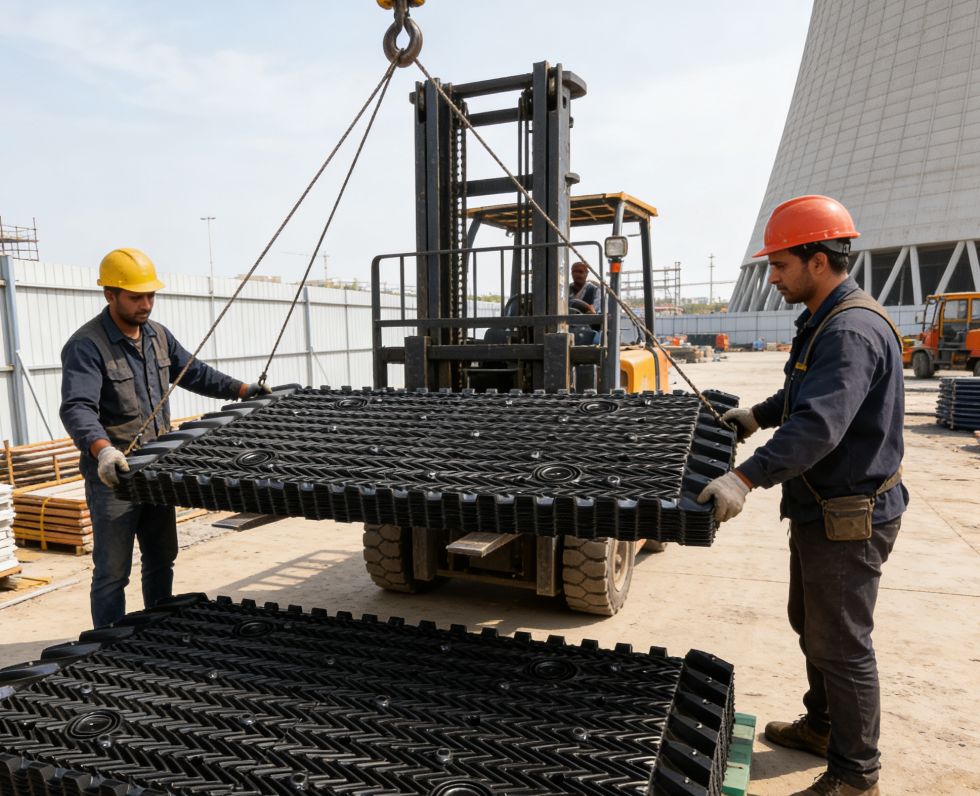
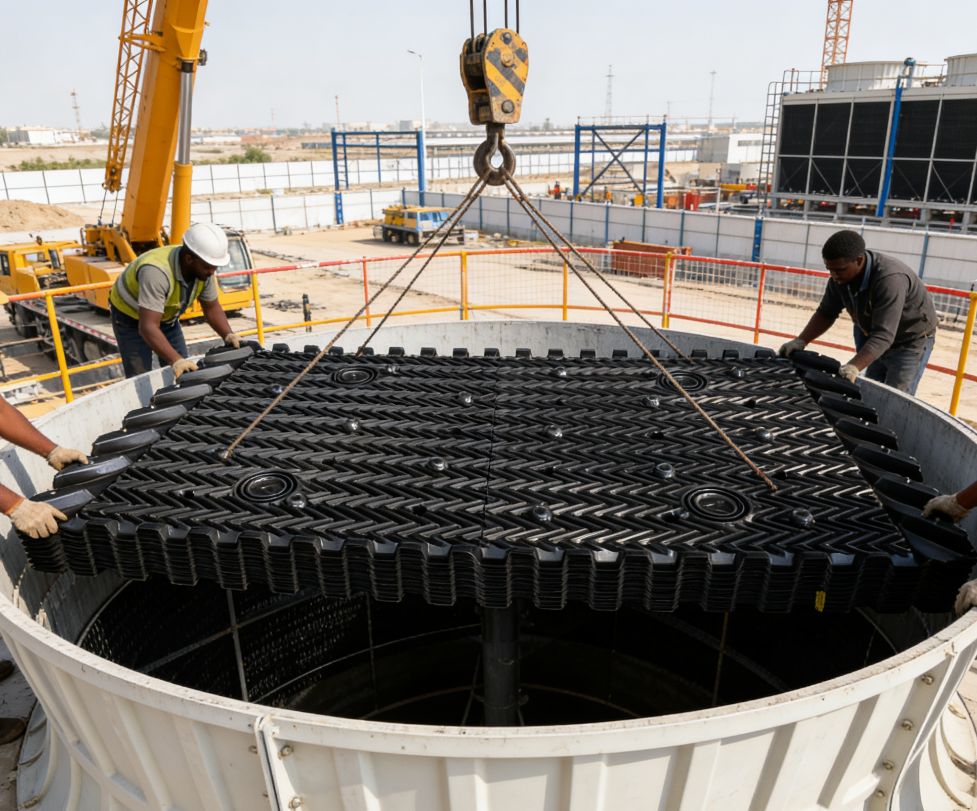
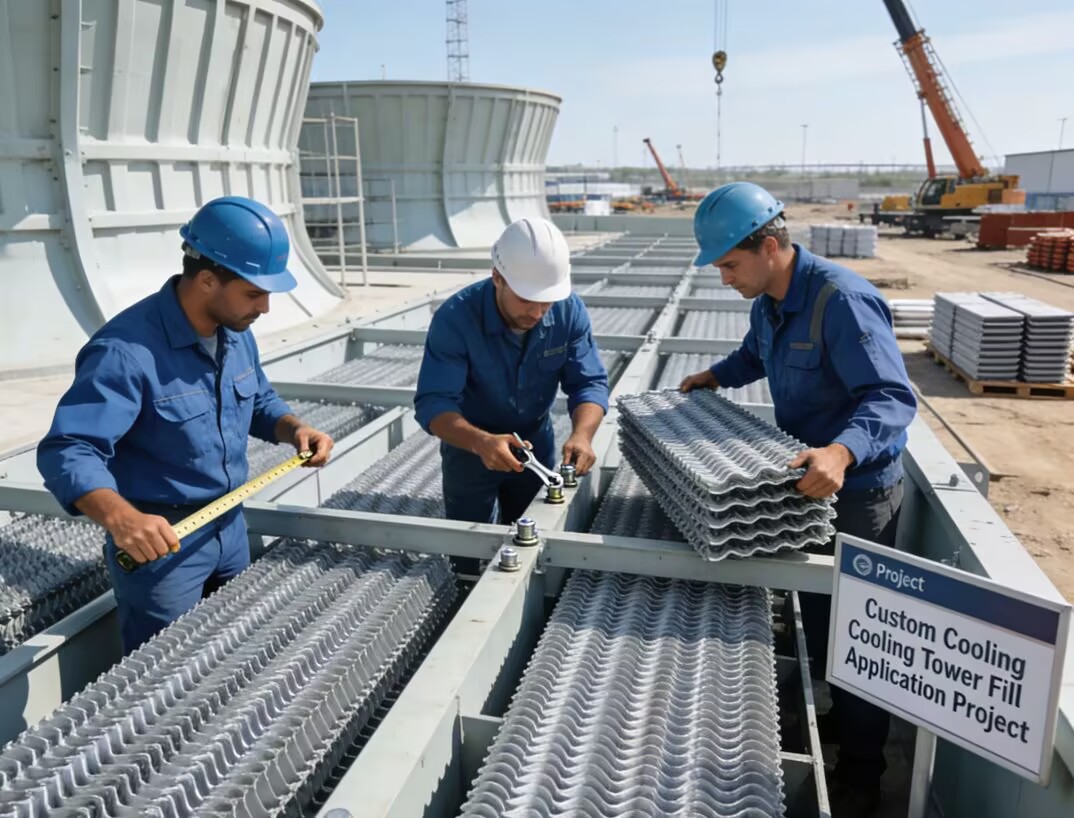
If you have ever had to specify cooling tower fill, you have faced this question: crossflow or counterflow? The choice affects everything from thermal efficiency to maintenance access to installation cost. After evaluating both configurations across dozens of facilities, I have developed a clear framework for deciding which one fits your plant. Cooling Tower Fill Manufacturer products are available for both configurations, but the right choice depends on your specific conditions.
The cooling tower fill market was valued at USD 4.59 billion in 2026 and is projected to reach USD 5.89 billion by 2031, with counterflow installations capturing 43.10** of revenue in 2025 and growing at a 7.69** CAGR[reference:0]. That growth is driven by data centers and pharmaceutical clients prioritizing high liquid-to-gas ratios and compact footprints. But does that mean counterflow is always better? Not necessarily.

Let us start with the basics. In a crossflow cooling tower, air flows horizontally across the fill while water flows vertically downward. In a counterflow tower, air moves vertically upward while water flows vertically downward – opposing directions. That 180-degree difference in flow geometry has profound implications for performance.
In counterflow towers, the air hits the coldest water at the bottom of the fill, then moves up to meet progressively warmer water. This creates a temperature gradient that maximizes the driving force for heat transfer. Studies show counterflow towers can achieve 5-10** higher thermal performance under similar conditions[reference:1]. The fill Merkel number (a measure of heat transfer effectiveness) for cross-counterflow configurations falls between that of purely counter- and crossflow fills[reference:2].
But crossflow has its advantages too. Crossflow towers are wider and shorter, suitable where vertical height is restricted. Counterflow towers are taller and narrower, occupying less ground area – advantageous when you have limited real estate[reference:3].
I have run thermal performance tests on both configurations using CTI ATC-105 procedures. Here is what I have observed: at the same water loading rate (gallons per minute per square foot) and air velocity, counterflow fill consistently delivers a lower leaving water temperature. The Merkel number for counterflow fill is typically 15-20** higher than crossflow at comparable operating points. However, the difference narrows when water loads are low. At partial loads (30-50** of design flow), crossflow towers maintain reasonably uniform water distribution, while counterflow nozzles can lose coverage[reference:4]. If your plant operates at variable loads, crossflow may be more forgiving.
Space is often the deciding factor. I recently consulted for a power plant in a dense urban area where the only available rooftop space was long and narrow. Counterflow towers – taller and narrower – fit perfectly. The same cooling load in crossflow would have required a footprint three times wider, which simply did not exist.
For cooling capacities below roughly 750 refrigeration tons, counterflow towers usually require less floor space. Above that capacity, crossflow towers may become more efficient in terms of footprint distribution[reference:5]. Before you choose a configuration, measure your available area carefully. Do not assume one is universally smaller.
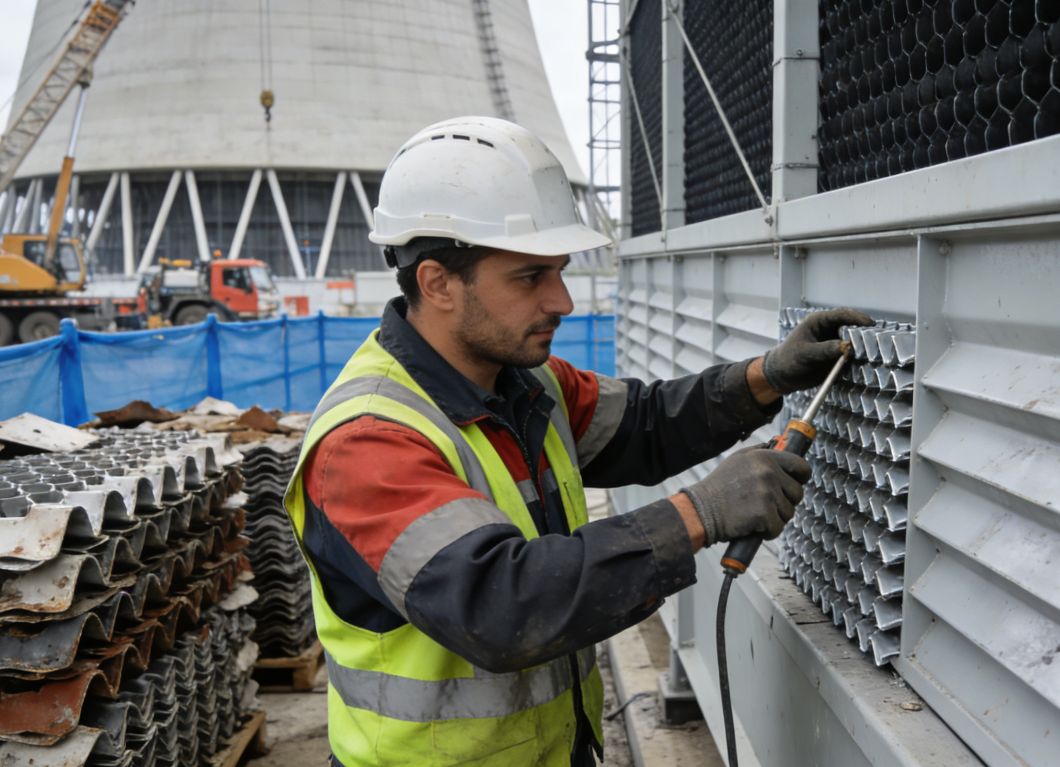
Here is where crossflow has a clear advantage. Crossflow towers use gravity-fed water distribution and side access doors. You can walk up to the fill from the side, inspect it, clean it, and even replace individual sheets without climbing to the top. Counterflow towers are taller and require top access. To get to the fill or the spray headers, you need scaffolding or a lift[reference:6]. That adds time, cost, and safety risk to every maintenance activity.
I have worked with facilities that chose crossflow specifically because they lacked permanent lifting equipment. For them, the slight reduction in thermal efficiency was an acceptable trade-off for being able to do maintenance in-house. For data centers and pharmaceutical plants with dedicated maintenance crews and lifts already on-site, counterflow’s higher efficiency may be worth the extra access hassle.
Counterflow fill generally handles dirty water better. Because water flows straight down through vertical channels, sediment and solids are less likely to accumulate. Gravity works with you, pulling debris down and out. Crossflow fill, with water flowing horizontally over vertical sheets, can trap sediment in the channels, especially at low flow rates[reference:7].
If your water has high suspended solids, scaling potential, or biological activity, counterflow is the safer choice. I have seen crossflow fill clog in a steel mill within two years while counterflow fill in the same plant lasted five. But if your water is clean – city water or well-treated industrial water – crossflow works fine.
An automotive assembly plant in the Midwest had six crossflow towers with 8-year-old fill. Water quality was moderate but contained oil residue from parts washing. The crossflow fill was heavily fouled, with oil and debris trapped in the horizontal channels. Approach temperature had risen from 3.5°C to 6.2°C. After evaluating options, the plant switched to counterflow towers for the replacement. The new counterflow fill has been in service for three years with annual cleaning only, and approach temperature is holding steady at 3.8°C. The plant manager told me the change was worth the additional installation cost.
Crossflow towers generally have lower initial installation costs because the gravity distribution system is simpler. Counterflow towers require pressurized spray headers, higher pump head, and more structural support – all of which add upfront expense. However, counterflow towers can reduce fan energy consumption by 5-10** depending on system load and airflow optimization[reference:8]. Over a 10-year lifecycle, that energy saving can offset the higher upfront cost.
The global cooling tower market is seeing accelerated adoption of counterflow configurations, driven by data-center and pharmaceutical clients who prioritize higher efficiency even at higher upfront cost[reference:9]. For most industrial plants, I recommend calculating total cost of ownership across 10 years, not just first cost.
One more factor: PFAS-free fill materials are increasingly required, and the shift to PFAS-free materials is reinforcing the cooling tower market's growth trajectory[reference:10]. When comparing crossflow and counterflow fill, ensure both options are available in PFAS-compliant materials if required in your region.
Based on my experience, here is a simple decision guide. Choose crossflow if: your site has height restrictions, you need easy side access for maintenance, your water quality is clean to moderate, or initial cost is your primary constraint. Choose counterflow if: your site has limited footprint, you require maximum thermal efficiency, your water quality is poor or fouling-prone, or you have long-term energy cost savings as a priority. For applications with both footprint constraints and dirty water, consider counterflow with added filtration.
Do not let anyone tell you one is universally better. The right choice depends on your plant. If you need help comparing options for your specific site, reach out. We supply both configurations and we give honest recommendations.
We help you compare thermal efficiency, footprint, maintenance access, and long-term operating costs. Free configuration analysis based on your site conditions. No obligation.
Contact Us Here →We are professional cooling tower fills manufacturer, which can supply wide ranges of cooling tower fills with PVC, PP or CPVC materials.
The brake oil pipes we provide have multiple monitoring certifications and complete compliance documents to help your business smoothly enter the global market.
Fully automated production line, supporting individual customization. Combined with just-in-time logistics solutions, ensuring stable inventory.
A professional foreign trade technical team provides rapid response and is a trustworthy partner, offering everything from technical Q&A to market insights.

The cooling tower fill from this company has performed reliably in our systems. We appreciate the consistent quality and noticeable efficiency improvement.
CEO & Founder

As a CEO, I value partners who deliver on their promises. Their cooling tower fill is a solid product that contributes to stable operations.
CEO & Founder

We are satisfied with the performance of this cooling tower fill. It has integrated well into our existing setup with good results.
Manager

This company provides quality cooling tower fill that meets our operational needs. It's a dependable component in our infrastructure.
CEO & Founder

We are professional cooling tower fills manufacturer, which can supply wide ranges of cooling tower fills with PVC, PP or CPVC materials.

Instant Chat Support
+8615303180686
packingesale@gmail.com
Get the latest information
Scan the code to follow
Return to the top of the page