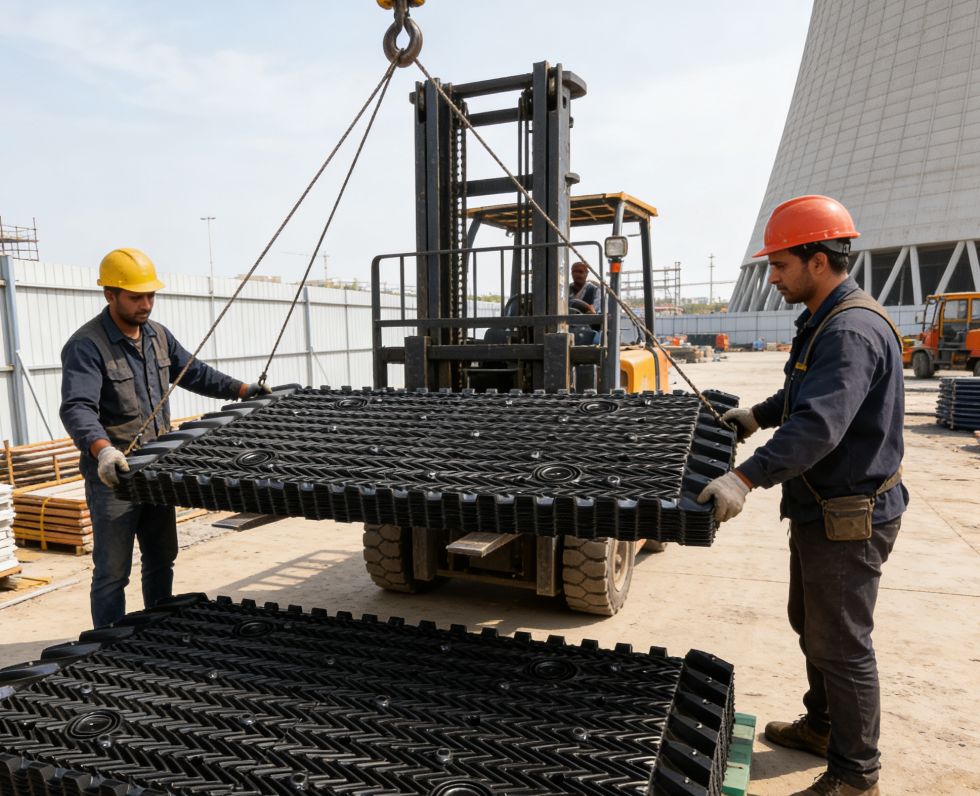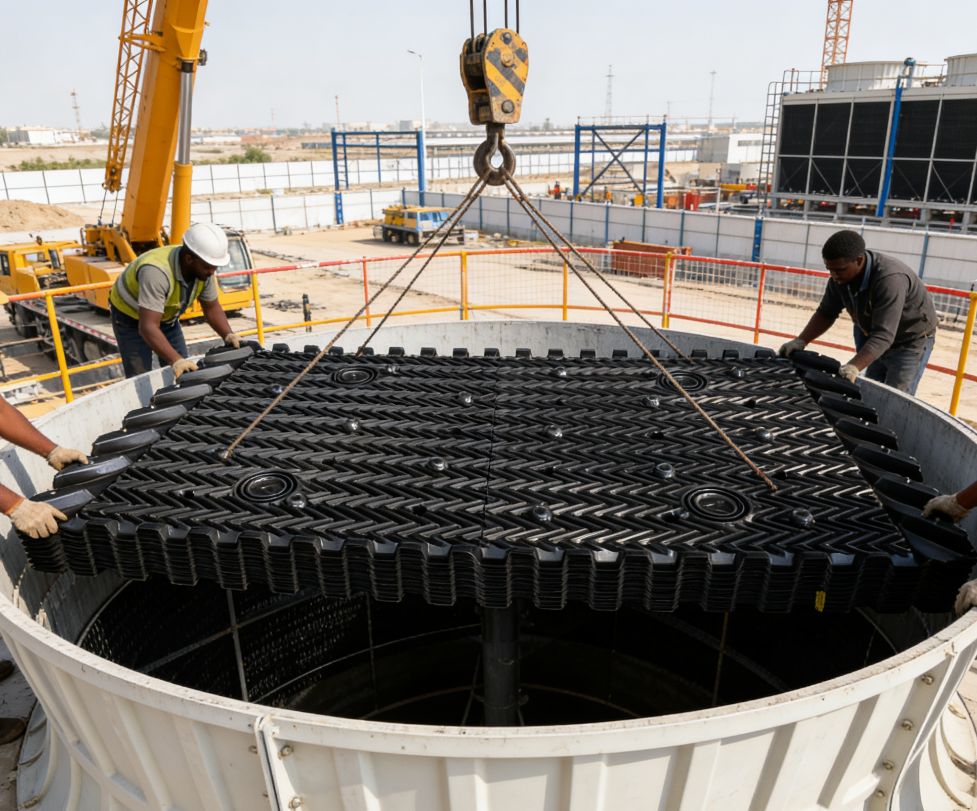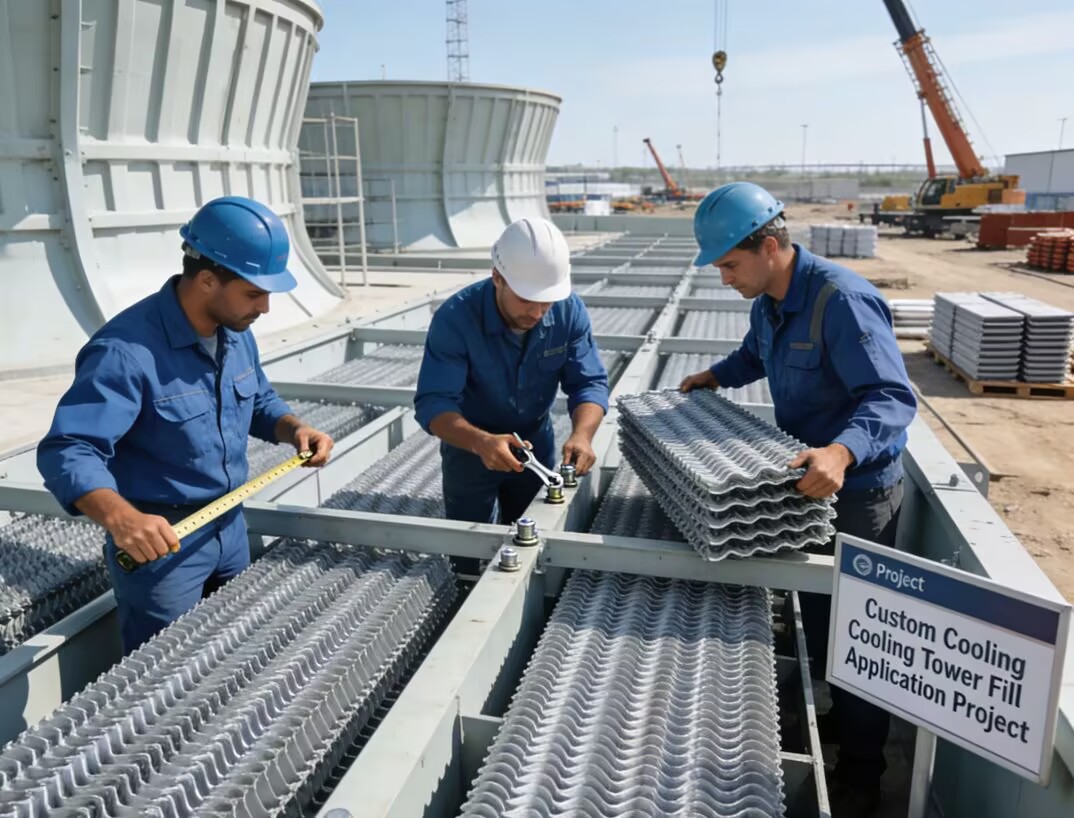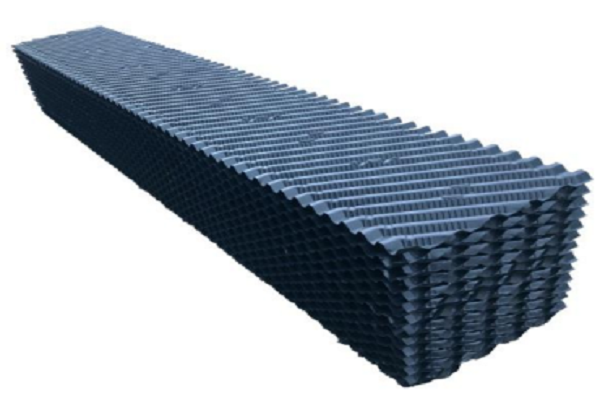
Name: Counter flow cooling tower film fill pack
Description: Our counter flow cooling tower film fill pack is engineered with optimized flute geometry to maximize water-air contact time while minimizing pressure drop. Made from high-grade, flame-retardant PVC, it resists fouling and scaling, ensuring sustained thermal performance. The vertical sheet arrangement promotes uniform water distribution and efficient heat transfer, making it ideal for demanding industrial and HVAC cooling applications.
The film fill pack is the primary heat and mass transfer component in a counterflow cooling tower. In this configuration, hot water enters at the top and falls vertically downward, while air is drawn upward from the bottom, creating a direct countercurrent flow. The fill pack consists of a stack of thin, closely spaced sheets (typically made of PVC or other engineered polymers) that spread the water into a thin film, dramatically increasing the surface area for evaporative cooling and sensible heat exchange.
The performance of a film fill pack is largely determined by the shape and arrangement of its sheets. Key geometric parameters include flute pattern, spacing, and surface texture.
Common flute designs include vertical flutes, cross‑flutes (angled corrugations), and offset/herringbone patterns. Vertical flutes allow high water velocity and reduce fouling, while cross‑flutes induce turbulence and enhance heat transfer at the cost of higher pressure drop. Offset patterns repeatedly break and reform the water film, providing a balance between efficiency and fouling resistance.
Flute height (spacing between sheets) typically ranges from 12 mm to 27 mm. Tighter spacing (12 mm) yields a specific surface area of up to 300 m²/m³, maximizing thermal performance but increasing airside pressure drop and fouling risk. Wider spacing (19 mm or 27 mm) is preferred for applications with poor water quality, as it allows easier cleaning and reduces clogging.
Material selection affects temperature resistance, flame retardance, chemical stability, and service life.
Rigid, unplasticized PVC is the industry standard for most HVAC and light industrial applications. It offers excellent self‑extinguishing properties (UL 94 V‑0 rating), good chemical resistance, and cost‑effectiveness. Maximum continuous operating temperature is approximately 50‑60°C.
For elevated water temperatures up to 70‑80°C, polypropylene is used. PP provides superior resistance to thermal degradation and many chemicals, but it is less flame‑retardant than PVC unless specially formulated.
In high‑temperature industrial applications (inlet water above 85°C), CPVC is required. It maintains structural integrity up to 95‑100°C and has excellent flame and chemical resistance.
Thermal efficiency, pressure drop, and fouling tendency are interrelated and must be balanced based on water quality and cooling duty.
For treated water with low suspended solids and biological activity, high‑density cross‑fluted PVC fills (12 mm spacing) deliver maximum cooling capacity and approach temperature. These fills are common in commercial HVAC closed‑loop systems.
When water contains scale‑forming minerals, algae, or high turbidity, vertical fluted fills with 19 mm or larger spacing are recommended. Some designs incorporate self‑draining features or removable sections to simplify cleaning. Splash fill is an alternative but is less efficient than film fill.
Film fill packs impose a resistance to airflow. The pressure drop is a function of flute geometry, spacing, and air velocity. Engineers must balance thermal performance against fan power consumption. Typical design values range from 20 to 80 Pa per meter of fill depth.
The fill pack must completely fill the tower’s cross‑section to prevent air bypass, which would degrade performance. Proper sealing between the fill and the casing is essential.
Many counterflow film fill packs are manufactured with an integrated drift eliminator section at the top. This captures water droplets entrained in the upward air stream, reducing water loss and environmental impact.
The fill pack is positioned directly below the hot water distribution basin (or spray nozzles) and above the cold water collection basin. Uniform water distribution across the top of the fill is critical; any dry areas will reduce effective heat transfer area.
When specifying a counterflow film fill pack, consider the following parameters:
Clean water, normal temperature → PVC cross‑fluted, 12‑15 mm spacing.
Poor water quality → PVC vertical fluted, 19‑27 mm spacing.
High inlet temperature (>60°C) → PP or CPVC, wider spacing.
Highest efficiency requirement → cross‑fluted with offset pattern, 12 mm spacing.
The counterflow cooling tower film fill pack is a precision‑engineered component that directly determines the tower’s thermal capability, energy efficiency, and resistance to fouling. Proper selection based on water quality, temperature, and maintenance strategy ensures reliable operation, lower operating costs, and extended service life. Regular inspection and cleaning of the fill pack are essential to maintain peak performance.
We are professional cooling tower fills manufacturer, which can supply wide ranges of cooling tower fills with PVC, PP or CPVC materials.
The brake oil pipes we provide have multiple monitoring certifications and complete compliance documents to help your business smoothly enter the global market.
Fully automated production line, supporting individual customization. Combined with just-in-time logistics solutions, ensuring stable inventory.
A professional foreign trade technical team provides rapid response and is a trustworthy partner, offering everything from technical Q&A to market insights.

The cooling tower fill from this company has performed reliably in our systems. We appreciate the consistent quality and noticeable efficiency improvement.
CEO & Founder

As a CEO, I value partners who deliver on their promises. Their cooling tower fill is a solid product that contributes to stable operations.
CEO & Founder

We are satisfied with the performance of this cooling tower fill. It has integrated well into our existing setup with good results.
Manager

This company provides quality cooling tower fill that meets our operational needs. It's a dependable component in our infrastructure.
CEO & Founder

We are professional cooling tower fills manufacturer, which can supply wide ranges of cooling tower fills with PVC, PP or CPVC materials.

Instant Chat Support
+8615303180686
packingesale@gmail.com
Get the latest information
Scan the code to follow
Return to the top of the page